Cart
0
In highly competitive fashion industry categories like B2B setup, struggling to maintain retailers, importers, wholesaling, and luxury brands with an authentic pashmina shawl for different values is neither acceptable nor optional but a must. The result at large is the existence of fake pashmina shawls that look practically the same, almost feel authentic, and come in nominally priced packages. Nevertheless, fakes are mainly a threat to your brand's reliability and the trust of your customers for those relationships to last for projected periods.
This guide is compiled for professionals, a point of view character impossible procurement of genuine pashmina shawls in order to source, stock, and sell them in the most ethical manner. Whether you procure for upscale accessories boutiques, shop your buying services by retailer orders, or give-a-way as a wholesaler who is trying to distinguish his or her looks from those of others, the guide ensures that you have the knowledge base and tools at hand.
We will answer all the questions, such as:- How are pashmina shawls made in actuality, and distinguish between the originals and the looks ones? What are certification benchmarks that should be sought from a supplier to authenticate real pashmina? How are the prices put together? Who looks to source and sell confidently, and where to purchase these shawls from?
You will know enough on the subject by the end of this buying guide on making sound purchasing decisions in the authentic market for shawls.
The authentic case for pashmina has never been clarified in heavier terms. Demand is rising, the consumer is increasingly aware, and the luxury Universe is looking for the real thing. Let us now get started.
Why Authentic Pashmina Shawls Matter
In order to understand how authentic pashmina scarves add to business, one should first understand the distinctive superiority of pashmina in the first place.
Pashmina shawls are made of the fine undercoat of the Changthangi goat, a highland breed native to the Ladakh high plateaus and the greater Himalayan region. This fiber, known as pashm, is collected by gentle combing during the molting process, making it a truly renewable and entirely limited natural resource. Diameter of pashmina fiber lies in the range of 12-16 microns, which makes it significantly finer as opposed to conventional cashmere and many times softer than any standard wool.
The process of making genuine pashmina is truly an art. From cleansing the raw fibre to preparing wool on its charkha wheel and weaving it by hand on a wooden loom, the whole process takes craftsmen years of learning to complete. Their creation is certainly unmatched by any mechanically made equivalent in terms of the caressable softness, warmness, and refinement. This is why the prices of genuine pashmina shawls can be sustained in luxury competition.
The business presence of authentic pashmina shawls in the eyes of B2B buyers actually exceeds the product within commercial circles. Brands established around quality, integrity, and trust are monumental and indisputable, brought about by these products which are actually rare and genuine. So much so that a customer investing in an authentic pashmina becomes a loyal advocate, returning to do repeat business and referring new customers to the business. However, the retailers who knowingly or unknowingly sell fake pashmina suffer the "Day of Judgment" in their reputability which they can never really overcome.
The debate between the pure and the fake Pashmina is no longer limited to a small audience. A good number of the shawls globally branded as Pashmina fall into the category of acrylic, viscose, or low quality wool, and many have no real pashm fiber. It is not just morally wrong but illegal for any high-end retailer or importer to sell these products under the name of authentic Pashmina shawls, and can be troublesome for markets with strict consumer protection laws, like the European Union, Britain, or the United States.
Talking about real Pashmina shawls means being aligned with contemporary premium consumer values- sustainability, ethical manufacturing, cultural legacy, and slow fashion. These values are not just talk but reasons really considered by a prospective customer to buy real Pashmina shawls. Engaging in authenticity means that your customers are paying more for what you offer.
The market for genuine pashmina shawls is increasing each year. Genuine sourcing and open product storytelling are investments made today towards growing the business trust of the next several years in this premium category.
How to Identify Authentic Pashmina Shawls
The single most valuable tool for a B2B buyer in terms of purchasing pashmina shawls is the ability to correctly identify an authentic pashmina shawl. In light of the abundance of fakes available, the ability to ascertain the genuineness of the product is a great advantage for buyers who can do so without hesitation.
All methods of identification of authentic pashmina shawls on the market can be applied, from the senses to the laboratory. Below comes a detailed view of the most trustable identification methods.
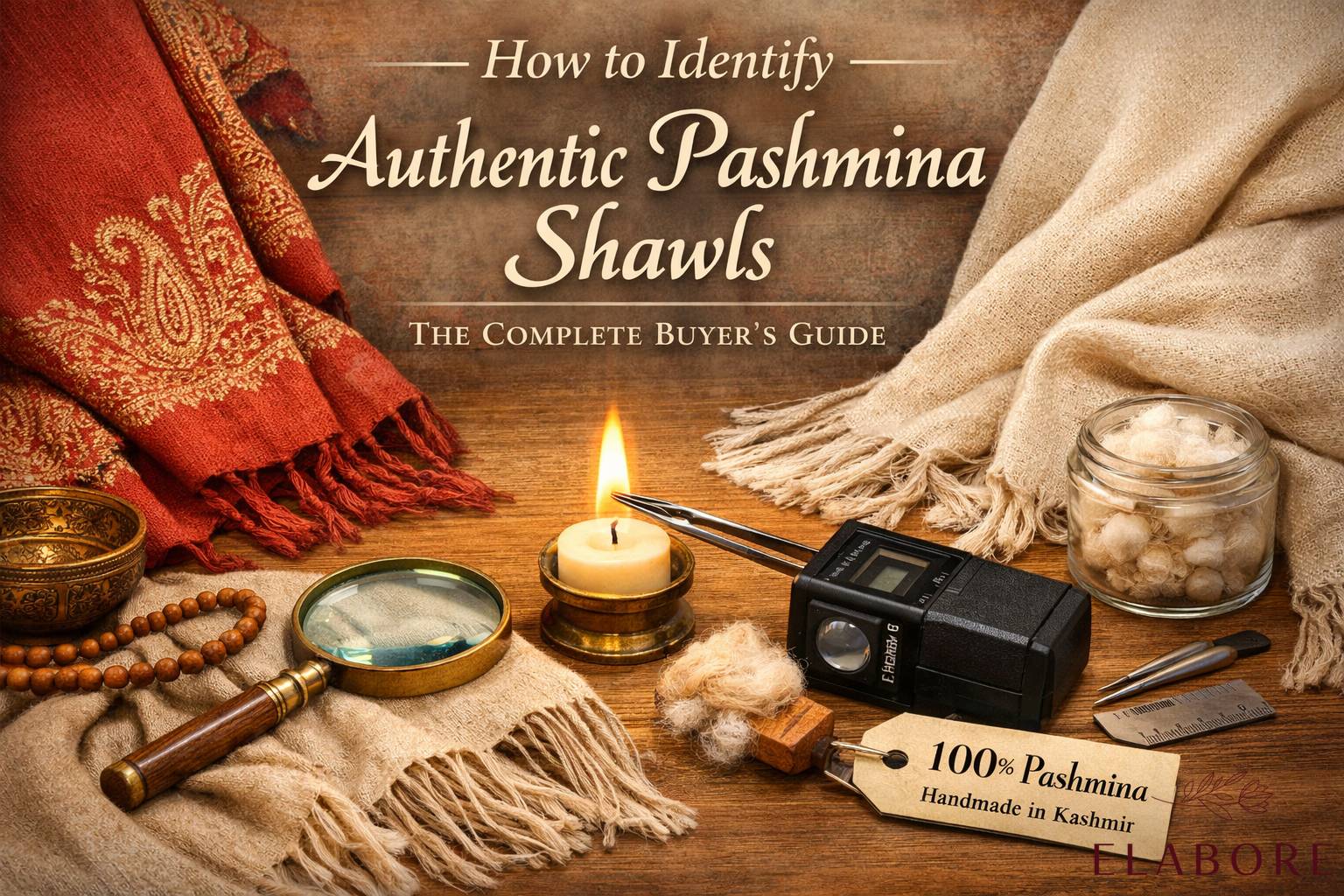
The oldest and most reliable method of identifying an authentic pashmina shawl is called the "burn test." This is because real pashminas come from natural animal proteins, namely hair, and burn almost like our hair-determined and slow, which smells something burned, giving a very soft ashy residue. Fake fibers, on the other hand, do not burn but melt, thus producing lots of smoke. Moreover, when these fibers cool, they leave a hard residue on debris. If a particular vendor or product is incapable of passing the "burn test," it will not be the real deal.
The ring test method of determining genuine pashmina shawls is another descriptive outline. Pashminas can be light and fine enough to go comfortably through a particular-sized finger ring. This is an immediately distinguishable and intricate manifestation of natural pashm fiber from this luxurious animal. However, with the increased production of machine-made versions, the test is one of the last methods to try because of the latest innovative blends. It is recommended that the ring test be given a secondary set of methods and criteria, otherwise it might give apparent authentic serves in a standard.
One more highly pertinent feature on pure pashmina shawls is pilings. Real pashminas do pill with use—an undeniable characteristic of fine animal fibers and not indicative of quality defects. Hence a shawl with almost no pillings at all would be suspected synthetic in exact terms. Conversely, excessive pilling right from the first use can be indicative of very low-grade and poorly processed fiber.
Fiber test is by far the strictest scientific validation when dealing with real pashmina mufflers If real pashmina under microscope yields or displays the characteristic scale, which is markedly different from all wool, cashmere, and synthetic fibers. The Charkha Development Institute (CDI) in Srinagar and several accredited textile laboratories provide fiber testing services that spell the last word on the authenticity of pashmina stoles. It's a matter of wise counsel for these buyers, who represent B2B and make significant bulk purchases, to contract laboratory testing of representative samples.
The so-called quality was felt and tested by weight would naturally rely on almost shear experienced from buyers. Pashmina products always blend an extraordinary touch of softness, area shine, and unsurpassed heat in an article that mixed or synthetic sorts not build astonishingly. If the scarf is perceived as too hard, heavy, or beaded, using plastic, it is not real pashmina.
It is most beneficial to do the visual assessment of the quality of the weave. The real pashmina shawls, especially those made by hand, should possess some human irregularity in the fabric, considered as a character of fine handwork. The design is almost picture-perfect; the form is the exact opposite of this beautiful imperfect weave. In our observation under a microscope, hand-spun yarn that goes into making traditional pashmina shawls depicts great variability in thickness, from the same prime reason of its being handspun, even while machine-spun synthetic yarn presents perfectly even texture.
Principles pertaining to the testing of cashmere quality, then, have a significant degree of relevance in this connection since pashm is indeed a type of cashmere. Thus, whenever examining a product as pure pashmina on the basis of a cashmere quality test, look carefully for the fineness of the fiber in question. If sold as a pashmina, it is 12–16 microns. Therefore, any fabric claiming to be pashmina over 19 microns is not real pashminas, irrespective of marketing claims.
Authentic Pashmina Shawls vs Fake Products
The differentiation between real and fake pashmina has the most importance in every luxury textile business to the B2B buyer. The sheer mass of fake pashmina products floating in the global market makes this subject invaluable to importers, retailers, and distributors.
Those markets with fake pashmina products can be somewhat confusing, depending on how knowledgeable the buyer is about the purchasing of rare, authentic pashmina shawls.
The first and most common one consists of viscose or acrylic products sold under the name of pashmina. These are mass-produced machine-made shawls with absolutely no pashm content. They are very often sold with terms like, "pashmina-style," "pashmina feel," or simply "pashmina" without any information about fiber composition highlighted. For as little as $2-$5 per piece, one can buy such a product and then sell it to hundreds of potential victims as genuine pashmina shawls. On paper, selling fake goods with such a profit margin sounds good, but then come a few horrified customers, audacity to destroy your entire brand!
The second category is made up of blended products. These are shawls which make use of original-digit pashmina embedded over silk, wool, or finely blending with synthetic fibers. It isn't that all blended pashminas are faulty in any way: pashmina-silk blouses, for example, are a genuine and widely regarded product as long as labeled right. The problem of representation arises when worsted pashmina is promoted as authentic-only pashmina shawls. Thirty percent pashmina and 70% viscose are not a quality of pashmina; bulk packing will not change that fact.
The third category always encompasses shawls within the name of pashmina but the reality is low-grade cashmere. Even though related with fibers, it is typically rare and much lighter than any regular cashmere. It is, therefore, certainly certain that anything with the fiber document with the bulk of cashmere from Mongolia or China with above a 19-micron limit cannot be an actual pashmina shawls irrespective of the opposite interpretation. In any case, a cashmere-grade test on the document is one of the most effective means of determining the substitution.
Knowledge of real v. fake distinctions between products allows B2B buyers to leverage better positions with suppliers, put the right queries forward, and avoid dealing with enormous commercial and legal risks associated with selling falsely termed luxury items. Damage to the company reputation can be catastrophic. With the help of social media, luxury good consumers have become much vocal in exposing any brand selling misbranded goods. Just one post that goes viral regarding the authenticity of a pashmina collection will reverse the entire summons of the brand. In order to protect your brand, it is necessary to make everything that you have in your pashmina true. It should be dwelling in your overall business strategy.
So, if the shawls are in the category of "verified pongee", and they are labeled as "real pashmina", and no verification has taken place, now is the time to do so. You must contact our sourcing department, who will guide you on complete verification of the real pashmina shawls certified by the recognized Kashmiri manufacturers.
Certification for Authentic Pashmina Shawls
Certification is the first quality route for a pashmina buyer to prove the product's genuine nature. It is mandatory for a serious importer, retailer, or luxury brand to understand the certification system in authentic pashmina shawls.
For authentic pashmina shawls, the most iconic certification is the Pashmina Mark. Trade Mark Registration No. 1037 was issued and is said to originate from the Craft Development Institute in Srinagar under the auspices of the Indian government. The Pashmina Mark, of course, is a holographic label certifying the fiber composition, origin, and authenticity of a genuine handicraft of Kashmiri pashmina, in the way that nowadays literally hundreds of stations certify pashmina producing groups in Ladakh. It is obtained only after genuine pashm fiber confirmed by laboratory tests meets specific quality standards that must be followed. While sourcing for authentic pashmina shawls, the Pashmina Mark must be provided and mandatory in every case.
GI is an essential pashmina certification, regarding genuine pashmina shawls from Kashmir. The GI tag protects the origin of specific products of the Kashmir Valley, ensuring that only products actually made in the region by the traditional method are entitled to the appellation of Kashmiri origin. Authentically GI-tagged pashmina shawls are shielded from claims of being mere imitations and are highly respected by luxury buyers and retailers around the world.
Moreover, the GI tag related to Kashmire Pashmina was registered under the Geographical Indications of Goods (Registration and Protection) Act, India. The scope of protection under this GhI tag covers handmade products of pashmina, which are created by hand spinning, weaving, and finishing, inside the Valley of Kashmir by traditional methods. To the global consumers and retailers who are serious about selling real stuff, sourcing GI-certified pashmina shawls will be the highest ideal.
Lab certifications alone do not suffice in the certification of pashmina products. Third-party textiles' lab testers — namely, SGS, Bureau Veritas, and state government-approved test hubs in India — can provide reports on fiber composition related to genuine pashmina shawls that define quite a few other intricate attributes. These reports measure fiber diameter sizes; verify or attempt to determine species origin, in extreme cases, by use of DNA testing; and measure the level of purity. For larger orders to B2B clients, samples submitted for lab work for quality assurance prior to the production process is considered as an option.
Certification from the Woolmark Company is mostly applied in relation to wool goods. Still, it was aimed at certain blended pashmina merchandise to guarantee wool quality. At the supplier end, with the Woolmark certification, at least one aspect of material quality is ensured for blends in pashmina garments.
To be specific, when examining a certification from a supplier that provides pashmina, ensure that it is genuine. The certification itself will be in conjunction with the real pashmina shawls showing the fiber diameter (in microns), fiber content percentage and origin region, as well as any test method used. Unsigned certificates missing lab references and test parameters in general should trigger a signal of caution. Set down in writing a sourcing policy that embraces withstood pashmina certifying as a must and safety line for your business. Genuine sellers of pashmina shawls are legal that is eligible and should have designs to back up the certification. Anything that appears to knock back the certification should be added only to your list of rejected suppliers where no time is wasted.
Pricing of Authentic Pashmina Shawls
Pricing is one of the primary signals that identify true pashmina shawls from cheap imitations. It is valuable to possess knowledge of the pricing range for real pashmina shawls if one is looking to buy smart and sell most competitively.
At the wholesale level, plain pure pashmina shawls or semi-finished types, all handily touched up, usually begin at around $40-$80 USD per piece from direct manufactures in Kashmir. This is pretty much the cost of manually combing pashm fiber, manual spinning, manually weaving, and finishing. Anything sold under the real pashmina label is probably not actual pashmina, when prices are that low.
Medium range authentic pashmina shawls may be sold in assortments at wholesale prices of between $80 and $200, depending on the complexity of hand embroidery and the silk content mixed with the pashmina. Wholesale price ranges would be between $200 and $600 for premium sozin-embroidered authentic pashmina shawls. Master embroiderers' investments are reflected in embroidery displayed for such exquisitely made pieces.
Though these are the high-end price range shawls, the pashmina shawls woven in kani weaving come in the topmost price range. It is the months of work with hundreds of wooden spools carrying out this meticulous weaving that give these authentic shawls value between $500 and beyond up to $2,000. Retail prices for these pieces will usually, either in designer boutiques or at auction, correspond to prices between $3,000 and $10,000.
An understanding of pricing models assists B2B clients in debunking their hypotheses and detecting peculiarities. For illustration: If a vendor offers real pashmina shawls at a price too low to be real in the marketplace, one may deduce that something less than desired is going on: perhaps there are adulterating agents in the fibers, or exaggerated labeling, or both. To exercise care in pashing a few cashmere quality checks will become far more needed in prices of much less and lower.
Retail profit based on actual pashmina shawls is huge-usually 3x to 8x the wholesale cost to the supplier, depending on where the market is and which retail route is being used. A pure pashmina shawl that may have been bought at a cost of $60 from the wholesaler should receive a profitable sum of $180 to $400 in the category of a middle ranking boutique. A prestige-embroidered pashmina shawl bought wholesale at $300 may reap $900 to $1,500 at a renowned retail outlet.
Margins are high so that authentic pashmina shawls are one of the most interesting product categories in luxury textiles, provided they present the real thing and offer it at the right prices.
Transparent price communication is also a strong brand strategy. Educating retail customers about why authentic pashmina shawls cost as much as they do-the hand-combing, the hand-spinning, the hand-weaving, the certifications-creates a perception of value that makes price acceptable and builds the store's goodwill in the customers' minds.
How to Source Authentic Pashmina Shawls
To procure authentic pashmina shawls from valid, export-ready suppliers, a systematic approach combines market intelligence, supplier due diligence, and quality verification procedures.
To obtain authentic pashmina shawls, it is best to be involved with the manufacturers and exporting houses in Srinagar, Kashmir--they have direct access to the raw pashm fiber, in-house weaving and embroidery facilities, and a ready-made export infrastructure. This direct exposure to the supplier of a Kashmiri manufacturer for authentic pashmina shawls will remove various kinds of "padding" in the form of middlemen, resulting in competitive pricing while ensuring more transparency on the production floor.
Trade fairs and handicraft exhibitions are among the best locations where one can source genuine pashmina shawls. Among the trade fairs: the India International Trade Fair takes place annually in New Delhi, Crafts of India Expos, and those exclusively on Kashmiri handicraft in Srinagar promise vendors with genuine pashmina shawls. It allows you to perchance examine the products in person, run some initial feel and quality assessment, and also establish a direct channel communication with the original supplier.
It is possible to get hundreds of authentic pashmina shawl suppliers listed on online B2B platforms like IndiaMart, Alibaba, and the official portal of the Jammu & Kashmir Handicrafts Department. Be very particular in filtering for GI-certified and Pashmina Mark-holding suppliers when using these platforms. Ask for documentation, sample products, and video proof of their units before finalizing an order.
Agents from the place concentrating on Kashmiri textiles can help someone so much in such a scenario. When one refers to one from a reputed Indian agent sourced very well might have been working some years with some good Srinagar businesses to ensure, inspect, undertake negotiations, sell at the best price, perform quality acts of control, have the goods prepared for shipment and manage customs — therefore, significantly minimizing the risk and ambiguity of ordering.
When ordering pashmina shawls in samples, ensure that one gets a good evaluation before buying. Sound evaluation of the samples, including hand feel, weight, burn tests, weave look, and perhaps laboratory fiber analysis when ordering in bulk. Good suppliers of pashmina shawls let you have their products for sampling.
It would be wise to set up a strong understanding with the manufacturers of your genuine pashmina shawls. Do make sure that your particular agreements also include any percentage breakdowns in the fiber content, specific assurance or compliance certification, quality cut-off points in the supply, delivery times, and possible liability for undelivered goods. Having everything in writing will do you much good in case you meet some challenges in quality issues down the line.
Do you think you are ready to source authenticated pashmina shawls for your wholesale/retail business? Be a part of our network of Certified Manufacturers from J&K and get hand-selected product catalogs with full certification documentation now.
Challenges in Buying Authentic Pashmina Shawls
The genuine pashmina shawl market has significant challenges for the interest of the B2B buyer despite broadly or hugely commercial demand.
The struggle for the authentic pashmina shawl market is the challenge of algorism and mere market saturation due to counterfeit products. Procedure to authenticate products and suppliers becomes more complicated due to the sheer magnitude of blended and counterfeit products that flood the markets globally and easily overshadow the relatively minimal procedure in other luxury textile categories. But the contrast between real and fake pashmina is always there — rather, sophisticated problems arise out of the fact that the copycat comes better engineered.
Price pressures are an enormous challenge. Counterfeit pashmina is just too low-cost to make, enabling sellers of imitation products to undercut the prices of authentic pashmina shawls substantially. This is a serious problem of market perception, where consumers sometimes reverse-haggle in order to pay higher prices for authentic pashmina shawls without appreciating the difference. Planning annual educational modules for your sales teams and consumers on basic reasons to cost high for genuine pashmina is mandatory.
Ensuring consistent supply in the authentic pashmina shawls market can be a daunting task. The supply of genuine pashm is limited by nature: it is found in small quantities, collected under seasonal conditions, and affected by variations in fiber harvest yield and geopolitical situations of the Kashmir region. One way to manage risk would be to develop relationships with more than one genuine bazaar, pashmina, and cashmere scarf suppliers and to strategize for inventory acquisition in advance for those times when customer demand would be peaking.
Even among genuine vendors of authentic pashmina shawls, there is a real danger of variations. Hence, differences in terms of softness and weave density occur, although they do not always stand as indicators of quality variation from the customer's point of view. The most effective way to manage this variability in quality is to create comprehensive specifications that encompass all aspects of quality and to carry out consistent quality inspections with third-party surveillance services based in Kashmir.
The vis-a-vis of Pashmina certification complexity can be very difficult for a buyer uninitiated in the certification process of an Indian festival. The Pashmina Mark is something to be distinguished from GI certification calculations. However, like laboratory analysis, all co-exist with the pashmina market knowledge for these buyers to get. Furthermore, with helping this information in functioning with a very qualified sourcing partner or an industry professional, one's learning curve increases at the fastest rate of which one can handle.
Logistics and customs logistics for the original pashmina shawl are supported by extreme specificities. Correct HS code allocation, proper labeling of fiber content, and proper observation of import regulations on the destination must all be regarded as prerequisites to facilitate quicker customs clearance. However, with the help of a forwarder who understands the basics of Indian handicraft export, the procedure is eased out beyond comprehension.
Market Demand for Authentic Pashmina Shawls
The authentic pashmina shawl market is indeed fragmented. From the sides of the manufacturers, wise representatives of B2Bs must formulate strategies with regards to numerous challenges.
Market saturation with counterfeits is the most common problem in the authentic pashmina shawl business. The fakes are available in substantial quantities and reputedly undermine the authenticity of the product. Wholesalers have the considerable task of determining the genuineness of the third-party label tucked away inside. Sourcing challenges are abundant all around; the real vs. fake pashmina issue has yet to be overcome — in fact, things should seem more complicated with time, as counterfeiters add a subtle twist to their product.
Another major challenge is pricing pressure. Since the imitation pashmina is cheap to make, sellers stocking imitations price the authentic pashmina shawls through the floor. This is the market perception problem, where sometimes consumers fail to see the difference in value in really paying high prices for authentic pashmina shawls. Training your sales staff and consumers about the reasons for which authentic pashminas are sold is an ongoing investment.
When it comes to the authentic pashmina shawl market. the challenge of supply consistency takes on new proportions. Since authentic pashm is a rare commodity in nature — obtained through the fibers of a specific breed of goat in an equally specific Himalayan environment — seasonal variations and the yield of harvested fibers as well as the situation prevailing on the Kashmir region occasion variations in supplies. Head for multiple authentic pashmina shawl suppliers big time, and make sure you build sufficient inventory before the demand pressure mounts.
Even among genuine suppliers, quality standards are inconsistent with the authentic pashmina shawls. The growth phase of these product varieties has reached robust multiplicative levels in the midst of strict cultural, consumer, market, and other organizational pressures.
Sustainable and Ethical Fashion is not only a growing movement but also an essential impetus for the development of authentic pashmina shawls. As both consumers and brands are moving away from synthetic, petroleum-derived textiles, the demand for natural products with real provenance is skyrocketing. Authentic pashmina shawls — hand-combed, hand-spun, hand-woven, and sustainably harvested — embody every value that the mindful luxury consumer is looking for.
Captivatingly, an authentic pashmina is increasingly considered profoundly chic in a time when heritage and artisan fashion is a growing trend. Incidentally, the Kashmir motif has been increasingly injected in presentations in recent years at fashion weeks in Paris, Milan, and New York, but there have been more direct outcomes still — in the exalted scraps of fine pashmina-grade fibers for their silhouettes from prestigious brands like Hermès or Loro Piana in their collection — thus raising with the consuming eye yet again the global prestige attached to an authentic pashmina shawl.
Investing in authenticity is a huge deal in the marketing of pashmina shawls. Through online sales channels, retailers are reaching out to millions of loyal consumers who would never get a chance to visit a brick-and-mortar store in their market. This array will significantly open up new avenues of customer base for the real pashmina shawls, which means that B2B buyers that believe in the potential thereof and are willing to spend significantly on their online infrastructure will stand a chance to benefit from this materialization.
Giving corporate gifts of pashmina is however a new trend with sharp growth-a domestic initiative that has really been nothing more. Ponderous firms in need of celebrating a great moment today choose pashmina as a premium gift for discriminating clients, executives, and VIP guests alike. Therefore, such a channel proffers business volume coming through large-value purchases by frank repeat buyers opening doors to the rest.'
Then the market for original pashmina shawls vents, also spreading over geographical lines. Europe and North America, key strongholds for pashmina shawls appear to be doing high-quality business with booming interest in parts like Japan, Korea, South East Asia, and Latin America. Early settlers have the advantage. Buyers, importers, and distributors, harbored ad-hoc in developing markets for original pashmina shawls, will make the most of the opportunities accruing once later comers start being welcomed by an increasing demand thus creating consumer awareness.
The outlook of the pashmina shawls to be genuine is full of promise. Buyers who set up genuine supplier relations with certified manufacturers of Kashmir today will ensure a greater share in the premium market likely to grow indefinitely for the far-reaching distance.
The differentiation of pashmina shawls is indeed a concern for the user. Different crafters, weaving units and production batches bring out products of varying softness, weave thickness, and finishing quality. The best way to curb this variability is by working with the supplier on detailed process specifications and quality checking of the product variety based on what each supplier may at least attain at the second base with Kashmir.
It can be perplexing for the non-initiated buyer to navigate through the complex criteria for Pashmina certification in India. An array -from Pashmina Mark to GI certification to fiber tests at the laboratories- becomes a wide scope of market awareness to be followed in order to confirm the authenticity of every piece of luxury, handmade woolen work. Working with a good sourcing partner or trade consultant makes this process so much more straightforward.
To have your precious pashmina shawl get to you without difficulty, one must be detail-oriented about the logistics involved. Correct HS classification, proper fiber content declaration, and full compliance with the packaging rules in the destination country should be ensured to ensure easy clearance of customs. With the help of a well-versed air freight forwarder in the business of handicraft exports from India, one may be spared the tassels of worry in the processing of suitable fabrics.
Conclusion on Authentic Pashmina Shawls
Pashmina shawls made of the real deal present an unparalleled combination with rare quality in the product, very margin acceptable by retailers, very deep cultural heritage, and talking to today's luxury consumers and upscale fashion enthusiasts. Anyone wishing to invest in sourcing the genuine article and getting authentication must recognize this: the pashmina shawls are among the most rewarding categories within the global textile industries.
Possessed perhaps of imperative importance, we have exactly established the genuineness of product factor in the market of authentic pashmina shawls. We have provided meticulous techniques for B2B buyers on how to differentiate utmost clarity between authentic heaters from the imitation that inundates global markets with burn tests, ring tests, and laboratory fiber analysis. We outlined critical certifications like the Pashmina Mark, G. I. tagging, and reports from an independent laboratory as proof of authenticity for authentic pashmina shawls.
Actual pricing framework for authentic pashmina shawls, sourcing strategies that connect buyers to authentic Kashmiri manufacturers, challenges that require proactive efforts, and market forces make the case for authentic pashmina shawls an ever increasing bet.
The real versus fake pashmina problem can be solved, and manageable for buyers who have the knowledge, perseverance, and links to the right suppliers. The pashmina certification, high-quality control standards, and clear communication on the product are the main characteristics of a model strategy for the genuine production and sale of pashmina shawls.
The cashmere quality-control principles, GI certification requirements, and all the supplier due diligence processes outlined in the text are what can ensure the protective limits of your brand, your customers, and your business in a market so overtly concerned with authenticity.
To an extent, an authentic pashmina shawl is no mere commodity, but rather is a promise. It is a promise of pure quality, genuine heritage, and that absolute level of skilled and meticulous workmanship that wins the satisfaction of loyalty and brand equity with an already flourishing business.
Do you have plans to make or expand your genuine pashmina shawls business? Contact the reliable sourcing team today. B2B players who are seriously considering buying Pashmina Mark-endorsed manufacturers in Srinagar supplying genuine pashmina shawls on competitive wholesale prices with full documentation of their certification.
Book your order now to get product catalogs, samples, and bulk prices for genuine pashmina shawls. Your hi-end textile business only deserves the real deal.