Cart
0
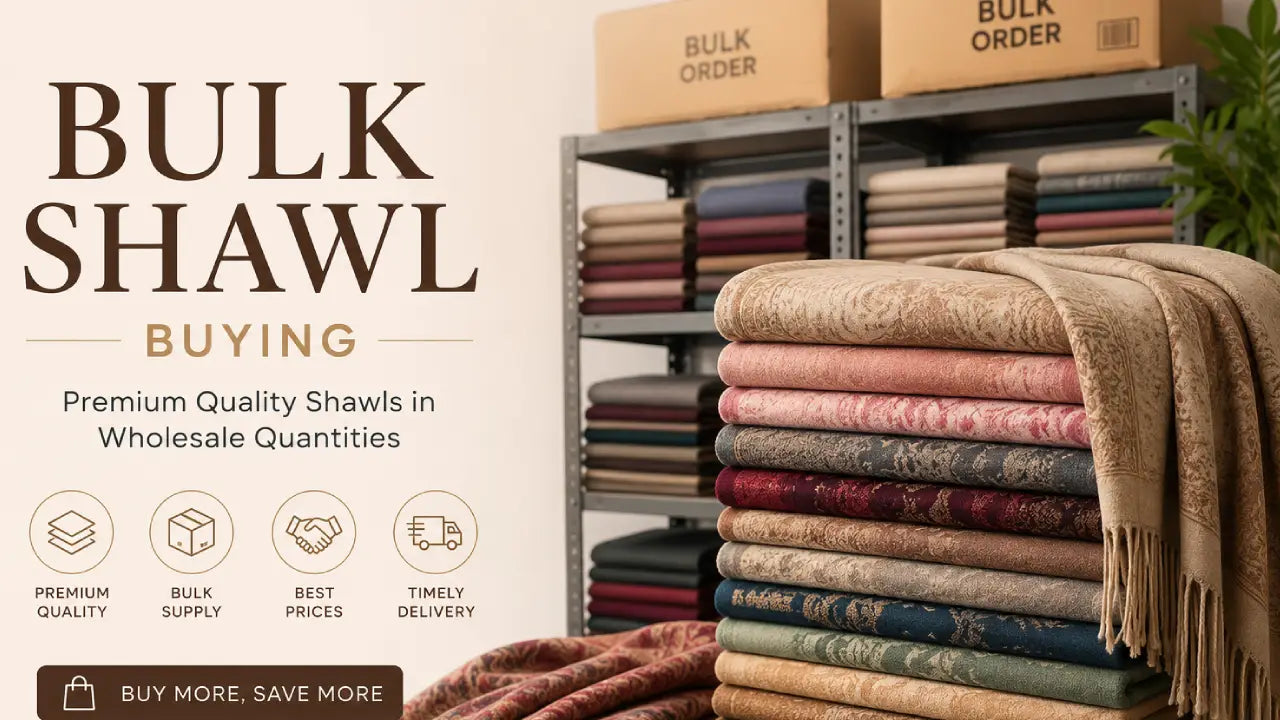
Purchasing shawls in volume is one of the most consequential decisions a retail buyer makes each season. If handled well, bulk shawl buying can bring margin efficiency, product uniformity, and supplier relationships that truly keep a luxury retail operation healthy. If handled carelessly it often leaves you with stock that does not move, quality disputes that quietly eat time and working capital, and partnerships that weaken before they ever deliver their real promise.
The global premium shawl market favors buyers who apply the same discernment to volume sourcing as they do to each individual product selection. Wholesale pricing structures, minimum order quantities, fibre authentication, and pre-shipment quality protocols are not mere paperwork, they are the commercial architecture that decides whether bulk shawl buying creates value, or ends up destroying it.
This guide has been written for professional retail buyers, boutique owners, e-commerce brands, and fashion wholesale operators who are ready to approach bulk shawl buying with the rigour , knowledge and confidence that premium sourcing demands. From understanding wholesale shawl pricing to negotiating MOQs and building a quality checklist that protects every order , everything you need is here.
Understanding the Bulk Shawl Buying Landscape
The market for bulk shawl buying spans an extraordinary range, from fast-fashion volume operators purchasing generic acrylic wraps by the thousand, to luxury retailers sourcing hand-embroidered Kashmiri pashmina in carefully curated runs of fifty pieces per style.
Where you sit in that spectrum determines everything, your supplier type, your pricing expectations, your quality standards, and the kind of trade relationships that will serve your business over time.
For buyers operating in the premium and luxury segment, which is where the most defensible retail margins exist, bulk shawl buying is less about raw volume and more about steadiness, authenticity and the supplier trust that makes it all possible.
Understanding the landscape means understanding three things clearly:
-
Who your supplier is — manufacturer-exporter, merchant exporter, or trading intermediary — and how that affects pricing and accountability
-
What the true cost of quality looks like at wholesale — and why the cheapest option is rarely the most profitable
-
What your buyer's journey looks like from inquiry through delivery — and which pressure points require the most rigorous management
With that foundation in place, every subsequent choice in the bulk shawl buying flow becomes a bit more lucid and self-assured.
Wholesale Shawl Pricing: What Drives Cost and How to Interpret It
Wholesale shawl pricing is set by a confluence of factors, that seasoned buyers learn to “read” like a map, you know. If you understand what drives the price of a shawl at the wholesale level you get the analytical tools to assess supplier quotes objectively and to spot when a price feels suspiciously low, not just attractively competitive.
The Primary Drivers of Wholesale Shawl Pricing:
Fibre type and grade is, honestly, the single largest variable in wholesale shawl pricing. Genuine Kashmiri shawls (12–16 microns) tends to command significantly higher wholesale prices than standard cashmere, which prices above merino wool, and so on down the fibre hierarchy. So if a supplier is offering “pure pashmina” at wool prices, they are misrepresenting either the product or the fibre content, and often both.
Weave complexity and production time: A plain-weave cashmere shawl and a Kani-woven pashmina of the same dimensions may share the same base fibre, but the Kani piece needs weeks of skilled artisan effort , against just hours for the plain weave. That labour gap shows up straight in wholesale price and it is absolutely legitimate.
Embroidery technique and density in bulk shawl buying is a big factor. Sozni hand-needle embroidery, Aari chain-stitch work, and Zardozi metallic thread embellishment each add meaningful cost when people buy in volume programmes. The denser the embroidery shawls, plus the finer the needle work , means longer production time , and that is why the wholesale price gets justified higher.
Certification and documentation for GI-certified Kashmiri pashmina, plus Oeko-Tex certified textiles, and fair-trade certified products include small but real premium expenses because the paperwork and checks have to stay active. Some budget suppliers that cannot show certification may look cheaper, however they are usually not saving you money, they are transferring compliance risk to you instead.
Order volume, volume pricing is real and, I mean, significant in bulk shawl buying. The pricing gap between a 50-piece order and a 500-piece order for the same product can land around 15 to 30% depending on the supplier production economics. Getting a feel for those volume thresholds helps buyers choose when and where to consolidate orders for better pricing efficiency. In the end, it is all about leverage, not only price.
Realistic Wholesale Price Benchmarks for Premium Shawls:
-
Plain-weave merino wool shawls: £8–£22 wholesale per piece
-
Cashmere blend shawls: £18–£45 wholesale per piece
-
Pure cashmere shawls: £35–£90 wholesale per piece
-
Genuine pashmina plain-weave: £40–£110 wholesale per piece
-
Pashmina with partial Sozni embroidery: £70–£180 wholesale per piece
-
Full hand-embroidered or Kani-woven pashmina: £120–£400+ wholesale per piece
These ranges reflect genuine artisan-produced Indian exports. Quotes significantly below these ranges for claimed luxury fibres, warrant immediate scrutiny.
Explore Elabore Luxury wholesale and bulk shawl collections to benchmark quality and pricing against a verified premium supplier — the clearest reference point available for serious B2B buyers.
Understanding MOQ: What Textile Suppliers Mean and How to Negotiate
MOQ — Minimum Order Quantity — is one of the most negotiated variables in any bulk shawl buying relationship, and one of the most misunderstood too. A lot of buyers treat MOQ like a fixed constraint, when it is in practice a starting position, for a conversation that can go differently depending on timing.
Why MOQ Textile Suppliers Set Minimums:
MOQs exist because production has fixed setup costs. Cutting and setting up a loom for a specific pattern , dyeing a colourway to your specification and attaching custom labels all take time and resource, so the supplier needs to spread or amortise that effort across enough units to make your purchase economically viable. Once you grasp this logic , MOQ negotiation becomes far more productive.
Typical MOQ Structures in Premium Shawl Sourcing:
-
Plain-weave or catalogue designs: 30–50 pieces per style, per colourway
-
Custom colourways on existing designs: 50–100 pieces per colourway
-
Bespoke embroidery or weave patterns developed to your specification: 100–300 pieces
-
Private label programmes with branded packaging: 50–150 pieces depending on packaging complexity
Supplier Negotiation Tips for MOQ Flexibility:
The following supplier negotiation tips consistently produce better MOQ outcomes for buyers who apply them:
-
Consolidate colourways rather than fragmenting — Ordering 100 pieces across three colourways of the same design often triggers better MOQ terms than ordering 30 pieces of three entirely different designs
-
Offer longer-term commitment — Suppliers will often reduce per-style MOQs for buyers who commit to seasonal repeat orders, as the total relationship volume justifies the setup investment
-
Begin with catalogue stock — Starting your bulk shawl buying relationship with a supplier's existing designs (lower MOQ) before progressing to custom development (higher MOQ) builds the mutual confidence that enables more flexible terms over time
-
Be transparent about your volume trajectory — If you are a growing business with genuine scale ambitions, communicating that context professionally often unlocks more accommodating MOQ terms from suppliers who value long-term relationships over transactional maximisation
-
Combine styles into a single production run — Where designs share the same base fibre and similar production processes, requesting combined production runs can reduce effective per-style MOQs
The International Trade Centre's SME Trade Help Desk offers useful frameworks for small and mid-sized buyers navigating supplier negotiations in international textile markets — worth referencing as you develop your negotiation strategy.
Building Your Bulk Shawl Buying Quality Checklist
No bulk shawl buying guide is complete, without some kind of rigorous quality management framework. The distance between placing an order with an overseas supplier and receiving goods at your warehouse creates major opportunity for quality deviation, and the cost of fixing quality problems after delivery, almost always exceeds the cost of preventing them before.
The following checklist represents the minimum quality assurance standard for any serious premium bulk shawl buying programme, it is not optional, not even for small volumes.
Pre-Order Quality Verification:
-
Request and physically receive samples before any order confirmation — never place a bulk order based on photographs alone
-
Commission independent fibre content testing on samples if the product is positioned as a premium natural fibre
-
Verify GI certification documentation for Kashmiri pashmina shawls products
-
Confirm Oeko-Tex or equivalent chemical safety certification for markets with strict import standards
-
Review the supplier's production facility credentials — FIEO membership, export licence, and existing client references
Purchase Order Specification Standards:
-
State full fibre composition by percentage (e.g., 80% pashmina, 20% silk)
-
Specify fibre micron count for luxury fibres
-
Define finished dimensions with acceptable tolerance (e.g., 200cm x 70cm ±2cm)
-
State GSM (grams per square metre) requirement
-
Specify colorfastness standard — ISO 105-C06 for washing, ISO 105-B02 for light exposure
-
Define embroidery density and stitch type for embellished pieces
-
Confirm label, care instruction, and packaging specifications in writing
In-Production Quality Control:
-
For orders exceeding 200 pieces or high-value product, arrange mid-production inspection through a third-party quality control agency
-
Establish clear communication protocols for in-production deviations — how are changes communicated, how quickly, and who authorises them?
Pre-Shipment Inspection
This is the single most important step in the bulk fabric buying guide for overseas sourcing. A pre-shipment inspection — conducted by an independent third-party quality agency such as Intertek, Bureau Veritas, or QIMA — verifies that the finished goods actually match your exact specifications, before they leave the supplier’s premises
Pre-shipment inspection should confirm:
-
Quantity against purchase order
-
Fibre content compliance (spot-check fibre testing if required)
-
Dimensional accuracy across a random sample
-
Colorfastness, pilling resistance, and handle assessment
-
Embroidery quality and density against approved sample
-
Label and packaging compliance
-
Absence of defects across an AQL (Acceptable Quality Level) sampling protocol
Elabore Luxury's luxury pashmina shawl collection is produced to pre-shipment inspection standards as a matter of course — the baseline quality assurance that professional B2B buyers should expect from any premium supplier.
Supplier Negotiation Tips: Securing the Best Terms for Bulk Shawl Orders
Beyond MOQ, supplier negotiation tips for bulk shawl buying extend across pricing payment lead times, and quality accountability. It’s not just about haggling, but about how you ask. Experienced buyers usually approach each dimension in a calm, almost deliberate way and they keep it written down, so later there’s no arguing.
Pricing Negotiation:
-
Never open with your maximum budget — anchor the conversation at a level that leaves room for movement without insulting the supplier's quality positioning
-
Understand the supplier's cost structure well enough to negotiate intelligently — a supplier who has explained their fibre cost, artisan labour rate, and export overhead can be engaged as a business partner rather than adversarial vendor
-
Volume commitments are your most powerful pricing lever — use them deliberately
-
Ask about off-season production slots — suppliers often offer better pricing for orders that fill their production calendar during slower periods
Payment Terms:
-
Standard for new relationships: 30–50% advance at order confirmation, balance before shipment or against shipping documents
-
Established relationships: Open account terms (30–60 days from shipment) may be available
-
Letter of Credit: Offers maximum security for both parties on high-value orders — worth the administrative cost for first-time large orders with new suppliers
Lead Time Management:
-
Build realistic lead time expectations into your buying calendar — plain-weave shawls: 3–4 weeks; custom embroidered: 8–12 weeks
-
Always add 20% buffer for shipping and customs clearance
-
Confirm production calendar commitments in writing at order placement
Elabore Luxury's hand-embroidered pashmina wraps are produced with full lead time transparency — a standard that all professional bulk shawl buying relationships should meet.
The Bulk Shawl Buying Checklist: A Summary Reference
For buyers who need a rapid reference to apply across any supplier evaluation, this consolidated checklist sort of distils the essential standards:
Supplier Qualification:
-
Verified IEC and GSTIN registration
-
FIEO or AEPC membership
-
Export licence and track record with international buyers
-
GI certification capability for Kashmiri products
-
Independent third-party references from existing clients
Product Specification:
-
Full fibre content by percentage confirmed in writing
-
Micron count certified for luxury fibres
-
GSM, dimensions, and colorfastness standards specified
-
Embroidery and finishing standards documented against approved sample
Commercial Terms:
-
MOQ confirmed per style and colourway
-
Pricing confirmed at stated volume with volume break points documented
-
Payment terms agreed and documented
-
Lead times confirmed in writing with production start and shipment dates
Quality Assurance:
-
Pre-order samples physically received and approved
-
Independent fibre testing commissioned where required
-
Pre-shipment inspection arranged with accredited third-party agency
-
Defect rate tolerance (AQL level) agreed and stated in purchase order
For buyers building a long-term bulk fabric buying programme with Indian suppliers, Elabore Luxury's Kashmiri luxury textile range and private label shawl collections demonstrate the standard of documentation, quality consistency, and supplier transparency that serious B2B buyers should hold as their benchmark.
Conclusion: Bulk Shawl Buying Done Right Creates Brands, Not Just Inventory
The buyers who build some of the most successful luxury retail ranges through bulk shawl buying share one defining quality: they treat every volume purchase as a strategic decision not a transactional one. They understand wholesale shawl pricing deeply enough to know when a quote is fair and when it is a warning. They negotiate MOQs with the confidence of someone who understands their supplier’s business model. They use quality checklists, not as bureaucratic formality but as the protection that their brand equity deserves.
Bulk shawl buying at its best is not simply about filling inventory it is also about building a product range with genuine quality integrity, a compelling provenance story, and those supplier relationships that sustain it all season after season.
India’s remarkable artisanal textile heritage, like the pashmina of Kashmir, the silk weaving of Varanasi, and the embroidery traditions carried through a thousand year craft lineage offers B2B buyers access to some of the world’s finest shawl materials through the right supplier partnerships.
Elabore Luxury is that partner. We focus on quality, transparency, and professional B2B service, so each bulk shawl buying decision you make with us stays supported by authenticated materials, verified artisan production, and a trade relationship built to last.
Ready to elevate your shawl buying programme with India's finest luxury textiles? Enquire about bulk and wholesale shawl sourcing with Elabore Luxury or explore our premium collections and discover what exceptional bulk sourcing looks like.
Frequently Asked Questions
What is the typical minimum order quantity for bulk shawl buying from Indian suppliers?
MOQs for bulk shawl buying in India can change a lot depending on the product type and how big the supplier is. For plain-weave catalogue styles, you’ll usually see starts at around 30–50 pieces per style, but some makers can go lower. If you want custom colourways, those often need 50–100 pieces and bespoke embroidered designs typically begin at 100–300 pieces. Elabore Luxury puts forward flexible MOQ structures, to help both smaller boutique retailers and bigger wholesale operations, with terms that adjust as the partnership grows.
How is wholesale shawl pricing calculated by suppliers?
Wholesale shawl pricing is not just one number it’s determined by fibre type and grade, weave complexity , embroidery density, certification costs and order volume. Genuine pashmina is priced notably above standard cashmere , and cashmere again tends to price above merino wool. Labour intensive methods like Kani weaving and Sozni embroidery add a fair amount of cost to the base fibre pricing, and if you’re buying in bulk, the final quote will reflect that.
How do I negotiate better MOQ terms with textile suppliers?
The most effective supplier negotiation tips for MOQ flexibility include, consolidating colourways within single styles, offering seasonal repeat order commitments, starting with catalogue stock before moving on to custom development, communicating your volume growth trajectory professionally, and merging similar styles into shared production runs. Suppliers usually value long-term partners. Communicating partnership intent, rather than transactional intent, consistently helps you get more flexible terms.
What quality checks should I conduct before bulk shawl buying?
A rigorous bulk shawl buying quality programme includes things like physically receiving and testing pre-production samples, then commissioning independent fibre content verification for luxury fibre claims, and making sure you specify GSM, dimensions, colorfastness standards, plus embroidery density in writing within your purchase order. After that you arrange pre-shipment inspection through an accredited third-party agency like Intertek, Bureau Veritas, or QIMA, before the goods leave the supplier's facility.
What is AQL and how does it apply to bulk shawl orders?
AQL, Acceptable Quality Level, is the internationally recognised statistical sampling standard used in pre shipment inspections for bulk shawl buying of bulk fabric. It defines the maximum acceptable defect rate inside a production batch and it is often used so everyone agrees, before goods are dispatched. For premium shawl sourcing, AQL 2.5 is commonly applied (meaning no more than 2.5% defective units in a batch) and that becomes part of the specification.
How do payment terms typically work for bulk shawl buying from India?
Standard payment terms for bulk shawl buying from Indian suppliers typically mean you pay 30 to 50% advance payment when you confirm the order , and the remaining balance is settled before shipment or against the shipping documents. For buyers who already have a steady relationship, many exporters accept an open account setup of 30 to 60 days counted from the shipment date. If it is a higher value first order, Letters of Credit can be the most protective option and are widely accepted by established Indian exporters.
What certifications should I require from bulk shawl suppliers?
For premium bulk shawl buying, please request GI certification for Kashmiri pashmina items, plus Oeko-Tex Standard 100 for chemical safety compliance, along with confirmation of FIEO or AEPC membership. Also ask for IEC registration, and fibre content laboratory reports issued by accredited testing bodies. These documents, together protect you from misrepresentation disputes, help with import compliance in regulated markets, and show the supplier’s professional standing within the MOQ textile supplier ecosystem.
How far in advance should I place bulk shawl orders?
Lead times for bulk shawl buying can really swing depending on how intricate the product is. If the shawls are plain-weave or only lightly embellished , and they follow existing designs then usually you are looking at about 3–5 weeks of production time. But when the work is heavily embroidered or it is a Kani-woven custom piece , the window is more like 8–12 weeks. Also, add an extra 20% buffer for freight and customs clearance, because that part rarely behaves perfectly.
Can small boutique retailers access bulk shawl buying pricing?
Yes, many premium bulk shawl buying suppliers, especially in India, use tiered pricing schemes that fit smaller boutique buyers at moderate volume thresholds. The per unit cost usually won’t reach what’s offered to department store level quantities, though boutique buyers can still get real wholesale shawl pricing gains compared with RRP purchases by clustering styles and building steady reorder habits with a few reliable suppliers.
Why should I choose Elabore Luxury for my bulk shawl buying programme?
Elabore Luxury offers B2B buyers a combination that few suppliers can really match. Like authenticated GI-certified Kashmiri pashmina and other luxury textiles, plus full pre-shipment quality assurance, transparent wholesale shawl pricing with documented fibre specifications, flexible MOQ structures for buyers at every scale, and a professional export operation with complete documentation compliance. Our bulk shawl buying programme is designed for retailers who will not compromise on quality, because their customers will not compromise on experience.