Cart
0
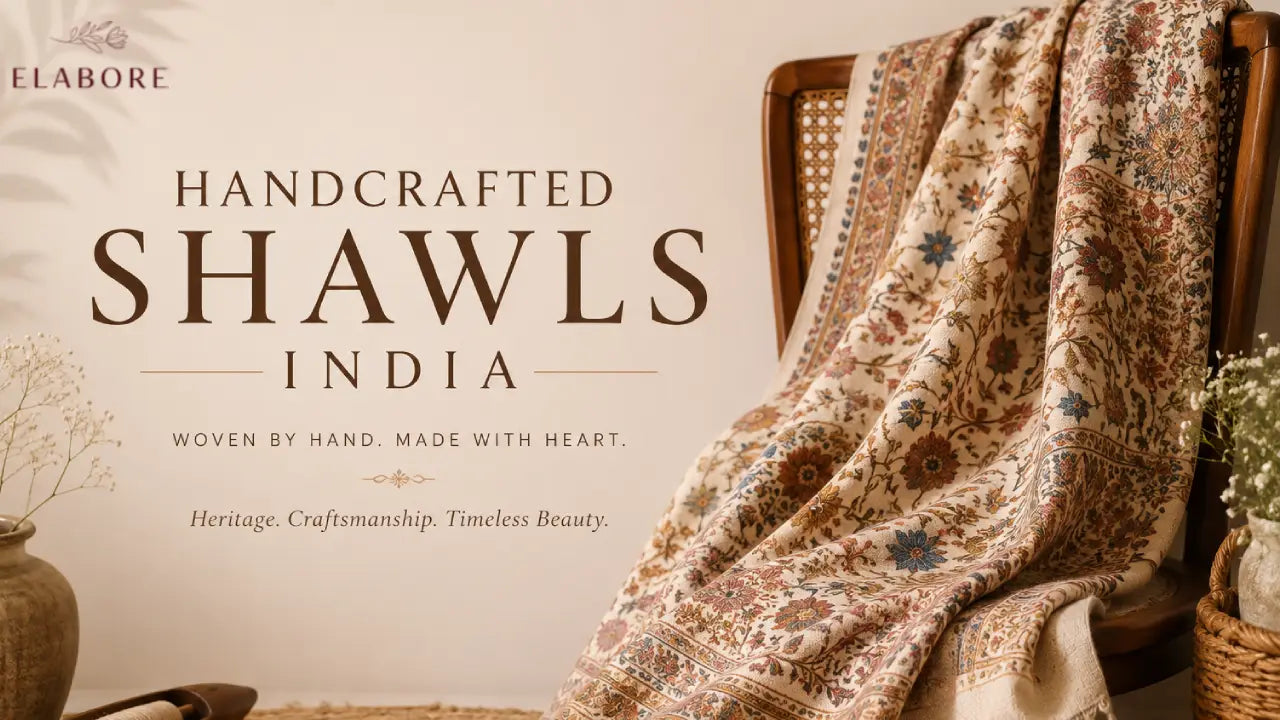
Some things cannot be rushed. A seed growing toward light. A conversation that changes how you see the world. And a handcrafted shawl — worked slowly, thread by thread, stitch by stitch, by an artisan who has devoted years to mastering the language of fabric.
India is home to some of the world's oldest and most technically astonishing textile traditions. In the valleys of Kashmir, in the weaving villages of Rajasthan, in the embroidery workshops of Srinagar — craftspeople are producing handcrafted shawls today using the same fundamental techniques their ancestors perfected across hundreds of years of unbroken practice.
But the world is changing around them. Fast fashion compresses prices. Digital marketplaces prioritise volume over authenticity. Buyers — many of them well-intentioned — choose machine-made imitations simply because they do not know how to tell the difference or why it matters.
This post exists to make that difference clear. To show you what genuine handcrafted shawls India are — in their making, their meaning, and their value to the people who create and wear them.
What Separates a Handcrafted Shawl from Everything Else
The Difference That Hands Make
Walk into any high street store and you will find products described as handmade, artisanal, craft-inspired. Most are none of these things. They are products of automated systems dressed in the language of human skill.
A genuine handcrafted shawl India is definitively, verifiably different. The difference begins at the raw material — fibres collected by hand from animals whose biology produces something no factory can synthesise — and it continues through every subsequent stage of production.
Hand-spinning introduces a subtle, natural variation in yarn texture that gives the finished fabric its characteristic warmth and depth. Hand-weaving builds the cloth row by row with tension controlled entirely by the weaver's touch. Hand-embroidery places each stitch with the considered intention of a person who understands not just where the needle goes but why.
The result is a textile that carries the evidence of its own making. Not in flaws — but in the quiet, unmistakable character of something worked by human hands with genuine skill.
This is what artisan shawls from India are. And it is why nothing else quite compares.
The Craft Traditions That Define Handcrafted Shawls in India
Pashmina Weaving — Fibre from the Roof of the World
Every conversation about handmade Pashmina shawls begins in the same place — 14,000 feet above sea level, on the high-altitude cold deserts of Ladakh, where the Changthangi goat grazes on sparse vegetation through winters that drop to minus 40 degrees.
It is this extreme environment that produces the fibre. The Changthangi goat's body responds to the cold by developing an inner undercoat — the Pashm — of extraordinary fineness. Measuring just 12 to 16 microns in diameter, this fibre is softer than cashmere, warmer than wool at the same weight, and possessed of a drape and luminosity that no synthetic fibre has yet approximated.
The Pashm is collected once a year in spring by hand-combing — not shearing — as the animal naturally sheds its winter coat. A single goat yields between 80 and 170 grams of usable fibre. A single handmade Pashmina shawl requires the yield of three to five goats and weeks of skilled production to complete.
The fibre then travels to Kashmir — primarily to Srinagar — where it is cleaned, hand-carded to separate the fibres, and hand-spun on traditional spinning wheels by women who have learned this skill from their mothers and grandmothers. The yarn produced by hand-spinning has a quality that mechanically spun alternatives cannot replicate — a controlled inconsistency that creates the tactile warmth and depth that defines a genuine handcrafted Pashmina shawl.
Elabore Luxury's Original Pashmina Shawl Collection is built on this foundation — every piece sourced from verified Changthangi fibre and produced through the full hand-craft sequence from fibre to finished shawl.
Discover the full range of Pashmina Stoles for Women — each one a direct expression of Kashmir's most extraordinary fibre tradition.
The Kani Weave — Where the Loom Becomes a Paintbrush
Of all the handcrafted shawl traditions of India, Kani weaving stands as the most technically demanding — and the most visually spectacular.
Developed in Kashmir's Kanihama village — from which it takes its name — the Kani technique replaces the conventional shuttle with dozens of small wooden spools, each carrying a different colour of thread. The weaver manipulates these spools simultaneously, interlacing them according to a coded design chart — called a talim — that translates the intended pattern into a weaving language only trained practitioners can read.
The resulting fabric is a tapestry. Every colour in the design is built from individually controlled threads. The pattern appears identically on both face and reverse — with no floating threads on the back — because every thread is fully integrated into the weave structure rather than carried loosely behind pattern areas.
This characteristic reversibility is the definitive authentication test for genuine Kani work. No power loom can produce it. It is the exclusive mark of true hand-weaving at its most technically demanding.
A standard Kani weave handcrafted shawl might take six to eight weeks to complete on the loom. A complex, highly detailed design — incorporating fine pattern work across the full surface of the shawl — can take months or even years of sustained work.
The artisans who practice Kani weaving at the highest level are among the world's most skilled textile workers. And the pieces they produce are among the world's most extraordinary textiles.
Explore Elabore Luxury's Kani Shawl Collection for Women and Kani Stoles for Women — a curated range of authentic Kani weave pieces representing this tradition at its finest. Men can explore equally extraordinary Kani Stoles for Men.
Sozni Embroidery — The Patience of Perfection
Sozni embroidery is performed entirely by hand, using a single conventional needle and silk or wool thread on a plain-woven base fabric — most commonly Pashmina or fine wool. The technique uses a running stitch so fine that individual stitches are barely visible to the naked eye, building complex floral and geometric motifs from thousands upon thousands of these micro-stitches.
The craft is learned over years of dedicated practice. A beginner Sozni embroiderer may work for two or three years before their stitch quality meets the standard required for premium artisan shawls from India. A master embroiderer — one whose work carries the depth and precision of the finest Jamawar pieces — may have thirty or forty years of practice behind every centimetre of thread.
The specific knowledge of Sozni — its stitch sequences, its traditional motif vocabulary, its colour grammar — is transmitted person to person within artisan families and workshops. It is knowledge that lives in hands, not books. When a master Sozni embroiderer retires without passing their knowledge on, that specific expertise is gone from the world.
This is why every genuine handcrafted shawl India embroidered in Sozni style is not simply a beautiful object. It is a repository of knowledge that took a human lifetime to accumulate.
Discover Elabore Luxury's Embroidered Kashmiri Shawl Collection — where the full depth of Kashmir's embroidery tradition is available to buyers who understand what they are choosing.
Aari Work and Zari Embellishment — Craft in Relief
Where Sozni creates beauty in flatness — the embroidery level with the surface of the base fabric — Aari work and Zari embellishment create beauty in dimension.
Aari embroidery uses a long hooked needle to produce continuous chain stitches that build slightly above the fabric surface, giving motifs a sculptural quality that catches light from multiple angles. Bold floral compositions, flowing paisley patterns, and geometric field designs are the characteristic vocabulary of fine Aari work on handcrafted shawls India.
Zari — the use of metallic thread, traditionally real gold or silver wound around a silk core — adds the dimension of luminosity to embellishment. A handcrafted shawl with genuine Zari threadwork catches and reflects light in a way that printed metallic effects cannot approximate. The thread has depth, reflecting from different surfaces as the shawl moves, creating a living visual effect that is part of why Zari pieces have been prized at the highest levels of Indian fashion for centuries.
Elabore Luxury's Zari Stoles for Women brings this tradition to contemporary buyers — authentic Zari embellishment on premium bases, produced by craftspeople who have made this their life's work.
The People Behind India's Handcrafted Shawls
Artisan Communities Whose Craft Is Their Identity
The handcrafted shawls of India are not produced in factories. They are produced in workshops — often family workshops, sometimes individual home studios — by craftspeople for whom their technique is not simply an occupation but an identity.
A Kani weaver in Kanihama does not simply weave shawls. He is a Kani weaver — a member of a community defined by its mastery of a specific technique, carrying a social identity inseparable from the craft itself. When he teaches his son or his apprentice, he is not simply passing on a skill. He is perpetuating a community.
The same is true of Sozni embroiderers, Kalamkari painters, Aari workers, and the women who hand-spin Pashmina fibre in homes across the Kashmir Valley. Their craft is their heritage — and the products of that craft are its most visible expression in the world.
Understanding this transforms how you think about the handcrafted shawls India you choose to buy. They are not simply beautiful objects produced by anonymous labour. They are the work of specific communities, carrying specific knowledge, sustaining specific ways of life. For those who wish to support these communities directly, Elabore Luxury also offers wholesale access for buyers who want to bring authentic Kashmiri craft to broader audiences.
The Endangered Tradition Challenge
Several of Kashmir's finest handcrafted shawl traditions are under genuine threat. The number of master Kani weavers operating at the highest level of the technique has declined significantly over the past generation. The economic return on learning a technique that takes years to master, in a market that too often rewards cheap imitation over authentic craft, is insufficient to attract young artisans in the numbers the tradition requires.
Sozni embroidery faces similar pressures. The finest Jamawar pieces — those requiring years of work to complete — are increasingly rare because the market for pieces priced to genuinely reflect that labour investment has contracted.
This is not inevitable. It is a consequence of buyer choices — made often without awareness of their downstream impact on the artisan communities that produce the goods being purchased.
According to UNESCO's Intangible Cultural Heritage programme, the preservation of traditional craft knowledge requires sustained market demand at prices that make the practice economically viable. Without buyers who choose genuine handcrafted shawls India over machine-made alternatives, these traditions cannot survive.
Why Buying Handcrafted Shawls India Is an Act of Conscious Luxury
Quality That Outlasts Every Alternative
A genuine handmade Pashmina shawl, properly cared for, will remain as beautiful in three decades as it is today. The fibre does not degrade. The hand-spun yarn does not pill aggressively. The hand-woven structure does not distort with wear.
Machine-made alternatives — produced from synthetic or blended fibres at industrial speed — begin deteriorating almost immediately. They pill, fade, lose their shape, and lose whatever visual appeal they initially offered within a season or two.
The economics of genuine artisan shawls from India are unambiguous over any meaningful time horizon. You buy once. You own for decades. And what you own becomes more beautiful — more characterful, more personal — with the passing of time.
According to Vogue Business, investment in heritage craft pieces is one of the most financially and emotionally sound approaches to building a luxury wardrobe — pieces that hold their value, maintain their quality, and appreciate in cultural significance. Browse Elabore Luxury's Best Sellers to discover which heritage pieces discerning buyers return to, season after season.
The Environmental Logic of Natural, Handcrafted Textiles
Handcrafted shawls India produced using natural fibres and traditional techniques represent one of fashion's most environmentally coherent luxury choices.
Pashmina and wool are fully biodegradable. Hand-spinning and hand-weaving consume no industrial energy. Natural dye processes used in Kalamkari and traditional Kashmiri dyeing avoid the chemical runoff of synthetic alternatives. And the longevity of a genuinely crafted piece eliminates the waste cycle of disposable fashion entirely.
In a moment when fashion's environmental impact is under unprecedented scrutiny, choosing handmade Pashmina shawls and artisan shawls from India is a luxury decision that also happens to be the responsible one. These are also among the most thoughtful gifts available — explore Elabore Luxury's Gifting Collection for curated options across every occasion.
How to Care for Your Handcrafted Shawls India
Handcrafted shawls India reward proper care with decades of sustained beauty. Essential principles:
-
Hand wash in cool water using a mild, pH-neutral wool wash — never hot water, never machine cycle
-
Press water out gently — never wring or twist the fabric
-
Dry flat on a clean towel away from direct sunlight or heat sources
-
Dry clean embroidered pieces — Sozni, Aari, and Zari work benefits from professional care
-
Store folded in breathable cotton or muslin — never in plastic, which traps moisture
-
Use cedar or lavender sachets for natural moth protection in storage
-
Cool iron only, through a damp cloth — never apply direct heat to Pashmina fibres or embroidery
Treated with this care, your handmade Pashmina shawl or artisan Kani piece from Elabore Luxury will outlast every machine-made alternative many times over. For everyday elegance that pairs beautifully with your handcrafted pieces, explore Stoles for Office Wear — refined Kashmiri accessories for the professional wardrobe.
Conclusion: Hold the Real Thing. Feel the Difference. Keep It Forever.
There is a test that works every time. Hold a genuine handcrafted shawl India in your hands. Feel the weight — light but substantial. The texture — smooth but alive. The warmth — immediate, natural, coming from the fibre itself rather than from synthetic insulation.
It is not subtle. It is the difference between something made by a human being, with skill and care and time, and something made by a machine optimised for speed and margin. One of those things has a soul. The other does not.
Handmade Pashmina shawls from Kashmir are soul-carrying objects. Artisan shawls from India — Kani woven, Sozni embroidered, Kalamkari painted — are among the most remarkable things that human hands have ever produced in the service of beauty. They deserve to be chosen, worn, and treasured by people who understand this.
Elabore Luxury was built to be the bridge between those artisan communities and the buyers who are ready to choose the real thing. Every piece in our collection is genuinely handcrafted, authentically sourced, and worthy of the craft tradition it represents. Explore the complete collection — from occasion pieces to everyday stoles — and find the piece that will stay with you for decades to come.
Frequently Asked Questions (FAQs)
What defines a genuinely handcrafted shawls India?
A genuinely handcrafted shawls India is produced through hand-skill techniques at every stage of production — hand-spinning of raw fibre into yarn, hand-weaving on a traditional loom or hand-embroidery using needle or Aari hook, and hand-finishing. The craft must be performed by trained artisans, not replicated by machine. Genuine pieces carry the natural character of human craft — visible in weave texture, embroidery variation, and the overall depth that mechanised production cannot achieve.
How are handmade Pashmina shawls different from regular wool shawls?
Handmade Pashmina shawls use genuine Changthangi Pashmina fibre — measuring 12 to 16 microns in diameter — hand-spun and hand-woven in Kashmir. This fibre is significantly finer, softer, and warmer at lower weight than standard wool. Regular wool shawls use fibres typically measuring 18 microns and above, often machine-spun and machine-woven, producing a textile with less softness, less warmth-to-weight ratio, and none of the heritage provenance of genuine Pashmina.
Why are artisan shawls from India considered luxury items?
Artisan shawls from India are considered luxury items because they combine genuinely rare raw materials — particularly Changthangi Pashmina fibre — with extraordinarily skilled craft production that cannot be industrialised without losing the qualities that define the textile. The combination of rarity, skill, time investment, and cultural heritage places them in the same category as fine jewellery and couture fashion in the global luxury hierarchy.
What are the main types of handcrafted shawl traditions in India?
India's primary handcrafted shawl traditions are Kani loom weaving, Sozni needle embroidery, Aari chain-stitch embroidery, Zari metallic threadwork, and Kalamkari hand-painting — all centred in Kashmir. Each tradition requires years of apprenticeship to master and produces textiles of distinct visual character. Elabore Luxury preserves all of these traditions across its curated collections at elaboreluxury.
How can I verify that a handcrafted shawls India is authentic when buying online?
Look for specific craft technique naming, verified fibre content with percentages, confirmed Kashmiri origin, detailed photography showing weave structure and embroidery reverse, and pricing that reflects genuine material and labour costs. For Kani weave pieces, the pattern appearing identically on face and reverse is the definitive authentication test. Elabore Luxury provides full transparency on craft technique and fibre sourcing for every handcrafted shawls India in our collection.
Are handcrafted shawls India a good investment?
Yes — unequivocally. A genuine handmade Pashmina shawl or artisan Kani shawl from a reputable source will maintain its beauty and quality across decades of proper care. The cost-per-wear calculation over a ten to twenty-year horizon overwhelmingly favours the authentic piece over machine-made alternatives that deteriorate within seasons. Heritage craft pieces also carry cultural and emotional value that appreciates over time.
What is the Kani weaving technique and why is it significant?
Kani weaving is a handcrafted shawl technique native to Kashmir's Kanihama village, in which dozens of small wooden spools — kanis — replace the conventional shuttle to create intricate tapestry patterns in the woven fabric. The technique produces a reversible fabric — pattern identical on both face and reverse — that is physically impossible to replicate on a power loom. A complex Kani handcrafted shawl can take months to complete and represents one of the most extraordinary achievements in world textile craft.
How do handcrafted shawl purchases support Indian artisan communities?
Purchasing genuine handcrafted shawls India directly sustains the artisan communities — Kani weavers, Sozni embroiderers, Pashmina spinners, Kalamkari painters — whose entire livelihoods depend on demand for authentic craft textiles. When buyers choose machine-made alternatives, these communities lose their economic foundation. Choosing artisan shawls from India is a direct investment in the continuation of living craft traditions that are, in several cases, genuinely endangered.
What should I look for when buying handmade Pashmina shawls online?
When buying handmade Pashmina shawls online, look for: specific fibre content declared as "100% Changthangi Pashmina," confirmed hand-spinning and hand-weaving production process, Kashmiri origin verification, detailed product photography, and pricing that realistically reflects genuine Pashmina fibre costs and artisan labour. Elabore Luxury meets all of these standards across our Original Pashmina Shawl Collection.
How do I care for handcrafted shawls India to maximise their longevity?
handcrafted shawls India should be hand-washed in cool water with a pH-neutral detergent — or dry-cleaned for embroidered and Zari pieces. Always dry flat on a clean towel, never hang or tumble dry. Store folded in breathable cotton or muslin with natural moth deterrents. Press only through a damp cloth with a cool iron. With this care, your handmade Pashmina shawl or artisan Kani piece will remain as beautiful decades from now as it is today.