Cart
0
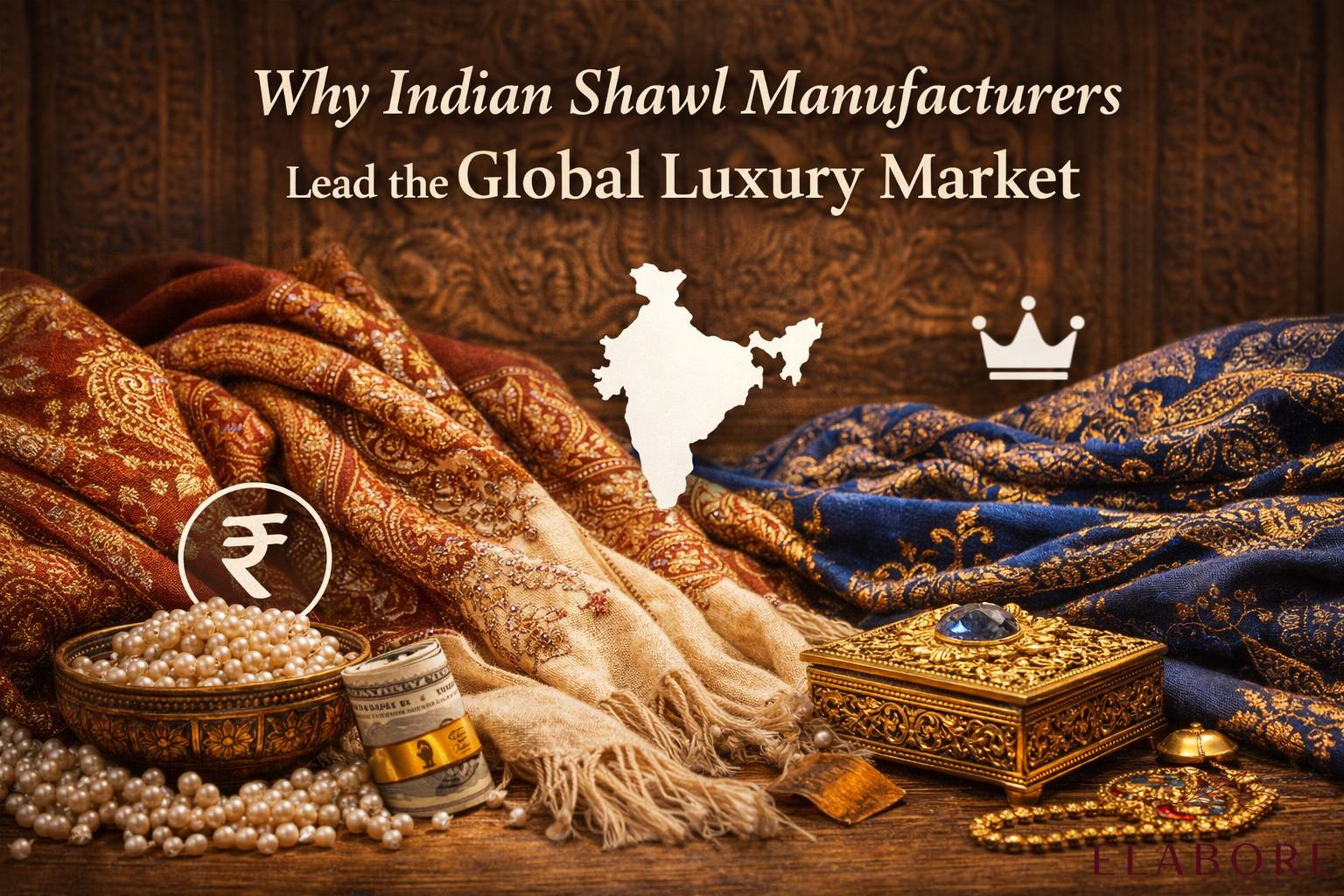
Retailers dealing with global markets, luxury, and fashion importers all focus while looking for the best shawls in any part of the world to one country, that is, India. Manufacturers in India, who have a long tradition of providing the world with high quality textile products for more than a thousand years, are still on the top of the global market for luxury shawls. Whether it is enchanting snow laden valleys of Kashmir, or white hot weaver of Rajasthan, or aesthetic artisans of Uttar Pradesh, indian shawl manufacturers offer artisanship in all its range of traditional as well as modern manufacturing and exporting.
Indian shawl manufacturers can be considered more than suppliers. They are the conservators of a craft practice stretching back hundreds of years - practices that dressed the emperors and wrote the annals of royalties, practices that got preserved in the world’s renowned Haute Couture collections. The trade secrets of the top Indian shawl manufacturers are not copyable by factories even with the most advanced equipment in any other country.
B2B customers be it a stylish Milan boutique buyer, New York wholesaler, a department store in Dubai or a fashion company willing to grow an accessories pedigree collection, understanding the layout of the Indian shawl manufacturers market is the primary strategy in developing an upper-class strategy for shawl procurement.
The Indian textile industry has put a great amount of effort in building manufacturing infrastructure, quality assurance systems and markets for exports in the last twenty years or so. Indian shawl manufacturers are today characterized by a professionalism, documentation and levels of international obligations that reassure buyers from all classes. Be it 50 hand-embroidered pashmina shawls for a luxury boutique launch or 5,000 printed woolen wraps for a department store seasonal buy – Indian shawl manufacturers are able to deliver them all regarding the quantities, their high standards and their style.
In this document, you will read about all the necessary information that any B2B buyer needs to know about the Indian shawl manufacturers and their goods, high quality, availability, export production, price revision elaboration, and hidden agenda on the current transformation. You should keep your reading, at least, if you are starting to look for this type of item serious.
Why Indian Shawl Manufacturers Lead Globally
The place where indian shawl manufacturers are on top of the chain is not a PR exercise. It is a naming of the perfect geography, availability of an opportunity, longstanding workshops dealing with a certain technique, and a packet ready to make – elements of seeking idealism which no one else across the globe offers on a large scale.
Indian shawl manufacturers control this aspect of business, along with the finest raw materials, thanks to the geography of India, positioned right in the center of this Himalayan corridor. Indian shawl manufacturers enjoy direct access to well-known fibers. The famed Kashmir’s location is literally next to Ladakh central plateau, home to the Changthangi grade goat and its exceptional pashm fiber - highest in demand raw material used in luxurious shawls among other ones. pashm fibre boros comes from the changthangi or the angor goat bred in ladakh. Pure Pashmina fiber is obtainable from the Indian Pashmina or Changthangi goat directly, which allows pashmina manufacturers in the country to produce their goods while ensuring all the provenance standards necessary for the luxury sector.
Within the Indian culture in general, and Indian clothing in particular, it is impossible to remove or replace the craftmanship of Indian shawl manufacturers. Traditional weaving crafts in Kashmir, including kani weaving, sozni stitching and pashm weaving craft have evolved over centuries, and continue to remain in families. The master craftsmen, who have been practicing their arts and crafts for many decades, grew up in the world it’s neither decorative nor Indian shawl manufacturing industry, wherein they produce items that have true artistic and traditional value. Even maximum industrialization cannot replace this level of human capacity.
The Indian textile industry is enormous and is eclectic in its scope, and as a result, provides numerous infrastructural advantages to Indian shawl manufacturers, which cannot be offered in smaller general economies. The textile supply chain of the country is highly integrated, from fibre sourcing to spinning of the fibre and dyeing, weaving embroideringing processing to quality check and export logistics, all operating in well-developed domestic systems. The cost benefits splitting production, as well as quality assurance is a luxury, which many other national players do not have, is enjoyed by indian shawl manufacturers by dint of this geographical position.
For a very long time, the Indian shawl manufacturing sector has been the beneficiary of government checked through-help. The branding of particular locations, the handicrafts exports council, the C D Institute located in the city of Kashmir, and also measures for promoting exports like refunds of duty and the MEIS scheme all increased the scope of role that shawl exporting street in India plus rendered the Indian shawls procurable in the lowest prices in different markets.
High-end fashion from across the globe has additionally confirmed the upliftment of the Indian shawl manufacturers at the top. Famous houses for example Hermès, Loro Piana, and high fashion designers have explored the use and innovation of Kashmiri and Indian shawl makers. In the age of the ultra-luxury brands, which patronize natural-fiber accessories, it is only the Indian shawl manufacturers that they turn to - guaranteeing the indispensable standard that these manufacturers hold.
Authentic fiber access, generational artisan craft, integrated production infrastructure, government trade support, and assurance from the global luxury market are what make indian shawl manufacturers, without a doubt, the ultimate leaders of the global shawl market presently and for a long time to come.
Types of Indian Shawl Manufacturers
The range of indian shawl manufacturers that exists today is extremely vast and includes various categories of products, processes, region-specific techniques and administration. Appreciation of the nuances that separate the various kinds of indian shawl manufacturers, helps make connections between the B2B client’s sourcing requirements and the optimal supplier that would meet those requirements.
Kashmiri pashmina manufacturers are at the top end of indian shawl manufacturers. These producers are located mainly in the city of Srinagar and its neighboring districts: Budgam, Pulwama and Anantnag and make the pure pashmina shawls from original Changthangi goat fibers. Different scales of operations are characteristic of Kashmiri pashmina manufacturers india: they may be represented by small family business weaving shops of five to ten looms, and large export manufacturers employing hundred agents and having all the formalities for exportation complete. Engage with only these suppliers for GIS that provide genuine pashmina products that call for high end outlets.
Companies that specialize in embroidering Indian shawls prioritize the sozni, aari, and crewel embroidery techniques which result in the creation of Kashmiri shawls that are artistically exceptional. Such Indian shawl manufacturers weave for themselves or get the base shawls from other weaving units and transform the base shawl or the pattern on it into embroidery by employing skilled embroiderers. Otherwise, if there is a market for heavily embroidered high value shawl without any exceptions, Indian shawl manufacturers with expertise in embroidery will be a strategic fit.
There are distinct types of shawl making experts that exist, each with their own level of expertise in kani craftsmanship, among other shawl making methods in India. The art of weaving of Kani which almost resembles tapestry where a great number of very small wooden “phants” or looms weave a shawl is carried out by very few skilled artisans and shawl manufacturers in the villages around Kanihama and Sultanpora in Kashmir. These shawl producers in India can create the costliest shawls that require skill and endurance since a single piece takes weeks or months of continuous crafting. To the high end boutiques, lama weaving indian shawl manufacturers deliver a product offer which no one else in the market could deliver.
Details In Ludhiana, Amritsar, and Panipat, the predominant segment of shawl manufacturers is the mass of the structural market which happens to be that of woolen shawl manufacturers for exports. The Indian shawl industry in these cities is dominated by, producers who deal in woolen shawls, stoles and wraps, mainly machine-made or semi-handmade, made at affordable rates. The Indian shawl cluster in Punjab is prompted to provide shawls to a significant portion of the shawls exported by the country of India's machine section and country wholesale retail goods with efficient systems of low pricing and large volume products provision.
Manufacturers of printed and digital designed shawls are located in Jaipur, Surat, Delhi and other cities. Digital printing technique is of a great advantage for these companies engaged in making shawls from fabrics such as silk, modal, viscose, and blended ones. Here, the design of the Indian shawls appeals to the fashion-infused mass market concerned with prices that should be low or affordable but gears the product to contemporary design at fast fashion paces. With the development of digital textile printing technologies, this faction of the Indian shawl manufacturers has seen a rapid growth.
Manufacturers of luxury blended and shahtoosh-alternative shawls produce high-quality shawls through the use of substitute of prohibited fibres such as very fine merino/ yak down/ pashmina-cashmere blend. The Indian shawl manufacturers focus on serving the elite clientele that seeks the fiber´s best characteristics, but within the boundaries of the existing registration and legislation.
In terms of market positioning, export-trading firms indian shawl manufacturers exist in a niche of their own. They are massive professionally run companies that organize production from many small weaving and embroidery enterprises and engage in quality assurance, export preparation, and direct engagement with the buyers. It’s always easier and more efficient to deal with locally based facilitating distributors who offer one shop in diverse kinds of shawl collections through export trading firms india kao margin ve shawl manufacturers. lmost house to the importers looking at local suppliers only.
Benefits of Working with Indian Shawl Manufacturers
The business reason for associating with indian shawl manufacturers is supportive of all sorts of key dimensions in purchasing of b2b businesses, product quality and prices, supplies and their magnitude, customization and properly exporting etc.
Indian shawl manufacturers are very critical to consider one such primary advantage is superior products make. Pashmina fabrics or cloth that are sourced directly from kashmiri pashmina producers india are producted in compliance with the provisions of the geographical indications act, and have a certification mean pashmina mark and these scientific identifiers are undeniable. This is the essence of how luxury is sold and perceptions are built – benefits cut across the entire organization.
An enormous range of products can be offered by Indian shawl manufacturers and gives them a competitive edge over other shawl manufacturers across the globe. No other nation is as rich and diverse in the shawl production resources such as the type of shawl products, techniques used, fibres goals, the number of pricing points and the designs all which the Indian shawl manufacturers follow. A complete shawl catalogue, consisting of inexpensive printed stoles as well as high end kani pieces, may be fulfilled by a single, and effective sourcing connection to Indian Shawl Manufacturers.
Because the supply chain for textiles in India is integrated, labor costs are lower than in the West, and there are government incentives to export, Indian shawl manufacturers are able to offer competitive wholesale prices. The cost of doing business in the textile sector in india is such that indian shawl manufacturers are able to provide pricing that is comparable to that available in the rest of the world without reducing the quality of their products – a phenomenon that is very unusual in the luxury market today.
Indian shawl producers have the advantage of customizing their products and private labeling. In particular, modified masses, designs with unique contours, selling convince packaging, customizing label particular to the buyers and full modification of the shawl customs from its original form to shawls complete to enhance and texture - India shawl sellers are more than able and statuesque enough to meet such challenges. There are major casket projects and reminder of retailing aimed at wishing this.
It is possible to produce competitive quantities of shawls of superior quality, at different stages of business growth of any consumer. At whatever stage of your business, be it for instance for the very first time for an exotic wedding where fifty shawls are needed, or a seasonal business order for ten thousand, it is possible for the Indian exporters to manage the order with keen focus on quality. This feature is essential to importers and distributors who are looking for vendor partners who would be ideal for the business and will scale up with it in time.
International merchants find it easy to deal with the shawl exporters india due to the presence of developed export capacity. The top Indian shawl manufacturers have their own export divisions, shipping company partners, specialists in custom clearance issues and, most importantly, know the import market rules and regulations in major economies namely the European Union, the United States of America, the United Arab Emirates and Japan. Thus, they save their international customers considerable amount of time and effort in logistics.
The demand for strong ethical considerations and sustainability practices among buyers classy products is growing worldwide, and the actors in the Indian shawl manufacture industry and mostly GI registered Kashmiri manufacturers, are best placed to satisfy such demands. The artisans economic empowerment, protection of indigenous traditions and control of the effect of industrialization are achieved in the practice of these indian shawl manufacturers. To retailers who are purposeful about creating sustainable brand stories, they can find enlightening stories in the indian shawl manufacturers.
Pricing from Indian Shawl Manufacturers
Comprehending price differentiation among Indian shawl manufacturers is an important aspect for b2b customers who intend to develop any profitable soles sourcing strategies aimed at retail without touching the retail margins.
The Indian shawl manufacturers’ pricing is far from homogeneous, engendered as it is by the very varied product ranges, quality of yarn, procedures used in the production and size of businesses. Mapping out this topography of prices clearly helps in avoiding paying too much and having to pay for very cheap goods, which are in the end known to be fake.
From within the clusters and in Ludhiana, Panipat and Surat, Knitted and woolen printed shawls and imitation knitted and woolen shawls at entry level standard quality come at wholesale prices; the price ranges from about $5 to $ 20 per each piece. In addition, these products are ideal for gift shops, general retail mass sourcing, and high street fashion accessories retailers as they provide wholesale or sometimes even lower priced products in large volumes.
A low-range pashmina can be plain or with some simple embroidery, and would costs between $40 and $120 a piece in wholesale when they are sourced from the Kashmiri pashmina Shayli manufacturers, india. Retail prices on these can go from 150 to 450 dollars and it is more on the cheaper side of the scale mostly because it still involves smaller amounts of shawl importation/retailing.
When it comes to most of the specialized indian shawl manufacturers floss-embroidered and plain Jamawar shawl they are priced in a range of $120 to as much as $500. Retail prices of these pieces can reach $400 to $1500 or more, as the extent of the embroidery touches hundreds of hours of work from artisans and that well displayed niche retailers.
The most difficult to create and by far the most respected shawls that indian shawl manufacturers offer are Kani. The prices of such shawls start from $400 to $2,500 and sometimes much higher when sold at wholesale depending on several factors like weaving pattern, the level of detail of the design and also the fame of that particular weaving unit. Instead, kani creations outstanding within their kind often go for no less than $3, 000, and up to $10, 000, in high-end shops, or at auctions, thus lucrative profits for the perceptive consumer are available.
Several factors impact the pricing negotiations involving Indian shawl manufacturers. The most desirable factor in these negotiations is the volume of the order — more quantity always attracts a lower unit price from these Indian manufacturer. The terms of payment affect pricing as well; buyers appealing for a discount by agreeing to prepayments or lesser credit days tend to receive lower prices, from the more cash conscious Indian shawl manufacturers. Buyers who create these long-term collaborations offer seasonal multiple orders to a particular manufacturer. This is one more effective strategy for acquiring the lowest wholesale price from Indian shawl manufacturers.
Because the buyers are introduced to Indian shawl manufacturers abroad, issues of currency also come into play. Almost all Indian shawl manufacturers either quote in Indian Rupee currency or in US dollar. Look at the exchange rate, and work on what currency should be used when further appropriate as these two will have an impact on your landed cost and the end picture in terms of profits from the Indian manufacturers.
I would always recommend that you receive priced proforma invoices from Indian manufacturers of shawls, that capture all costs of the shawl production, including labour, cost of embroidery/processing, export packaging design, mode of transport, cost of freight as well as documentation costs. This helps to ensure realistic and fair landed cost of a product and effective sourcing from multiple brands of shawls in India.
Export Capability of Indian Shawl Manufacturers
Indian manufacturers’ ability to export shawls is among the most impressive in the world’s textile industry. This earns shawl exporters india the reputation of among the best organized suppliers of textile products whether in-house or contracted out to an ‘export oil’ (export house) due to several decades of trade operations in these and several other countries and the available support infrastructure particularly that of the government.
Because India remains one of the biggest players in the international sector of creative and high-end textile products, textile industry india plays a vital factor when it comes to the country’s external revenue while the shawl and pashm rushing fasion and lifestyle exports continue to develop more rapidly. Most of the indian shawl manufacturers provide their products in more than 100 countries around the world, and the most important ones are the USA, Germany, France, the UK, Japan, UAE and more recently China and South Korea.
It could be said that the suppliers of shawls from India have a developed export documentation competence. The top shawl companies in India can offer a range of export documents needed by buyers, such as commercial invoices, shipping documents, the certificates of origin, the GI certificate, pashmina’s mark certificate, quality inspection report or reports and other specific import market compliance related documents. It is impossible to avoid – this ability is more important to importers of regulated markets, especially the EU that has stringent labeling requirements on textile fibers.
Due to an increase in freight and logistics skills, Indian manufacturers of shawls are no longer at their infancy in this regard. Indian shawl manufacturers, those who work in structured companies, make use of the services of freight forwarding companies. Therefore, it is possible for them to offer the buyer the FOB or the CIF prices. Such ‘Flying Projects’ for the delivery of either urgently needed goods or high-risk goods, or sea consolidation services for the transportation of large volumes are all a part of the extensive service of every stage of experienced indian shawl manufacturers.
Regarding the inspection activities, credentialed export-orientated councils also offer inspections in terms of content and safety. Those include quality inspections in terms of bleedability and shrinkage properties that are in demand from the market where a shawl is to be shipped. From this point of view, Indian shawl manufacturers have two ways: either rely on their own quality controllers or confide in foreign independent testing bodies.
Experts from the Handloom Export Promotion Council (HHEPC) and the Carpet Export Promotion Council (CEPIC) provide a wider opening for Indian shawl manufacturers by assisting them in their various initiatives. The certain level of advantage for buyers engaging with said councils is that they avail a book of controlled shawl exporters in india who are up to a certain yardstick in terms of conformity.
When importing from India for the first time, especially long knitwear products, it will be useful to employ the services of a qualified customs broker from your home country of import and a freight forwarder who most likely specializes in moving Indian textiles. Loads of indian shawl manufacturers who care about the best practices will make sure there is no hassle when it comes to exporting. And they are well acquainted with the export market and make no compromises on any compliance requirements in their particular export market.
How to Choose Indian Shawl Manufacturers
Business Merchandise Division of a Retail Store Selects Indian Manufacturing Unit
In the shawl business, that successfully selects the best ordered Indian shawl manufacturers to fulfill the demand of the product is among the leading concerns of a shawl retailers, importers, and brands, that maintain producing successively profit. However, before, I go further, the Indian shawl manufacturers’ in question will need to be assessed in occasionally for Kernel quality of service management or whether the proposed, Shawls, Kapoor, of the client, in this case Javaw, fit the Standards of the Company. Generally, building on relationships within an organizational setting might be, as a matter of fact, an advantage for business and awareness raising purposes. However, keep in mind that, as much as it can be advantageous, it can also turn out to be quite unfavorable, as usually it leads to quality blowbacks, different order shall excess of agreed tolerance in time, nor to reputational damages as well.
Here is how you should go about scrutinizing Indian shawl manufacturers so that you can be sure of your choice.
Start by making sure that you have a match in terms of the types of products being dealt with. As obvious as it may sound not every Indian shawl manufacturer makes every type of product. On the other hand, a weaving Kashmiri pashmina unit is unlikely geared to provide identical printed stoles while in the same breath Jaipur digital printing India house will not be able to provide embroidered pashmina without any complaint. The first step in the selection process of Indian shawls is matching the skills of each immortal being and the product required.
Conduct a stringent verification of credentials in certifications and compliance. To ensure the pashmina and Kashmiri products authentic to your market, ascertain that the potential Indian shawl makers have a valid GI certification, Pashmina mark and IEC (Import Export Code) registration. These certifications guarantee that there is no buyer to seller interaction to a mere registration of business as an exchange of business.
Investigate current operational production status for meeting existing order levels and if growing increases in capacity production will require any additional investments. It is important to know the specification of production capacity of the Indian Shawl Manufacturers you are planning to work with so that you will always be ready whenever you are inevitably supplied with many orders or when the company expands. Get production capacity figures such as the number of looms and artisans, present monthly capacity of production and the length of time taken for products and orders in order to establish the level and reliability of production that can be offered by any specific producer.
Request for evaluation of the product samples and determine their suitability for the intended purpose. Any potential purchase from indian shawl manufacturers should be subjected to physical samples and their examination on their construction, fiber, colors, embroideries, and that workmanship too. Regardless of the catalogary, the normal engagement with all Indian shawl manufacturers shall be around a sample evaluation policy bearing no room for negotiation.
Conduct references test and examine the exports or transactions previously performed. When Other Indian shawl manufacturers are being sought, get referrals and suggest that the existing customers outwardly contact their international second tier customers, preferably themselves. Through doing so, retailers or importers that have bought from your potential manufacturer can be helpful in giving the real picture of IoT manufacturer’s reputation and all this entails such as the quality of communication as well as the after sale services given. As per the order to verify the claims regarding exports, one needs to go through the exportation manifests and records of the potential suppliers.
Consider the possibility of inspecting production plants either in person or through online tours. In the case of important business cases, a detailed video or an actual visit to the factory gives us a chance to observe the extent of working conditions, exposure of artisan metalworkers, assurance and maintenance of quality practices, and in general, the operating interface in place within the confines of Indian shawl manufacturers. The finest Indian shawl manufacturers do not mind when buyers visit them as this is an indication that they have nothing to hide.
Assess communication behavior and make changes when necessary. Serious Indian shawl manufacturers who actively pursue B2B relationships will be active, precise and take steps to communicate effectively. When communication is too slow, too vague or absent during the initial phase of inquiry, that is a sign of issues with operational sourcing relationshipaturity.
Initial orders from new suppliers ought to be minimized despite extensive research. Even the most assured companies place lesser orders than they would like whenever they place their first orders with new manufacturers in India for shawls. In other words, there needs to exist an initial trial order to test the quality, compliance and functionality of the products to be purchased, the order processing schedule and all organizational documentation and procedures relied on, but in the form of real orders prior to purchases of larger volumes in embroidered orders meant for long periods.
Craving to meet the Indian export approved shawl producing companies? Utilise the services of our b2b Level Sourcing department and fill your order book with specified producers in accordance with the range of goods and positioning in the market.
Challenges with Indian Shawl Manufacturers
The decision to source shawls from India is almost irrefutable from a business point of view, but B2B buyers must familiarize themselves with issues likely to arise and workable strategies for overcoming such issues.
Consistent quality delivery across all the production batches for every shawl order is one of the complaints often raised by customers who go for cashmere and especially, washi tape. This is because genuine Kashmiri and traditional shawls whether cashmere or woolen go through hands of human artisans, have variation of raw material and the colors are not permanent because they are dyed by hand, hence making it impossible to have the same shade in every single piece of an order. The best way to deal with indian shawl manufacturers is to make sure that there are detailed quality requirements spelled out on a paper and for the better assurance, pre-shipment quality checks are conducted either by your representative or by hiring a third party service.
Mislabeled and counterfeit products remain a worry when purchasing from the Indian shawl manufacturers without proper checks. It is common for some suppliers to sell synthetic or blended made products claiming them to be pashmina and give false claims of being GI certified. Working with new Indian shawl manufacturers calls for vigorous credential checks and fiber testing.
communication capably contributes to the sourcing friction between the Indian shawl manufacturers particularly small artisan scale producers who may not have export managers or may not be able to communicate in English. This can be avoided by working with export houses or hiring a strong sourcing agent who has developed strong ties locally.
Order processing needs to be planned effectively if you are to partner with Indian shawl manufacturers, especially when it comes to producing any sort of hand-made goods as the category focuses on conventional handicraft. Long lead times are acceptable for Kani and other embroidered shawls, and it may take several months for any of the complicated designs to be ready. Without factoring in these lead times, customers who use inventory strategies based on seasonality may find themselves without stock as the demand peaks. Partnering with Indian shawl manufacturers based on future forecasting and, notably, production planning overcomes this common problem.
In some cases, minimum order quantity from different Indian shawl manufacturers poses a serious obstacle to small scale retailers. Although many larger Indian weavers and export houses in India allow smaller quantities of orders, there are also smaller weavers that have additional minimum order requirements that might not be enough for every buyer. Potential problems of time and re-conciliation can be saved if the understanding of MOQ levels is known beforehand when choosing a supplier.
Protection of intellectual property is becoming another issue of concern as far as indian shawl manufacturers are concerned. Where indian shawl manufacturers are engaged for custom designs and private label products, it helps to protect your designed goods in the contracts to prevent them from being sold to other clients. Clever luxury consumers always insist on clear IP ownership phrases in the contracts signed with the indian shawl manufacturers.
This includes any trade restrictions india textile market is subjected to, as it includes export licenses, restrictions on fiber contents, and so on – in your corresponding market, requiring that you know and observe these restrictrions. Engaging shawl exporters india who are experienced in export procedures and all relevant laws prevents many professionally affected erosion of business.
Future Trends for Indian Shawl Manufacturers
The way forward for Indian shawl entrepreneurs looks promising and its transformation through the use of digital technology, the change in the values consumers hold, the international tables of markets, and the improved craft to commerce process is very interesting.
Digitizing commerce is transforming how one imagines and serves their foreign buyers who are the Indian shawl sellers. The advent of B2B online trading platforms, virtual expos, and technical catalogs has enabled international buyers to source, review and even order from international Indian shawl manufacturers already seated miles away. International market opening is becoming accessible increasingly to Indian shawl manufacturers, the ones who nurture the digital marketing skills, such as developing websites, creating function videos on art works, and promoting brand products into the different global B2B markets experience an extraordinary reduction in cost of entering the markets.
While previously optional, obligations for sustainability and ethical sourcing certification are emerging as mandatory criteria, particularly for Indian shawl manufacturers offering their products in the international luxury markets. Few, if any, retailers in Europe and North America, however, supply their shelves with goods from suppliers who do not adhere regulating diligent labor practices, good environmental practices and responsible procurement of their materials. Those Indian shawl manufacturers committed to both Fair Trade measures and SA8000 incorporating respect for the environment will no doubt stand out and get the lion share of buying luxury retail outlets of tomorrow.
Some of the innovative Indian shawl producers have begun to think about technology-supported ways of guaranteeing the origin of their products. Advanced systems based on the blockchain technology, which details each step of the production process of a shawl, right from harvesting the fibers to selling it in the retail market, is being experimented by a few shawl exporters in India. Enabling customers to scan the QR code in order to check the authenticity of a shawl immediately is incredibly useful for the luxury retail brands that work with low cost Indian shawl manufacturers.
The exciting new product innovations occurring in the Indian shawl manufacturing industry are the outcome of blending traditional weaving techniques and modern aesthetics. A number of brands are incorporating practices of kani weaving or sozni embroidery, both of which are classical styles with a geometric pattern, minimal color and straight cut clothes into modern collections. Such concepts are finding favor with global fashion shoppers who seek traditional provenance as well as design that speaks to the current day. Further, some Indian shawl manufacturers are targeting new premium customers for their products by focusing on design and staying abreast of the latest fine trends.
The rapid growth and penetration of Indian domestic shawls is fast becoming a reality within and across its main markets. The lower end of the market continues to provide new opportunities to the Indian shawl manufacturers especially in China, South Korea, Japan and South East Asia where appreciating luxury consumers are growing. Pashmina manufacturers India as well as the larger shawl exporters India are benefiting from the expanding markets as government mechanisms of trade facilitation and promotion as well as Indian soft power have begun to play in those regions.
Indian shawl manufacturers are forefronting the commercialization of artisan protection as well as craft protection. Here, the increasingly informed and socially motivated luxury consumers make it pertinent that Indian shawl manufacturers have not only these principles in place, but also functional provisions for them including wages, training, medical care and development of [[the local economy]] also fundamental.
To boost the operational efficiency and market responsiveness, larger Indian shawl manufacturers are embedding artificial intelligence in design development, demand forecasting, and inventory management for adapting to changes in the business environment. And one particularly interesting application in this aspect that most of the top notch Indian shawl manufacturers have started heading towards is AI enabled pattern making which sticks to the grammar of the traditional Kashmiri designs while creating immerging usable designs.
Conclusion on Indian Shawl Manufacturers
When it comes to the hierarchical standing of Indian shawl manufacturers, there is no denying that they rank at the top in the world—the global luxury textile industry, in particular. The statement is firmly grounded in facts unlike any other. Indian shawl manufacturers, from the old, indispensable crafts of Kashmir to the organized export capacity of any other part of Indian industry, provide businessmen clients with quality, real, varying, and business-like goods and services that cannot be found anywhere else in the world.
The complete spectrum of the landscape indian shawl manufacturers has been explored in this book, from the global competitiveness of such manufacturers, a variety of types in it, the benefits of these types, how prices are determined, how export works, how buyers can choose, how to control some risks while working with the manufacturers, to the future developments of the manufacturers. The overall impression is of suppliers who are quite embedded and proud of and their culture but that also struggle to meet the expectations of the global luxury business.
Retailers, importers, distributors, or buyers of luxury brands yearn to understand the business case in using indian shawl manufacturers. In case you need authentic Kashmiri Pashmina shawls maybe from GI marked Kashmiri suppliers, huge quantities from the woollen shawls producers in Ludhiana, or ready to develop your label with the classy export firms in Srinagar, the indian shawl manufacturers will offer the right products, services and will be willing and able to help you in meeting business objectives.
Indian textile sector, which integrates all sub-sectors of fashion, is evolving in terms of international integration, superior quality and professionalism. The shawl exporters in India are moving to distant countries, securing approvals and investing in the infrastructural needs and processes values that the luxury customer wants. Producers of pashmina in India are preserving the traditional methods yet applying the business strategies essential for the frictionless cross-border activities.
In the coming decade, only those Indian shawl manufacturers will be able to sustain growth and achieve leadership on the market who can blend the age-old tradition of making these handwoven products with the use of modern management tools. Such manufacturers in large numbers are available for contact with interested foreign clients.
Now, are you looking for experienced Indian shawl manufacturers to work with? Please, forward your request to our b2b supply chain department Today and you will get a list of manufacturers linked closely to the respective market, the support of hand-drawn product labels and list prices of mass sale shawls to help bring your business one notch higher. Submit your request today and see for yourself why the Indian shawl manufacturer is the preferred supplier of shawl partners to all major luxury retailers in the world.