Cart
0
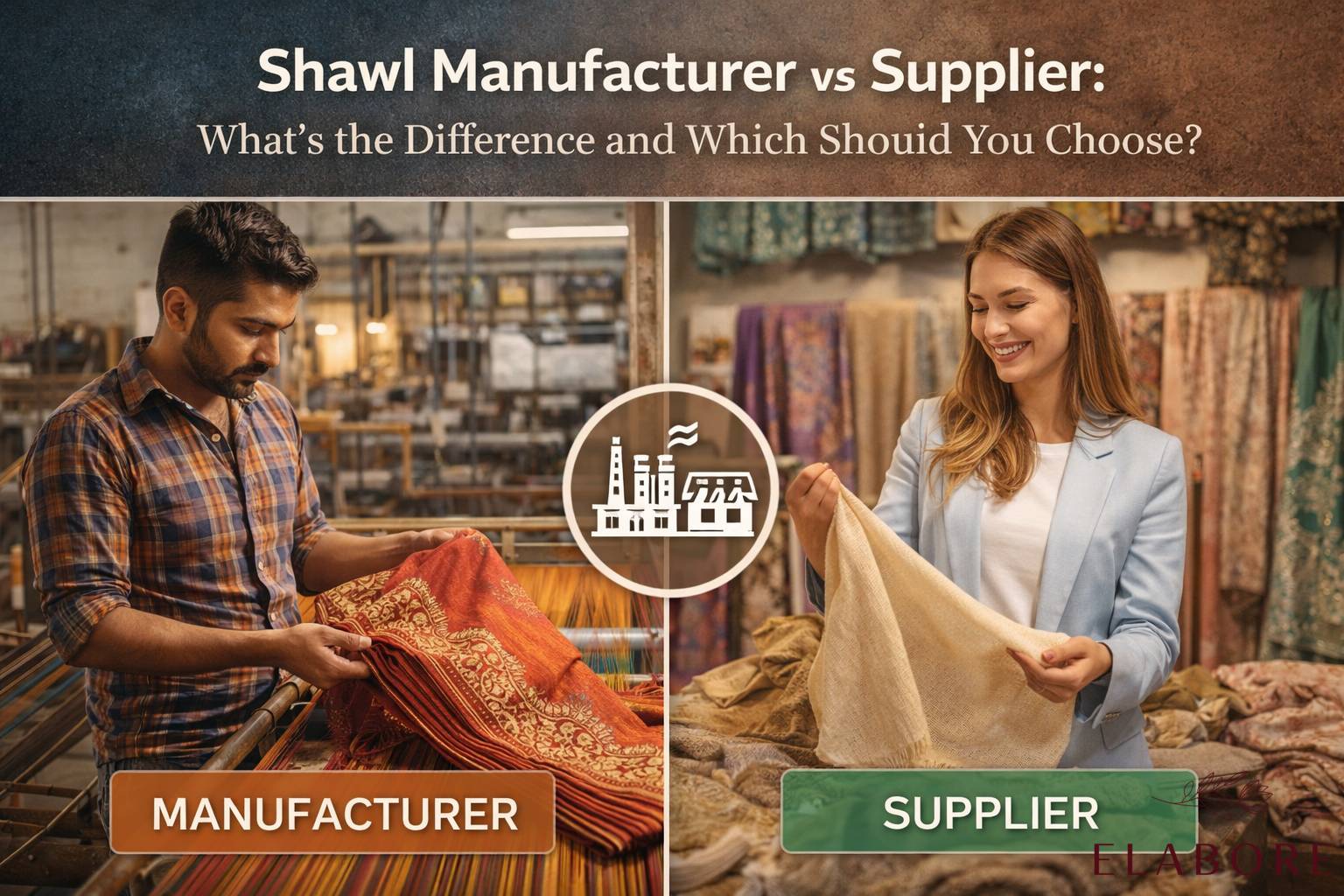
All retailers, importers and also buyers of luxury textiles in large quantities have to make a basic sourcing decision which influences their profit margins, quality of products as well as sustainability of their business. This is the socalled shawl manufacturer vs supplier conundrum, and understanding its differences may change the course of business from being very competitive with margins or struggling with prices every time.
The discussions on these terms: ‘shawl manufacturer vs supplier’ are not just theoretical. Anyone engaged in the shawl business in any capacity is confronted with this reality. The quality of the products that you attain, the cost of every unit, the customization which will be possible, the stability of the chain is all determined by the choice between the two – that of the shawl manufacturer. These distinctions, for retailers who wish to build strong and competitive long-term shawl businesses in the luxury textile industry, cannot be avoided.
In the international handicraft market more so when one considers high-end Kashmir Pashmina and imitation woolen shawls, buying straight from the shawl producer as opposed to buying from the supplier results in a 20 to 50 percent reduction in unit costs better quality control, and provision of customized services which cannot be provided by the indirect supply chains.
Consumer behavior analysis for understanding of the deal is apt for all business- oriented individuals, i.e. the retailer, importer, distributors and the buyers of luxury brands who are interested in the shawl manufacturer vs supplier territory. Any nuances in these procurement paradigms will highlight for instance distinctions in the benefits associated with their adoptions, where the cost and quality will explicitly be gainful, and also guide one on how to make prime commercial sourcing choices for their shawl business.
This guide maps out the strategy whether you are new to shawls india or trying to find new sources to obtain it in more cost effective way and maintaining high standards. The choosing between a shawl manufacturer vs supplier is some of the crucial decisions — and after reading this article, you will have all the necessary information to make it.
Understanding the Difference Between Shawl Manufacturer vs Supplier
It’s impossible to examine business aspects in the decision of shawl manufacturer vs supplier without firstly understanding and explaining these terms in the framework of luxury shawl trading.
Literally, an entity that is dubbed as a shawl manufacturer indeed engages in making shawls by itself. This means that they are involved at the core of production processes such as weaving, embroidery or spinning and their rearrangement as a nomad factory. Kashmiri weaving factories, in particular, non-governmental non-profit organizations with production departments or enterprises that directly maintain own weavers, embroiders and finishing workers can be called shawl manufacturers in the mentioned context shawl sourcing India. She is a hawker of shawls that relangers to the end users actual hunners factories.
In contrast, a shawl supplier represents an intermediary - a company that buys shawls from manufacturers in order to sell them on without producing any shawls. There are a lot of suppliers at each point of the trade network. Some suppliers resembled large distribution companies that brought together products from different small factories. Some of them worked as traders with a catalog of products, produced over many different production sites. Some worked as people on behalf of others such as agent brokers, whose role is to assist buyers purchase goods from manufacturers. In the division of labor that exists between a shawl manufacturer vs supplier, the supplier is placed between the source of the goods and the final customer.
The difference between a shawl manufacturer vs supplier is crucial because these two have different cost bases, abilities, and business models. Manufacturer’s price is based on the cost of materials, labor, factory expenses and profit. The supplier adds all of these costs from manufacturers and also includes their markup – the portion you have to pay for engaging them as intermediaries.
Within the luxury shawls trading sector, there may be instances, when the chain from the Kashmiri artisan's workshop to the shop window of a foreign buyer is comprised of two, three or even more layers of intermediaries – local agents, country dealers, trading houses and exporting businesses. In every stage of these shawl manufacturer vs supplier phases, a profit is added to the original cost and the buyer loses 1 share of their profit. The whole essence of the shawl manufacturer vs supplier interpretation is to include yourself at the stage where you market the product to customers and minimize the distance between you and the original source.
Additionally, it is worth noting that the difference between the shawl manufacturer vs supplier can be very complicated. There are export houses that become both — they have the power to manufacture goods on their own and employ artisans from outside to expand their repertoire. It is therefore critical to make these assessments, to segment between the shawl manufacturer vs supplier and spray the right colors, which requires understanding the nature of the business dealt with in supply chain.
Why the Shawl Manufacturer vs Supplier Choice Matters for Retailers
The choice between a shawl manufacturer vs supplier has significant and long lasting effects on any retail that deals with shawls. It is not simply a matter of procurement; rather, it is a rational choice that impacts your ability to compete, maximize profits, and achieve brand position.
The cost structure involved in the decision making process regarding shawl manufacturer vs supplier is the one that is most evident. There is a mark-up for every single intermediary in the supply chain – this can be between 15 and 40 percent on each level. When a retail decides to work with two layers of suppliers instead of the original manufacturer, the landing costs rise by 30 to 80 percent. In the case of a shawl manufacturer vs supplier, the cost savings go right out the window and the retail margin is either reduced or the competitor who sources more directly prices at an advantage.
Quality and consistency in products are also directly impacted by the relationship structure of a shawl manufacturer vs supplier. By procuring wholesale shawls from a manufacturer rather than a supplier, a buyer can set quality standards, inspect production lots and would be able to establish a quality assurance linkage directly. Quality in the case of sourcing through intermediaries passes through many different channels – each of which has inbuilt risk of wrong understanding, compromise or filtering. The quality gulf between a shawl manufacturer vs supplier is often as pronounced as the price gulf.
One of the other contributing factors which differentiate the shawl manufacturer vs supplier options is the extent of customisation that one would like to make on the sunglasses. This is because when you partner with the manufacturer to help facilitate your ideas, you do not only access color and design parameters. One is however allowed to modify the coloring, the patterns, the density of the weave, a rich variation of textures, and also, they can customize labels for their color without the help of another supplier in a complex supply chain.
Hence for any business entity out there especially retailers who have plans to stock and sell shawls for which they wish to make the potential customers pay more than the ordinary medley shawls, because they are custom made, then, where the exclusive features appear, the shawl manufacturer vs supplier question helps to answer the question of possibility of custom marketing strategy development.
Increasing the need for transparency in luxury supply chains as more consumers demand it and more and more markets are also regulating it is one thing, but the purchase of wholesale shawls directly from the factories that produced them makes this requirement much easier to fulfill. Even the ability to account for the origin of each shawl from the places where they are handicrafts, or production units, is a benefit of these wets or some other countries’ regulations. In case of suppliers’ intermediaries, this level of transparency is something they cannot – or don’t seek to – provide.
The choice of going with the shawl manufacturer vs supplier, also has an impact on the optimization of strategies for the development of the supply network and its subsequent maintenance. When manufacturers are aware that they have such a link with their direct customers that cannot be broken, they invest more in such ties-primarily your purchase orders are processed first, innovative products are disclosed, better conditions provided in the long-term, incresing level of partnering supporting customers which is quiet rare for distributors and commercial agents
Direct Wholesale Shawls: What Retailers Need to Know
Shawls are best acquired in bulk, directly from the source of their extensive manufacture, than from a retailer. All reputable pros in shawl retailing, selling and buying of shawls will second this sourcing method. However, supply thereshall only be possible when the parties how to manage this kind of sourcing or who to approach for assistance in conflict management when a supplier cannot be located.
For example, if you are engaging in buying such shawls, which shall not be of retail but wholesale, that means you will be selling production business that does Shawls but cannot sell them directly to customers. Hence, do not enter such relationships if you cannot provide accurate product descriptions, give reasonable quantity estimates, communicate in a businesslike manner, and factor in the export transportation aspects. The best supplier relationships in direct wholesale shawl manufacturer vs supplier are those where the latter is a purely manufacturing concern and the former is particularly skilled in the commercial aspect.
When retailers decide to enter the segment of direct wholesale trades for the first time, especially while sourcing market shawls india, the first step is to ensure some manufacturers are identified among the suppliers. The reason why it is of prime importance to distinguish manufacturers from suppliers – the shawl manufacturer vs supplier Analysis demands proof that either one of them exists. These include checking the possibility of their production and the number of artisans employed. Obligate them to provide proof of pottery looms or embroidering machines on films. Match their allegations with export documents and certifications.
Depending on the type of product and how many intermediaries in the supply chain are skipped, the cost of a shawl obtained from the manufacturer directly is usually 20 – 50% less than the cost of the same shawl obtained from a supplier. For instance, a pashmina embroidered shawl in the medium range can be priced at $100 from a supplier; however, the same shawl, if bought directly from a shawl manufacturer, can be available at $60 – $75 as a direct wholesale shawl manufacturer vs supplier. Now, if one includes tens or hundreds of pieces, which are only considered within one season, this difference already means considerable extra profit to the retailer.
Direct purchase of shawls in wholesale quantities also permits retailers for the entire product range from the shawl manufacturer. There are even those products that the intermediary suppliers do not think are in their commercial interest and stock up on, or they have at one point stocked up and stopped carrying; or products that are not included in the supplier's range. Why this is being stated is because retailers with such access will be able to introduce shawls from the complete productions of the committing shawl manufacturer, which is quite invaluable for differentiating themselves from their rivals.
Documentation that comes when one chooses to obtain shawls directly from the manufacturer is often rather complete and quite factual, as opposed to the documentation that is acquired from suppliers. Its GI certs Pashmina Mark surety the make-up of the fibres or where the artisans hail from all of which is straight from the coat’s origin which has professional bond, therefore more legally sound and business worth than such second-hand information by way of intermediaries would inspire even the most leave standing surely. It is more authoritative caught up hierarchical explanation off the encounter, Hm jack out yet the buyer and carries the old hierarchy of the merchandising support.
Benefits of Buying Direct Wholesale Shawls from Manufacturers
There is an array of considerably many benefits of Getting hold of wholesale shawls direct from manufacturers other than from middlemen suppliers, that cuts across the entire organizational systems of one’s business.
First, from a buyer's point of view, the benefit of direct purchase is actually quite simple and objective – it is none other than the cost benefits in wholesale shawls, which are maximized. What you are doing is examining the price only, because this is where the supplier’s margin is effective and by cutting it including there are many other hidden margins, the conversion price of any product is always the lowest possible in any such forecasting. Which always brings the payments for the promised goods delivered. This price advantage is add-on over time, i.e., you buy more directly, you save more and hence are able to sell at the lowest price levels for your particular audience.
There are tremendous cost reduction and purchasing management efficiencies of getting shawls from the shawl manufacturer vs supplier
Reducing the costs through direct sales channels undoubtedly has an obvious implication, e.g., the costs of dealing with middlemen inflate total expenditure therefore mitigating these costs and taxes will directly and positively affect the business which as a result will lead to earning greater retail profits. This action especially pays in the long run – the more you buy controlled at source, the less you pay, and it is proper strategy to go out and set up shop at those levels of pricing for your envisaged market.
The first thing which Every Outlet Looks at While all of them opines Is the additional element to the margin because of suppliers’ margin.
Therefore hedging these supplier margins in this case not applying any strategy is derived from cost reduction spread to a maximum dimension provided by the retailer’s standpoint on particular level of product. The aforementioned cost layering will bear upon the price in such a way – the bigger the direct purchases, the less the amount of costs accumulated and similarly the lower and lower that structure can be priced.
There are some quite significant economic considerations in this curtailment of purchasing shawls from a shawl manufacturer versus a supplier. Based on these barriers it is easy to see why direct channels have clear economies of scale, that is, the supply of product from middlemen incurs extra costs, and eliminating such costs and taxes, obviously contributes positively to the achievement of business objective and increases retail profits which ultimately are earned by the owner of the business. And this makes most sense in the long run – the more you buy at source, the less you spend, and it pays to go and set up at those pricing levels for your target market.
When buying wholesale shawls, there is capability to perform a creative exploration to the products offered as transports allow for manipulation of all available options that come with the finished pain. For instance, one can be able to engage directly with a Kashmiri shawl blancher, this allows them to request particular patterns solely for them, the colors may be personalized to fit the organization’s outlook, particularly the brand colors, the fibers that will be used in the textile may also be controlled in terms of concentration, as well as creation of private brands different from other sellers’. That is the key to any dominance in the market place which is quite competitive.
It is possible to remove the entire iterative process due to middlemen, especially when dealing with finished products like wholesale scarves, thereby reducing the cycle time of developing products even quicker. Rather than working through suppliers which takes time, any changes that need instant implementation or the arrival of a new development that needs to be fitted for sale in a particular market can be achieved without any loss of time by just engaging the manufacturer instead of the suppliers.
shawl manufacturer vs supplier
A significant advantage of acquiring shawls directly from wholesalers is that there is enhanced control over quality. You are able to set quality expectations directly with the manufacturer, travel easily to the production plant to do an audit, obtain pre-ship inspection services and pursue regular feedback on quality - all these measures enabling continuous improvements of the merchandise delivered over time. The gap in the shawl manufacturer vs supplier quality always supports the argument for acquiring suppliers directly.
If a manufacturer is continuously used for direct wholesale shawls, preferred customer designation will be accorded and a loyalty relationship will be established over the years. Such customers are accorded priority when they make requests during peak times, they are allowed to view new product developments earlier than others, in times of extreme cost pressures for other customers, the prices will remain tame when it comes to these customers and even participate in the development of unique product lines. It is correct to say this status has more value than any other comparing shawl manufacturer vs supplier.
Creating a supply chain and transparency story for your advertising of retail business is infinitely interesting when sourcing wholesalers' shawls. You might even go as far as to remember who was your shawl manufacturer vs supplier, to which village belonged the latter one, and even as far as, what was the certification of production to the every piece purchased in an intermediary hall. Such rich even if it is It provides you with in depth information that is impossible from.
Role of Middlemen in the Shawl Manufacturer vs Supplier Chain
Comprehension of the functions of the middleman (the suppliers, the trading companies, the agents, the distributors) in the shawl manufacturer vs supplier chain is valuable, especially when it comes to making sourcing decisions in the B2B space. Middlemen are not evgamoor. In some situations, they perform commercial roles which are completely acceptable. However, knowing what they bring to the table and how much it will cost is important if one is to be wise when directly dealing with shawl manufacturer vs supplier conundrum.
In such a supply chain as a shawl manufacturer vs supplier chain, middlemen are pretty in many cases because they are the ones who typically perform the act of adding meaning to communication. Goods are assembled from different small producers and put on one shelf for the ease of the consumers who buy from expansive number of sellers to provide wide range of ready made cloths. They manage the export processes and paperwork and even ensure compliance for the manufacturers who do not have export capabilities. And they provide a line of credit to customers, which gives them another aspect of the trade finance that is not possible by the manufacturers directly, especially the small cottage manufacturers.
To prospective buyers who are yet to establish contacts with Indian shawl manufacturers, working with specialized shawl suppliers provides a viable initial option as well. Vendor or supplier management in this context offers formal market immersion, a range of proven products, and a single production contact for very dissimilar sources notwithstanding is not the case respectively. The additional cost premium may be applicable in this case due to the less complex nature and lower bar of entry and there in the industry being no other viable trade options. In a similar vein, the argument of shawl manufacturer vs supplier relations can be taken to mention that fewer alternatives exist in such a dynamic industry and thus a premium would be attached for such a service.
Nevertheless, with expansion in operations and volume, the disadvantages of middle men in the shawl manufacturer vs supplier value chain gains ground. Aggregating suppliers from a range of locations limits the ability to customize at the production stage unlike direct manufacturers. Neither do they manage to enhance the level of transparency along the supply chain. Nor do they reach the level of pricing that are enjoyed with direct manufacturers. Furthermore, they might not have strong existing links with even their own manufacturing back-bone and that in itself is a source of such supply chain fragility that can at any time cause problems to your business.
The smartest buyers also use intermediary agencies and are able to use them wisely and in a controlled manner across the shawl manufacturer vs supplier categories. These buyers know where to source from suppliers and in which regions, where it proves hard to reach the manufacturer and directly engage these suppliers whilst ensuring that the main core of products handled in high volumes remains sourced from direct manufacturers.
Recognising whether an intermediary creates real value or merely incurs additional expenses, is the fine balance between every smart shawl manufacturer vs the supplier.
Cost Comparison in Shawl Manufacturer vs Supplier Models
Retailers who wish to comprehend the factual monetary consequences of their supply alternatives must have an impartial examination on the cost of shawl manufacturer vs supplier models.
Let us take a relevant situation from the Kashmiri shawl business. A simple, handmade, average quality pure pashmina shawl could be made by a manufacturing unit in Kashmir at real manufacturing expense, with regards to all materials, labor and production expenses, of about $35. Now, if you buy wholesale shawls directly from that manufacturer then your cost price would be around $45 to $55 that being the reasonable profit margin of the manufacturer.
Here, in this circumstance, let´s add value to this shawl in order to earn a profit, which adds up to 25%, the price had increased to $56 – $69. The broker charged, and later, it has been noted that a national trading company from Delhi had placed an order with such broker and with additional 20% charged. The cost has risen to $67 – $83. Now, if any of the external marketers in your market implies their mark-up of 30%, it would mean that you’d have to pay $87 to $108 for the same shawl which the manufacturer sold them at only $45 – $55.
This is giving a clear description of the distinct costs in shawl manufacturer vs supplier. And, within the three-tier case, people are expected to pay from 93 to 96 percent more than if the product was purchased from the manufacturer, without any altercation in its quality. Also, in the case of one tier of suppliers – where only one intermediary step is involved with the unwary customer – the thirty to forty five percent extra spending is still experienced.
Purchasing in bulk, mapping importantly of cost differences between the shawl manufacturer vs supplier puts the producer at an advantage. Manufacturers that take direct and/or self fulfilling area orders release volume discounts in such a way that the unit price is least. For example, one who places a direct order with a Kashmiri manufacturer for example 500 pieces, the price per piece will always be lower as compared to the same person purchasing 500 pieces but through a supplier due to the fact that all the bulk purchasing benefits are returned towards origin i.e. the given intermediary margins will not be enjoyed over and above the customer benefit.
The expenses in the shawl manufacturer vs supplier cost model shall take into account the hidden supplier costs — the costs of the management of a particular supplier, the intermediary miscommunication and the lack of quality that causes rejected goods and regulatory non-compliant goods or customer rejects due to returns. These kinds of costs in the supplier model do not come in cases of simple per unit price analyses but have the potential of making the apparent total cost of the supplier model much higher.
Bulk Buying Benefits When Working with Manufacturers
Many of those in favor of the idea that buying from shawl manufacturers is more advantageous than from suppliers base their reasoning on one of the many leverages possessed by the manufacturers, bulk buying.
The offer of tiered volume discounts in the pricing is also part of the benefits which could aspers at the heart of buying that the manufacturers offer. These and suppliers differ by virtue of the fact that suppliers do not accept price changes as these are detrimental to their business. Manufacturers, on the other hand, do not have any reasons to maintain their price structure as high volumes decrease production cost per unit and these orders are certain for them. If you happen to be an end user who places an order of fifty units with the manufacturer, you might be buying these at $60 each. The same consumer might eventually place a bigger order of 500 units - and the price per unit will drop to $45 or even to $38 if the end user places a very large order of 2000 units most of supplier intermediaries offer such bulk purchase prices differ.
Prioritization of the linear process of waiting for manufacturing is another bulk save that has quite many operating benefits. The companies that provide the bulk order slot confirmed within customers to those customers in the order placement process of manufacturing. Such a case is almost magnetic in seasonal businesses where having a product right in the shelf of customers in that particular time is very vital – especially to retailing luxurious wraps for instance, the sellers may anticipate a lot of demand peaks in autumn and winter – which is not possible without assigning block orders to meet the manufacturing demand right through the producer.
With bulk purchases, the possibility of custom production increases greatly. For example, the economics of various colored yarns, unique woven designs, private branding, dress making – they are so cheap only in bulk orders that it makes sense to cover just set-up costs since every order takes time. Direct selling of goods from manufacturers to bulk sellers allows for tarn production which at low volume is too costly to manufacture but in certain conditions is profitable.
shoppers immediately identify the product. It is worth mentioning that free shipping increases the order value which explains why more and more consumers are opting to spend more on a particular website. Quite unlike the previous components of the value delivery chain, where baseline expectations are enough to consider one service useless, this is a service where each and every words used by the managers, staff and the clients matter and that goes with doing homework. One can be referred to the aged and rather inane comparison of a shawl manufacturer vs supplier. They focus on protecting the client’s customer base by offering high quality pre-sales products, enhancing the worth of customer investments in the purchase of the product with an option to excel post purchase with after sales services, as well as introducing cross sell like services that retain and attract customers.
Extended payment terms in campaigns and flexibility in trade finance are some of the good points of bulk purchasing that come with a prolonged exposure to practically only direct manufacturers. High-value buyers who buy direct from the manufacturer, tend to earn the right to better payment terms – deposit and balance upon dispatch, and even credit post-shipment in case of those who have been consistent over time – as opposed to buyers who transact through intermediary suppliers.
In addition, the benefit of customization when purchasing in bulk from direct manufacturer sourcing can be availed. For example, customization of packaging in bulk orders for shawls sourced directly without any constraint unlike sourcing of the items via suppliers is a classic example of this bulk buying benefit i.e. customized hang tags, customized dust bags, branded authenticity certificate, self-designed gift wrapping and basically, any other custom gift packaging is possible.
Therefore, any Retailer's main strategy shall include direct sourcing from the main shawl manufacturing house as the main way to fully utilise the benefits of bulk purchase and not any other attempt to contract the target stated in ‘business relations/contacts’ with the shawl manufacturer vs supplier of other sorts where purchasing from suppliers will be destructive for the main component of sales provided by the well-positioned manufacturer.
Pricing Advantages in Shawl Manufacturer vs Supplier Decisions
When it comes to comparing the price advantages of buying from the manufacturer directly opposed to using a supplier, there are very solid economic issues to consider, and this particular one is one of the strongest points in the shawl manufacturer vs supplier sense and it requires a discourse in detail.
The base price advantage is emphatically the foremost benefit in the pricing scale in the case of shawl manufacturer vs supplier examination. Buying directly from another manufacturer means that there are no intermediary margins included in the pricing that the buyer is supposed to pay. As regards most products within the shawls trade, this means a base price advantage of about 25 percent to 50 percent for most categories of products that can be found from the supplier. This is not a discount that applies just once – it Apples to every single piece in every single order, and this cost advantage intensifies with the increase in purchasing amounts.
Currency efficiency is a cost advantage that sophisticated buyers leverage in the shawl manufacturer vs supplier sourcing model. When expert buyers import shawls in significant quantities from Indian manufacturers, they schedule the purchase to suit a particular Indian Rupees’ situation and deal with currency changes as a separate transaction — and also benefit themselves from currency fluctuations that would otherwise be lost in supplier transactions.
They are able to negotiate with great ease because they can see cost break downs – got from direct manufacturers but not suppliers in most cases. Any individual who has the cost of the fiber, the labor cost, and the cost of making a particular type of a shawl, would negotiate with prices that informed and not just accept what the suppliers give them. This is another probably one of the most pricing advantageous position with regard to shawl markets comparing with the suppliers.
To maintain market stability in the long run is more probable if dealing directly with product manufacturers than dealing with supplier vendors. Manufacturers more interested in long-term direct buyer relationships are more likely to take short-term cost shocks be it fiber prices, power, or labor costs without immediately transferring to a trusted direct buyer. On the other hand, supplier vendors have their own margins to protect so any increase in the cost is passed on to the buyers very fast.
For eternal happiness, most black mailers have only one thing in common, love we say in our hearts. Long distance relationships are less difficult for women than men which is more like camping out in the Sahara Desert instead of life in a desert city. There is no happy ending for all of us but then there could be happy memories if only things ended better. This will definitely not come up when deciding on a shawl manufacturer vs supplier.
Quality Control in Shawl Manufacturer vs Supplier Sourcing
A vital angle to this shawl manufacturer vs supplier debate is that of quality control. This is equally important just as pricing is and in some contexts such as luxury shawl retailing, it could be more important than any other issue.
Direct wholesale buying of shawls from manufacturers allows the buyers to enjoy beneficial advantage over the quality control. If you do not work with another assistant but you rather have the production unit, you are even able to set the parameters for quality such as type of material – fibers, density of the fabric, embroidery craft, waterproofness and even quality of finishing. All such defined parameters are the gaps that are covered in the agreement on manufacture and all of these are implemented even in the midst of production-all the products do not even leave the factory.
Allowing a quality control inspection before the shipment has become streamlined with direct manufacturers as compared to suppliers. Manufacturers can facilitate the third-party quality inspection and eliminate the costs incurred when poor-quality products are imported. On the other hand, products from a shawl supplier are less conducive to quality inspection or quality control prior to shipment and logistics inform customs-relevant problems.
SHAWL MANUFACTURER VS SUPPLIER
Direct shawls production is safer in terms of batch consistency as all of your quality requirements are explained to the manufacturers’ members without any interference. In case of any quality defects, as sometimes it happens with produced or crafted goods, it is possible to communicate with the direct shawl manufacturer vs supplier, troubleshoot and fix the issue at the production site quickly, thereby avoiding the long drawn and sometimes futile, quality dispute resolution processes in supplier transactions.
Direct supply helps to check the fiber authenticity. The established Kashmiri shawl manufacturers offering wholesale shawls to international buyers can meet all fiber certification requirements – Pashmina Mark certificates, GI certificates, laboratory testing and analysis reports, as part of commerce documentation. Obtaining the certifications check from the issuing organizations after getting such certifications from the source manufacturer is easier as it involves dealing with the manufacturer who made the product rather than the supplier intermediary with whom one obtains the certification from a third party.
Frozen text:
shawl manufacturer vs supplier
Sourcing Shawls India: Why Direct Manufacturers Are Preferred
International B2B customers invariably prefer sourcing shawls india directly from manufacturers instead of supplier intermediaries – this is an indisputable fact, the commercial and quality rationale being heavily in their favor.
India, equipped with such an integrated textile ecosystem as those of the Kashmir Valley or in the cities of Ludhiana, Amritsar, and Jaipur, and structured infrastructurally for exports, has made dealing with its shawl manufacturers way easier than ever before, and obtaining such manufacturers’ contacts possible. Fellow government programmes, online B2B marketplaces, international trade shows, and even boards that promote exports have played a role in making sourcing shawls india available for foreign companies of any size.
The framework for a Geographical Indication (GI) certification and SHAWL "incorporation" in India distinguishes two levels of SHAWL supply mechanisms, one of them being the direct sourcing of SHAWL from a particular shawl manufacturer vs supplier versus one that is indirect. Such a circuit of institutions protects especially direct-sourcing international buyers from encroachments on their legal and economic interests while building their luxury shawl retail businesses.
The benefits of cutting down the middle man and sourcing shawls indiacan`s true no additional costs mean that the trade earns the highest possible profits. Reduced labor costs against western counterparts, cartoonits governmental support by way of relieving skirmishes associated with the export of luxury textiles, i.e. export duty drawback inclusion, and the effective integration of the textile supply chain within India are various reasons why among other luxury textile sourcing options direct sourcing of shawls from india remains amongst the cost vehemently luxury textile sourcing options in the world.
Social and relational elements also enhance the direct procurement of shawls from India. Manufacturers from India – especially small Kashmiri weaving and embroidery companies - establish strong long term trading relationships with the direct international buyers who make an effort to understand their businesses, honor their arts and commit to many years of purchase. There is no transactional nature of such relationships as it is effective; improved prices, first production, and creative product innovation; though each of these factors is hard to achieve, if not impossible, in the traditional supplier intermediary model.
shawl manufacturer vs supplier
Challenges in Choosing Between Shawl Manufacturer vs Supplier
horizontal scale Vs vertical scale, especially when it comes to managing the cost components of their exports and climbing the ladder of value-addition from raw materials to finished goods.
With producers generally expected to seek economies of scale, minimum order quantities in the direct purchases of mounts and production jewellery may pose a barrier to trade. While merchants devise ways of amalgamating or sharing small purchase sizes of demand and suppliers generally have large orders because of advanced technology, every manufacture basis its operations on some minimum orders. However, it is crucial to appreciate what minimum order quantities are at the very beginning when one fashions the options shawl manufacturer Vs supplier and analyzing if any at all scaling direct supply is carried out.
Due to the distance in geography and culture from the production areas in India, foreign buyers may find it more difficult to establish supplier relationships at first. This is because the managers overseas will bear the necessity of engaging the Kashmir or the Punjab direct shawl manufacturers –– which means that there will be implications when it comes to communication, travel, or even video calls arrangements which often calls for cost and time commitments –– before the two parties become comfortable enough with each other for direct engagement. This is a classic example of the challenge of shawl manufacturer vs supplier relationships that buyers will need to make investments in.
The logistical and administrative export strain increases sharply while sourcing wholesale shawls directly from manufacturers than working through suppliers who incorporate such activities as part of their offer. Where buyers have never been involved in import logistics before –a common case, especially in matters of Indian exports documentation, customs clearance and transportation options –the need to deal with direct sourcing of shawls in India has provided more of a challenge and learning than they anticipated.
The manual production of handicrafts and its associated variation in standards is what wholesale customers, especially when buying shawls, have to deal with. Authentic, handmade Kashmiri shawls by their nature come with variability due to the human factor, fiber nature, and traditional production methods. For that, inconsistency in the goods across batches is bound to happen unless customer interventions are considered in relation to the production process. It’s a service which is done in a superior manner by the agents, but it remains inseparable from the equation of a direct buyer goes for it, pays for it and, lastly – takes full responsibility. In every case, one observes that shawl manufacturer vs supplier retains all these different agent relations which go down to the control of, or facilitating, exploratory activities.
How to Identify Reliable Shawl Manufacturer vs Supplier
Distinguishing a good manufacturer from an agent in the shawl manufacturer vs supplier context signifies core competence in the way of sourcing.
Asking for the documents related to the production business is a very first step in the shawl manufacturer vs supplier change. The actual production company can provide documents evidencing their production base such as lists of weaving machines, number of looms, number of artisans, or videos or pictures of the workshops together with outputs achieved. This proof cannot be shown by a supplier intermediary most of the times because the production facilities are not under his ownership or operational control.
Verify export and compliance credentials rigorously. Legal entities and business owners dealing in the bulk direct sale of wholesale shawls will require an IEC (Import-Export code), GST registration, and proper certifications in terms of the products they’re exporting which will include a Pashmina Mark license and GI certification for the Kashmiri products in question. Ask for a copy of those documents are they is the country they’re exporting for granted the permission or where they do export and validate it by checking in all the authorities involved, before any business transactions.
Check a company’s registration and whether it has previously exported products or a country to India using the Ministry of Commerce and the DGFT databases. Access to these official databases enables buyers to identify if the business is a registered exporter and to access trade records, which can help to separate a shawl manufacturer vs supplier or a supplier who claims to be the manufacturer.
Reach out to their current overseas buyers for reference checks. Any dependable organization within the shawl manufacturer vs supplier industry that is an actual manufacturer or a legitimate supplier shall have legitimate and present-day clients by all means. By talking to their existing buyer base, one can get a feel of the reliability, quality control, communication and ability to provide after sales services which no print or soft copy provides.
Plan factory visits or virtual tours. You need to worry about more than just catalogues and adverts – physical or virtual visits to the facilities are needed to find out exactly how the factories look like and the condition of their components, the present production process and the level of organization in the factories, all of which weddles down to the fate of the shawl manufacturer vs supplier issue.
To reach verified shawl producers in India, whose export credentials have been assessed, please feel free to contact the sourcing team. There’s no need for a go-between because you can get wholesale shawls by yourself.
Here’re a few things that you need to know first; for instance, do you know the difference between a shawl manufacturer vs supplier? The answer is very clear.
Mistakes to Avoid in Shawl Manufacturer vs Supplier Selection
Simple buyers are not alone in making inconvenient mistakes when deciding whom to choose. Grasping the mistakes and the threats they pose leads to effective prevention of these threats and pitfalls.
In the shawl manufacturer vs supplier selection, the worst error is to take for granted the manufacturer’s drums and whistles. False trays with attractive features are very often put by such agents, who want to attract and manage the attention of both nonmanufacturers, who are very often only selling magnets, and wholesalers who wish to dispense with brokers. When making any shawl manufacturer vs supplier decisions, try, as much as possible, to refrain from taking the given status as it is and do carry out your own activities that will confirm or dismiss the claimed production market as much as possible.
Concentrating solely on the cost dimension in the debate between a shawl manufacturer vs supplier OVERLOOKS equally crucial aspects regarding uniformity in quality, assurance in supply and provision of orders, possibility of customization and proving authenticity of documents. A slightly reduced price for a particular item from the perspective of reliable suppliers can only suggest that the item supplier in question is not a direct manufacturer and in fact skips the use of high quality fiber, alternative certification or even appropriate production – all of which fall within this scheme of false economy where one seems to save but at the end pays the cost as a result of returns, quality claims raised and damage to the business’ good will.
It is prudent to spare a few days at the beginning to get samples analyzed instead of ordering in bulk and regretting later. That is why savvy buyers always insist on this even when the promise of the shawl manufacturer vs supplier is very attractive at initial stages. When it comes to any new trades of shawls no single buyer is allowed to make any exceptions on sample assessment.
Concerning the consequences of depending entirely on one supplier in the shawl manufacturer vs supplier chain, excessive dependence leads to a very drastic exposure to risks of materials and commodities supply. Establishing ties with two or three approved direct suppliers in diverse markets helps in addressing supply avoidances even in cases where most of the manufacturers are pressed for production.
To simply ignore the importance of cultural and relational incorporation of direct manufacture into one's business strategy can prove to be counterproductive to a business. Long-lasting international direct really agent pots with salwars are great prospect with seniority in the orders, the way in which each of the manufacturers work and conduct business with the buyer. When manufacturers are viewed only as partners for transactions, there are cons due to better terms, preferred dates for shipping, and anticipatory product management offered in respectful direct relationships between a seller and a manufacturer.
Future Trends in Shawl Manufacturer vs Supplier Business
Manufacturers and suppliers of shawls are increasingly influenced by digital transformations, the evolving needs of the citizens as well as the trends of the international luxury fabrics market. These changes enable innovative B2B customers to develop strategies and prepare for the subsequent changes in the shawl market both in sourcing and distribution.
Most of the structural changes that are changing the shawl manufacturer vs supplier relationship is explained by digital disintermediation. In principle, more and more B2B e-commerce platforms, product databases and virtual trade exhibitions are easing the process for overseas consumers to find and contact shawl manufacturers in India – excluding the supplier middlemen that used to control the markets. This phenomenon includes decreasing the price and time burden associated with direct wholesale shawls sourcing at all levels maximally.
A notable dynamic developed in the shawl manufacturer vs supplier environment presently that dwells the technological growth is the blockchain-enabled, supply chain transparency and accountability structure. Producers of goods who have incorporated blockchains to trace the history of goods which they manufacture from the choice of the fiber to the finished good have enabled buyers across the world to see the total view of the supply chain of a particular product that they are sourcing. Such a strategy improves the inborn strengths of sourcing directly from the manufacturers without any concern of someone else faking the product line’s quality due to the fact that luxuries tend to have a huge purchase dependency on the country of origin of the good.
Concatenation, involving manufacturer and supplier hybrid entities, is what is now taking place when sourcing shawls in India. More prominent Kashmiri and Indian shawl producers have increasingly started to set up sophisticated exporting units so that they can exploit their advantage in sales and eliminate suppliers altogether. This new angle opens a window for B2B purchasers in that direct wholesale shawls become available to them as sources.
An increasing number of shawl manufacturer vs supplier criteria must change to include considerations surrounding issues of sustainability and ethical sourcing, as mentioned above, which is the norm in the international luxury business. In many premium markets, the expectation is that the customer will be presented with a full background of the supply chain, including the supplier’s declaration concerning all the artisans, proof of environmental compliance and all the other aspects of certification that are usually practised. Unlike supplier middlemen, manufacturers stand a better chance of satisfying these requirements since they exercise greater production control and sight of the processes.
The quest of consumers for tales of craftsmanship is driving up more the relevance of direct sourcing from factories. More and more, luxury customers value the reason behind their purchase, and this favors those shawl sellers who can provide their customers with a cohesive authenticated history which stretches back to the person who wove the shawl in question. In simple terms, direct sourcing i.e. from the manufacturer, will not just enhance the retailer’s position in the consumer’s mind but it will also aid in pricing beyond what counterpart retailers who do not have direct access to the supply can price. It is simply a case of shawl manufacturer vs supplier.
Conclusion on Shawl Manufacturer vs Supplier and Retail Savings
Choosing shawl manufacturer vs supplier is perhaps the most significant selection made by a reseller, import agents, or buyers for luxury stores. The proof of this, however, resonates with all the chapters in the present guide: for real, B2B customers with long-term interests are better off inducing superior results from the underlying fabric that is direct manufacturers attending mainly on price, customer expectations, customization service, integration of work with clients, appropriate to mention, all those plus more factors.
The advantages of purchasing wholesale shawls directly from suppliers are significant and can be leveraged – they are not low pricing advantages or single-point benefits but sustainable benefits that are enhanced with the improvement of purchase volumes or the quality of purchasing and power of the suppliers. The purely stratified economies of scale for manufacturers create a better harnessed synergies lever rather than squeezed the consumer for max. this, greater economies to be achieved in prices, appealing purchase conditions and goods exclusively, is innate to manufacturers’ bulk buying interaction.
The benefits of linear integrated‘s model as opposed to shawl manufacturer vs supplier include: enhanced quality control, which improves the image of the brand and turnover of products such as shawls. Additionally, any competitive market requires product diversity being possible through direct producer purchasing relationships and consumers enhancing the available offers with a particular positioning. The direct sourcing of shawls india of the company’s supply chAin he helps with other factors such as source traceability and appreciation of the artisan craft stories which are highly tolerated and even appreciated by Loewe’s clientele.
The source for manufacturers’ products comes with some inherent risks — a Count of high order quantities, obligation to manage logistics fully, and a relationship building effort to begin working with the most capital efficient suppliers — these challenges exist in real life. However, they are not all impossible to mitigate and the benefits arising from their members are always far greater than the pains of meeting them.
Whether you select one particular shawl manufacturer vs supplier in the end depends largely on the type of shawl enterprise one is looking to create. A company whose sales come from commoditized goods that are acquired through supply chains where it is hard to identify the source of the product and make small high-risk profits or companies that make an effort to source a product that has a story behind it, manage its costs, own the story behind the product, and foster the kind of growth of a brand and relations with the customers that is strong and high margin continuously every year.
That is the way the direct manufacturer is aligned to. And you have to do this right now, start creating those manufacturer connections for the first time – or strengthen those that already do exist.
Would you rather eliminate any middlemen and start new wholesale relationships with verified Indian manufacturers of shawls? Reach out to seasoned B2B sourcing experts for help today and be introduced to more manufacturer options, certified catalogues of the products they sell, and wholesale prices that help you get the most out of a ‘house-price’ cell. Place your request and see how differently the approach of working with a manufacturer who sells directly versus a supplier works in practice.
shawl manufacturer vs supplier