Cart
0
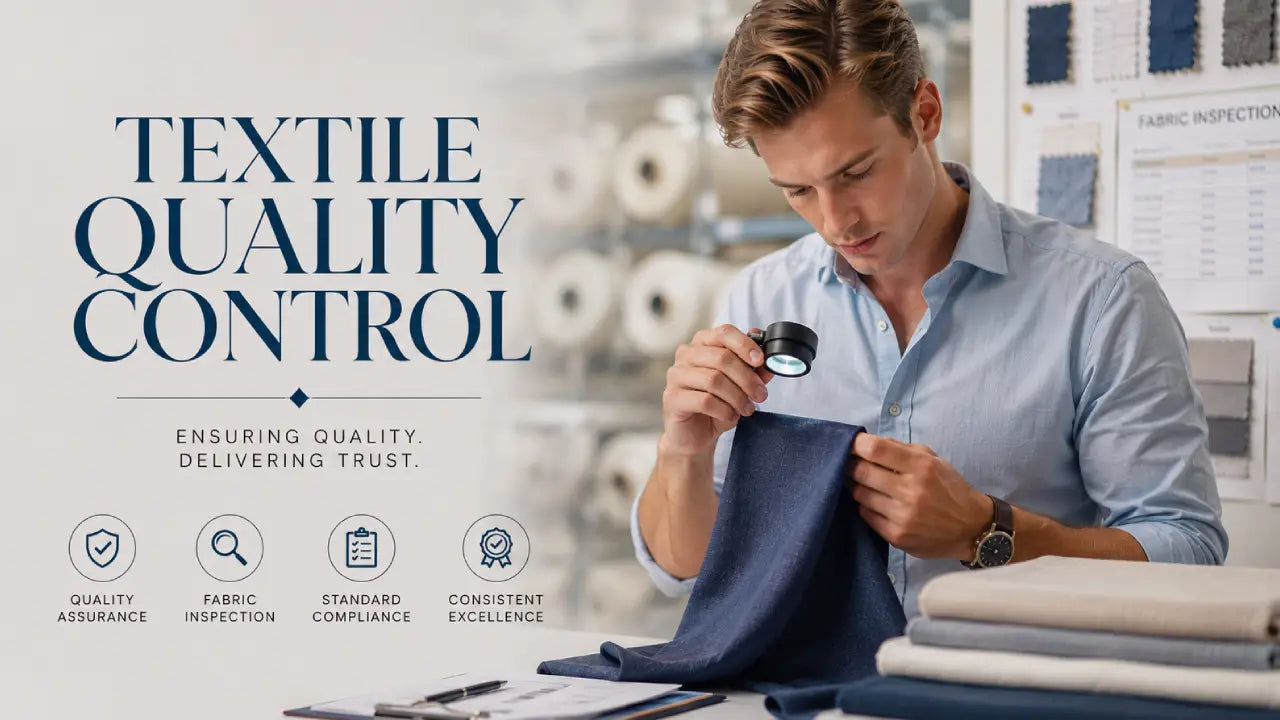
In the world of premium shawl sourcing, textile quality control is not a bureaucratic formality — it is the difference between a brand that earns loyalty and one that earns returns.
For shawl importers and retailers, the stakes are particularly high. Unlike basic apparel, luxury shawls carry an implicit promise — of extraordinary softness, impeccable finish, and enduring beauty. When a customer unwraps a Pashmina shawl or a hand-embroidered Kani piece, their first touch tells them everything. There is no margin for compromise.
Yet many importers and retailers — even experienced ones — operate without a structured textile QC process. They rely on supplier assurances, spot-check a handful of pieces per shipment, and hope for consistency. In the luxury segment, hope is not a quality strategy.
This comprehensive textile quality control checklist is built specifically for shawl importers and retailers who demand better. Whether you are sourcing Pashmina from Kashmir, embroidered wool stoles, or Zari-bordered silk shawls, this guide covers every critical inspection point — from raw fibre to final packaging.
At Elabore Luxury, textile quality control is not a final step. It is woven into every stage of how we work.
Why Textile Quality Control Is Non-Negotiable for Shawl Importers
The True Cost of Poor Quality
A single substandard shipment can trigger a cascade of consequences for shawl importers and retailers:
-
Customer complaints and costly returns
-
Damage to brand reputation in competitive retail markets
-
Loss of wholesale buyer confidence
-
Markdown pressure on inventory that fails to meet expectation
-
Potential legal liability under consumer protection regulations
Apparel quality standards in the premium segment are unforgiving. A shawl that pills after two wears, fades after one wash, or unravels at the fringe is not a minor inconvenience — it is a brand crisis in miniature.
Conversely, retailers who invest in rigorous fabric quality testing and structured garment inspection checklists consistently report higher sell-through rates, stronger customer retention, and more resilient supplier relationships.
Textile quality control is not a cost. It is a competitive advantage.
The Complete Textile Quality Control Checklist for Shawl Importers & Retailers
Stage 1 — Raw Material and Fibre Verification
Textile QC begins long before the loom. For luxury shawl production, the integrity of the raw fibre is the single most important quality variable. Inferior or misrepresented fibres cannot be corrected at any later stage of production.
Key checks at the raw material stage:
-
Fibre authentication — Verify that Pashmina fibres are genuine Changthangi Pashmina, not wool or synthetic blends. Authentic Pashmina fibres measure between 12–16 microns in diameter. Request laboratory fibre analysis certificates from your supplier.
-
Fibre origin documentation — For heritage textiles, provenance documentation matters. Confirm the region and source of raw fibre supply.
-
Colour fastness testing at fibre stage — Check that dye application to raw fibre meets minimum colour fastness standards before weaving begins.
-
Contamination inspection — Verify that raw fibres are free from vegetable matter, synthetic fibre contamination, or excessive short-fibre content that will cause pilling.
Elabore Luxury sources exclusively from verified Kashmiri fibre suppliers, with full traceability documentation available for our Original Pashmina Shawl range.
Stage 2 — Pre-Production Sample Inspection
Before a full production run begins, rigorous pre-production sample evaluation is the most effective quality intervention available to shawl importers. This is where apparel quality standards are set — and where deviations are cheapest to correct.
Pre-production sample checklist:
-
Dimensional accuracy — Does the sample match the specified dimensions (length, width, fringe length) exactly?
-
Weight per square metre — Does the fabric weight match agreed specifications? Lighter than specified usually means reduced fibre content.
-
Weave density — Count threads per centimetre in both warp and weft. Weave density directly impacts warmth, drape, and durability.
-
Colour matching — Compare sample colour against approved Pantone or physical colour reference. Assess under both natural and artificial lighting conditions.
-
Embroidery placement and execution — For embroidered shawls, verify motif placement, thread colour accuracy, stitch density, and reverse-side neatness.
-
Hand feel assessment — Does the sample match the agreed softness and drape standard? This is subjective but critical — establish a physical reference standard to compare against.
Insist on written, signed pre-production sample approval before any full production run is authorised. This document becomes your quality benchmark for the entire order.
Stage 3 — In-Process Textile Quality Control
Textile QC process discipline requires monitoring quality during production — not simply inspecting finished goods after the fact. In-process inspection catches deviations early, when correction is still feasible without scrapping entire production runs.
In-process inspection checkpoints:
-
Loom tension consistency — Uneven loom tension produces inconsistent weave density and dimensional variation across pieces. Check multiple units mid-production.
-
Colour consistency across the production run — Dye-lot variation is one of the most common quality failures in textile production. Sample pieces from different points in the production timeline and compare against the approved colour standard.
-
Embroidery progress audits — For hand-embroidered pieces, conduct mid-production audits of stitch quality, pattern adherence, and thread tension. Fatigue and inconsistency among artisans can affect embroidery quality across a long production run.
-
Fringe and selvage quality — Check that fringes are being knotted or twisted to a consistent standard and that selvage edges are clean and straight.
According to the International Textile Manufacturers Federation, in-process quality monitoring reduces final rejection rates by up to 60% compared to end-of-line inspection alone — making it one of the highest-return investments in any textile QC process.
Stage 4 — Fabric Quality Testing
Fabric quality testing for shawls should encompass both physical and chemical performance properties. Premium shawls are expected to perform beautifully not just on first wear but across seasons of use — and only rigorous testing can verify this.
Essential fabric quality tests for shawls:
Physical Performance Tests:
-
Pilling resistance — Test using the Martindale or ICI pilling method. For Pashmina and fine wool, a minimum Grade 3 result is acceptable; Grade 4–5 is preferred for premium retail.
-
Tensile strength and tear resistance — Particularly important for lightweight Pashmina weaves and fine silk blends.
-
Dimensional stability after washing — Test shrinkage or distortion after hand-washing or dry-cleaning per care label instructions.
-
Abrasion resistance — Relevant for shawls with fringe or embellishment that will experience handling friction.
Colour Fastness Tests:
-
Colour fastness to washing — ISO 105-C06 standard minimum Grade 4
-
Colour fastness to rubbing (dry and wet) — ISO 105-X12 standard minimum Grade 3–4
-
Colour fastness to light — ISO 105-B02 standard — particularly important for naturally dyed textiles
Chemical Safety Tests:
-
Azo dye screening — Verify absence of prohibited azo dyes under EU REACH regulations
-
Formaldehyde content — Test against applicable market standards (EU, Japan, US regulations vary)
-
pH testing — Fabric pH should fall within the skin-safe range of 4.5–7.5
Explore the apparel quality standards built into every piece in Elabore Luxury's Embroidered Shawl Collection and Kani Shawl range.
Stage 5 — Final Garment Inspection Checklist
The pre-shipment garment inspection checklist is the last line of defence before goods leave the supplier. For shawl importers, this inspection should be conducted on a statistically valid sample of each shipment — typically using the AQL (Acceptable Quality Level) sampling methodology.
Final garment inspection checklist for shawls:
Construction and Finish:
-
Dimensions match specification within agreed tolerance (typically ±2%)
-
Fabric weight within ±5% of specification
-
Weave is even, consistent, and free from dropped threads, holes, or pulls
-
Selvage edges are clean, straight, and free from fraying
-
Fringe is even in length, consistently knotted or twisted, and securely finished
-
No loose threads on face or reverse side of fabric
Embellishment and Embroidery:
-
Embroidery motifs are correctly placed per specification
-
Thread colours match approved reference standard
-
Stitch density is even throughout — no thin or sparse areas
-
No colour bleeding from embroidery threads onto base fabric
-
Reverse side of embroidery is neat with no excessive thread tails
-
Zari or metallic threads are securely integrated — no snagging or separation
Colour and Visual Standards:
-
Colour matches approved standard under natural and artificial light
-
No shading variation within a single piece
-
dye spots, staining, or uneven dyeing
-
No water marks or press marks from finishing
Defect Classification:
-
Critical defects (zero tolerance) — holes, tears, severe colour mismatches, wrong fabric
-
Major defects (AQL 2.5) — significant embroidery errors, major dimension deviation, visible staining
-
Minor defects (AQL 4.0) — small loose threads, minor fringe length variation, slight colour shade variation
Stage 6 — Packaging and Labelling Quality Control
Textile quality control does not end when the shawl passes inspection. Packaging and labelling are integral parts of the premium retail experience — and failures here undermine the quality investment made in the product itself.
Packaging and labelling checklist:
-
Care label accuracy — Fibre content, country of origin, and washing instructions must comply with destination market regulations (EU, US, and other markets have specific mandatory requirements)
-
Fibre content labelling — For Pashmina products specifically, fibre content must be accurately declared. Mislabelling Pashmina blends as pure Pashmina is a regulatory violation in most major markets.
-
Packaging integrity — Shawls should be folded and wrapped to prevent creasing, crushing, or contamination during transit
-
Brand and retail labelling — Verify that all hang tags, brand labels, barcode stickers, and retail price tags are correctly applied and legible
-
Carton marking — Outer cartons should be clearly marked with content description, quantity, country of origin, and handling instructions
Elabore Luxury's Wholesale Programme includes full packaging and labelling customisation for retail and B2B partners — ensuring your brand standards are upheld from production through to the retail floor.
Stage 7 — Post-Receipt Inspection at Destination
Even the most rigorous pre-shipment textile QC process cannot eliminate all transit risk. A structured post-receipt inspection protocol ensures that any transit damage or discrepancy is identified and documented promptly.
Destination inspection checklist:
-
Verify carton count against packing list on arrival
-
Inspect outer cartons for transit damage before opening
-
Conduct random unit inspection from multiple cartons — do not inspect only top-layer pieces
-
Compare received goods against pre-shipment inspection report
-
Document and photograph any discrepancies immediately
-
Notify supplier within the agreed claims window — typically 14–30 days from receipt
For shawl importers working with overseas suppliers, having a clear contractual framework for post-receipt claims is as important as the garment inspection checklist itself.
Explore the full quality range available to retail importers through Elabore Luxury's Women's Shawl Collections and Men's Stoles and Scarves.
Building a Long-Term Textile Quality Control Partnership
The most effective textile quality control is not a series of adversarial inspections — it is a collaborative partnership between importer and supplier, built on shared quality standards, transparent communication, and mutual commitment to excellence.
The best suppliers — those who are genuinely invested in their craft — welcome rigorous quality standards. They see fabric quality testing and structured garment inspection checklists as validation of their work, not criticism of it.
According to Vogue Business, luxury fashion brands that build deep, long-term sourcing relationships with their textile partners consistently achieve higher quality consistency and lower rejection rates than those who treat supplier relationships transactionally.
At Elabore Luxury, we actively invite our retail and wholesale partners to engage with our quality processes — from sampling through to final inspection — because we know that transparency builds the trust that sustains great partnerships.
Discover the quality craftsmanship embedded in every piece across our Kalamkari Shawl Collection and Zari Shawl range.
Conclusion: Your Quality Standards Define Your Brand
For shawl importers and retailers, textile quality control is ultimately a brand statement. Every inspection point in this checklist represents a commitment — to your customers, to your retail partners, and to the craft traditions that make premium shawls extraordinary.
The luxury consumer is perceptive. They feel the difference between genuine Pashmina and a clever imitation. They notice whether embroidery is precise or hurried. They know whether a shawl was made with pride or produced carelessly for margin.
A rigorous textile QC process — built around structured garment inspection checklists, thorough fabric quality testing, and clear apparel quality standards — is how importers and retailers consistently deliver on the promise that premium pricing demands.
Elabore Luxury is built on exactly these standards. Every shawl, stole, and scarf in our collection passes through a quality discipline that begins at the fibre and ends only when the product is ready to carry your brand's name with pride.
Frequently Asked Questions (FAQs)
What is textile quality control and why is it important for shawl importers?
Textile quality control is the systematic process of verifying that textile products meet defined quality standards across fibre, fabric, construction, and finish. For shawl importers, rigorous textile QC is critical to ensuring product consistency, protecting brand reputation, minimising returns, and meeting the regulatory labelling requirements of destination markets.
What should be included in a garment inspection checklist for shawls?
A comprehensive garment inspection checklist for shawls should cover dimensional accuracy, fabric weight, weave consistency, colour matching, embroidery quality, fringe finish, packaging integrity, and care labelling compliance. Defects should be classified as critical, major, or minor and evaluated against AQL (Acceptable Quality Level) sampling standards.
How do I verify that a Pashmina shawl is genuine?
Genuine Pashmina fibres measure 12–16 microns in diameter and can only be accurately verified through laboratory fibre diameter testing. Request fibre analysis certificates from your supplier. Burn testing and touch alone are insufficient for authentication. Fabric quality testing by an accredited laboratory is the most reliable method of Pashmina verification.
What fabric quality tests should shawl importers request from suppliers?
Essential fabric quality testing for shawls includes pilling resistance (Martindale or ICI method), colour fastness to washing and rubbing (ISO 105 standards), dimensional stability after washing, tensile strength, and chemical safety screening including azo dye testing and formaldehyde content — particularly for EU and US market compliance.
What are AQL standards and how do they apply to shawl inspection?
AQL — Acceptable Quality Level — is a statistical sampling methodology that defines the maximum acceptable defect rate in a shipment. For shawl importers applying apparel quality standards, AQL 2.5 is typically used for major defects and AQL 4.0 for minor defects. The AQL table determines how many units to inspect based on total shipment size.
How often should shawl importers conduct pre-shipment inspections?
Pre-shipment inspection should be conducted on every order as a baseline textile QC process discipline. For new suppliers or new product categories, additional in-process inspections are strongly recommended. Established suppliers with a proven track record may transition to periodic audits, but pre-shipment inspection should never be eliminated entirely.
What are the most common textile quality control failures in shawl imports?
The most frequent textile quality control failures in shawl imports include fibre content misrepresentation, colour inconsistency across dye lots, pilling caused by inferior fibre quality, embroidery defects including colour bleeding and irregular stitch density, dimensional variation, and care labelling non-compliance with destination market regulations.
What apparel quality standards apply to shawl imports in the EU and US markets?
EU apparel quality standards require compliance with REACH chemical regulations, accurate fibre content labelling under EU Regulation 1007/2011, and care labelling under EN ISO 3758. US requirements include FTC fibre content and care labelling rules. Both markets require azo dye screening and formaldehyde testing. Failure to comply can result in customs detention or market withdrawal.
Does Elabore Luxury provide quality documentation for wholesale shawl orders?
Yes. Elabore Luxury maintains rigorous textile quality control documentation across our production process and can provide fibre traceability records, quality inspection reports, and care labelling compliance documentation for wholesale and B2B partners. Visit our Wholesale Page to discuss your specific documentation requirements.
How can shawl retailers build better quality control partnerships with their suppliers?
The foundation of effective textile QC process partnerships is clear, written quality specifications agreed before production begins — covering fibre standards, dimensional tolerances, colour standards, embellishment requirements, and packaging specifications. Regular communication, pre-production sample approval, and in-process audits build the kind of supplier relationships that deliver consistent apparel quality standards across every shipment.