
Cart
0
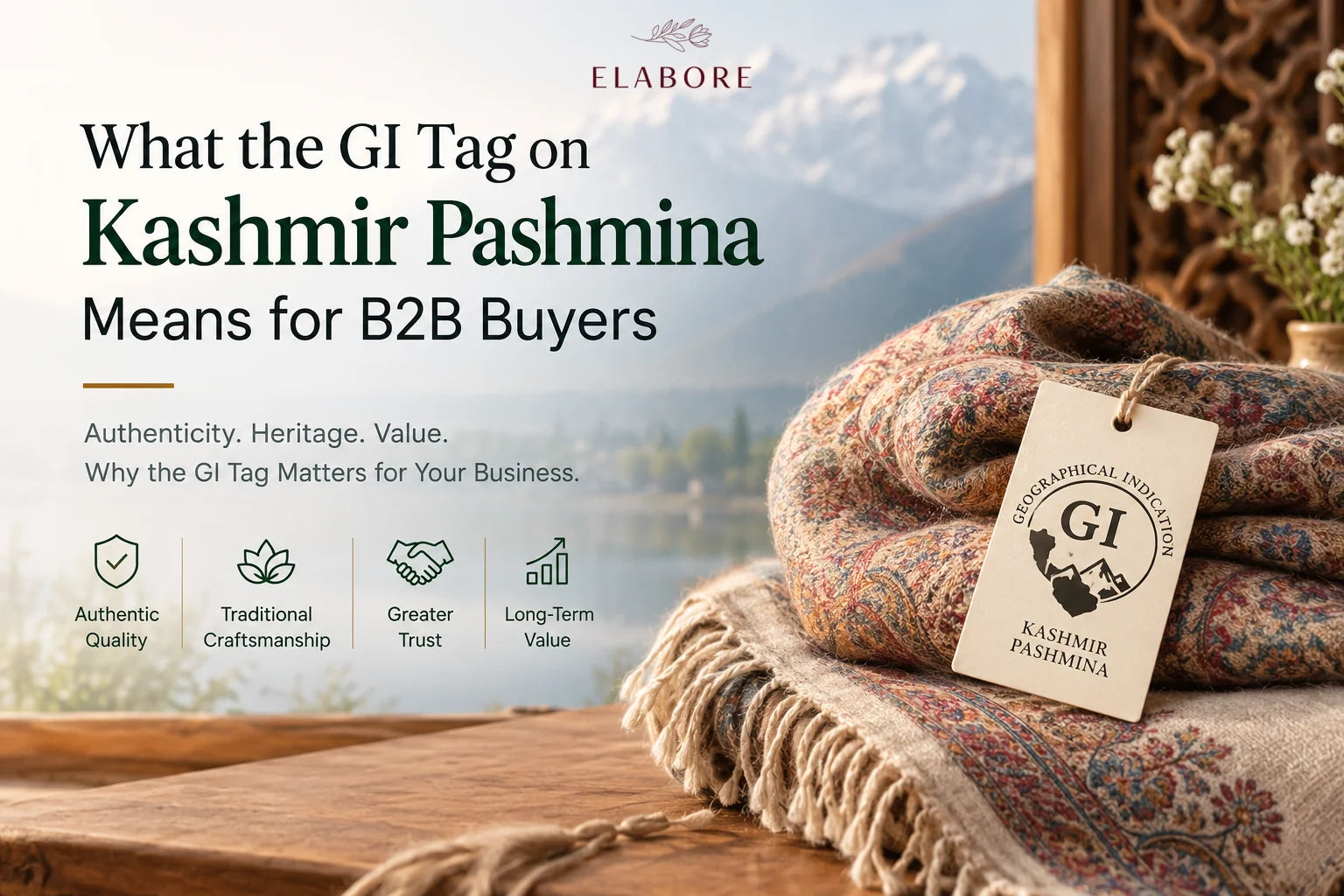
The GI tag on Kashmir pashmina is an official proof of origin and traditional making, applied after testing at a government centre in Srinagar. For B2B buyers it lowers fibre and origin risk and gives your own customers a label they can scan. It does not guarantee design, finish or on-time delivery, so verify the label on sample pieces and keep your usual quality checks.
What is the GI tag on Kashmir pashmina?
GI stands for Geographical Indication, a sign for products whose qualities come from a specific place. The GI tag on Kashmir pashmina works like a protected name: only shawls made in the right region by the right method may use it. The same system also covers other Kashmir crafts, including Kani Shawl, Sozni embroidery and hand-knotted carpets. kashmirlife
Sources disagree on the year the pashmina GI was granted, with both 2005 and 2008 appearing online. Check the official register before you quote a date in your own catalogue or website.
What the GI tag Kashmir pashmina certifies
A seller with authorised user status describes a GI-certified pashmina as made in Kashmir with traditional methods, handspun yarn and Changthangi goat fibre. Testing is done by the Pashmina Testing and Quality Certification Centre, which the J&K government set up at the Craft Development Institute in Srinagar to check whether products are genuine. Pashmina fibre is usually described as 12 to 16 microns, finer than generic cashmere. GI certified Pashmina Shawls +2
Certified pieces carry a QR based label. One seller says it is a break-to-remove tag that cannot be reapplied to another product. Officials say that scanning it lets a buyer verify authenticity, origin and quality, and trace the product to the artisan or institution that made it. kepratribuneindia
How the GI tag Kashmir pashmina is issued
In outline, products are tested at the centre, and the ones that pass receive the QR based label, which buyers can then scan. The scale is real. A news report quoted officials saying the centre had certified and labelled more than 16,000 genuine Kashmir pashmina products, and that demand for labelling rose by 1,100 per cent in 2022. That tells you the GI tag on Kashmir pashmina is now a mainstream request, not a niche one. kashmirlifekashmirlife
Because the label is applied per product, a supplier can sell GI-labelled and unlabelled shawls side by side. That is why your order sheet should say which is which.
Why the GI tag Kashmir pashmina matters to B2B buyers
Lower fibre risk. Fake and blended pashmina is the biggest risk in this category. A GI tag on Kashmir pashmina gives you a stronger basis than a seller's word, because the piece was tested before it was labelled.
A story your customers can check. Retail buyers like proof they can scan. A labelled shawl lets your store back up the claim on the tag.
Better paperwork for export. Traders have complained that older testing methods led customs to flag pashmina consignments for banned Shahtoosh guard hair, in what they call false positives. Test records and labels give you evidence to show. Read our pashmina import duty and HS code guide before you quote a landed price. iasgyan
Fewer disputes. With a GI tag on Kashmir pashmina, if you and your buyer scan the same label, there is less room to argue about what was sold.
What the GI tag on Kashmir pashmina does not cover
The GI tag on Kashmir pashmina proves origin and method. It does not replace your normal checks.
- Design, colour and finish. A GI label does not stop a badly dyed or poorly finished shawl.
- Delivery and MOQ. Lead times and minimum quantities depend on the supplier.
- Your whole range. Not every shawl in a catalogue carries a label. Ask for each product, not for the supplier in general.
- The business behind it. GI applies to a product, not a company. Vet the supplier too, using our guide on how to vet a shawl manufacturer.
- Other fibres. Blends, wool and cashmere need their own proof. A GI tag does not apply to them.
A lab report and a GI label are also separate proofs. One Kashmir seller notes that a lab report is its own document and does not mark the shawl. For business buyers, the report can be the better fit when you want verification without any permanent tag. shahkaar
How to verify the GI tag Kashmir pashmina before you order
- Ask which pieces carry the label. Get the answer per design, in writing.
- Inspect the label. It should look factory-applied and tamper-resistant. A loose, re-stuck or photocopied label is a warning.
- Scan the QR code. Check that the details match the product in your hand.
- Use the official route if a scan fails. One seller advises contacting the Craft Development Institute in Srinagar or the J&K Handicrafts Department. kepra
- Scan pieces from the real lot, not only the sample.
- Record it. Photograph labels and scan results for every lot you buy.
- Add a lab report for anything unlabelled. Our guides on how to identify authentic pashmina and pashmina, cashmere and wool differences explain what to look for.
Common mistakes buyers make with the GI tag on Kashmir pashmina
- Treating the label as a quality guarantee. It proves origin and method, not finish or colour.
- Accepting photos instead of pieces. Ask for physical samples and scan them yourself.
- Not matching the label to the lot. A good sample means little if the bulk goods are unlabelled.
- Paying a premium for unlabelled goods. If the price assumes a GI label, the piece should carry one.
- Mixing up crafts. Pashmina and Kani are separate GI categories, so ask for each one.
GI tag Kashmir pashmina vs unlabelled pashmina
| GI-labelled Kashmir pashmina | Unlabelled pashmina | |
|---|---|---|
| Origin proof | Scannable QR label | Supplier's word and papers |
| Fibre proof | Tested before labelling | Needs your own lab report |
| Making method | Traditional, handspun, handwoven | Varies, ask directly |
| Cost | Usually higher | Varies widely |
| Best for | Premium retail, gifting, export | Cases where a lab report is enough |
What the GI tag on Kashmir pashmina means for pricing
Expect a GI-labelled shawl to cost more than an unlabelled one. Testing and traditional handwork both add cost, and you are paying for proof as well as fibre. Two rules help. First, never pay a GI tag Kashmir pashmina price for a piece that has no label. Second, do not assume the label justifies any price. Compare quotes for the same size, weight and weave, and use our bulk shawl buying guide to check MOQ and margin before you commit.
The GI tag and private label orders
If you plan to sell under your own brand, ask how your label and the GI label sit together on the product. Do not remove, copy or reuse a GI label, and ask your supplier and an IP adviser what is allowed in your target market. Our guides on private label shawls and custom logo shawls cover branding choices.
Where Elabore Luxury fits
Our wholesale page lists quality control on every piece and verified source certificates for premium fibres. If the GI tag on Kashmir pashmina matters for your market, tell us at the quotation stage which proof you need for each design, so it can be written into the proforma invoice. Browse original pashmina shawls, Kashmiri pashmina shawls and kani shawls, stoles and scarves, or read our pashmina wholesale guide and Kashmiri shawls wholesale guide.
FAQs about the GI tag on Kashmir pashmina
What is the GI tag on Kashmir pashmina?
It is a geographical indication label showing a pashmina shawl was made in Kashmir by the approved method and passed official testing. It carries a QR code buyers can scan.
Is every Kashmir pashmina shawl GI certified?
No. A shawl carries the label only after it is tested, so ask for proof piece by piece.
How can I verify a GI pashmina shawl?
Scan the QR code, match the details to the product and, if the scan fails, contact the Craft Development Institute in Srinagar or the J&K Handicrafts Department.
Does the GI tag cover Kani shawls?
Kani Shawl has its own GI certification, listed alongside Kashmir Pashmina among the crafts with GI coverage. kashmirlife
Does a GI label replace a lab report?
No. They are separate proofs. Many B2B buyers ask for both.
The bottom line
The GI tag on Kashmir pashmina is a strong signal of origin, method and testing, and it gives your customers something to scan. It is not a full quality guarantee. Use it with samples, a lab report where needed and written terms. When you are ready to compare, request a quotation or use the wholesale lead form.