Cart
0
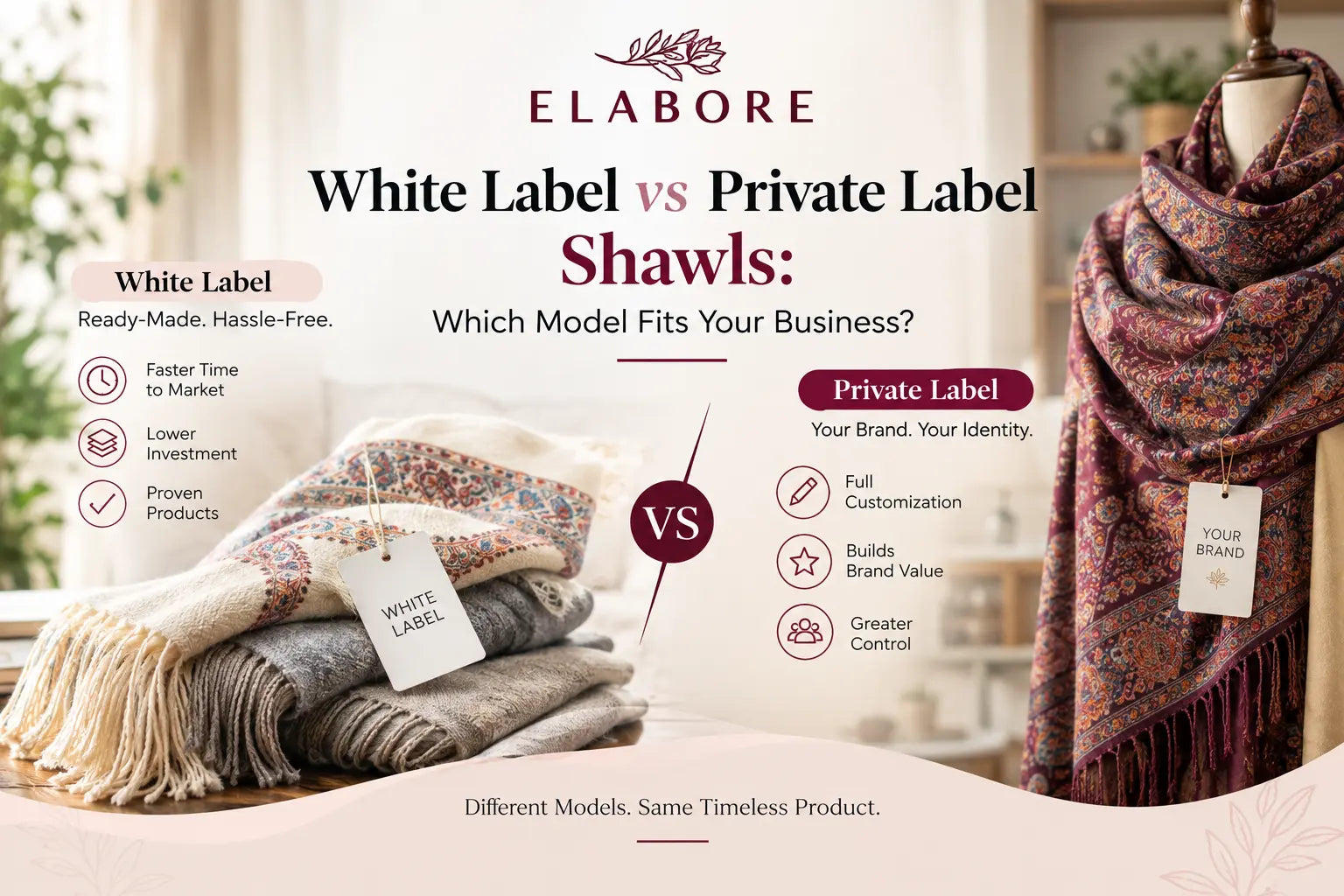
In white label vs private label shawls, white label means you add your brand to ready-made shawls a supplier already produces, so you launch fast with low cost. Private label means the shawls are made to your design, colours and specifications, so you get exclusivity and a stronger brand but pay more and wait longer. Start white label to test demand, then move your best sellers to private label.
White label vs private label shawls: the short version
The two terms are used loosely, and some suppliers swap them, so always define the term in your contract. In common usage, the difference in white label vs private label shawls comes down to who owns the design and who else can sell it.
- White label shawls are finished or standard designs from a supplier's range. Several brands may sell the same shawl under different labels.
- Private label shawls are made for one brand. You decide the design, colourway, size, fibre and packaging, and the supplier does not sell that design to others.
Think of white label as choosing from a rack and private label as ordering a tailored piece.
What white label shawls are
With white label shawls, the supplier has already developed the design, sourced the fibre and set the price. You choose from the catalogue, add your logo or tag, and sell.
Where it works well:
- You want to launch quickly, often with a small first order.
- You are testing which styles your customers want.
- You have no design team and no time to build one.
- You want lower upfront cost and fewer decisions.
Where it hurts:
- A competitor can sell the same shawl under another name.
- Your range looks like everyone else's, which makes price the main way to compete.
- You depend on the supplier's catalogue, so a discontinued design can leave a gap.
What private label shawls are
With private label shawls, you take part in making the product. That may mean a custom pattern, an exclusive colour palette, a woven or embroidered logo, a new size or custom packaging. Our private label shawls guide covers the full process.
Where it works well:
- You want a signature look that customers connect to your brand.
- You plan to sell for years and want a defensible range.
- You can commit to larger quantities and longer lead times.
- You want better margins than a shared catalogue allows.
Where it hurts:
- Higher minimum quantities and a higher upfront spend.
- Longer timelines for design approval, sampling and production.
- More stock risk if a design does not sell.
White label vs private label shawls side by side
| Factor | White label shawls | Private label shawls |
|---|---|---|
| Design | Supplier's existing range | Your design or brief |
| Exclusivity | None, others may sell it | Should be exclusive to you, in writing |
| Upfront cost | Lower | Higher |
| Minimum order | Usually lower | Usually higher |
| Lead time | Shorter | Longer, includes sampling |
| Brand control | Label and packaging only | Design, colour, packaging and label |
| Margin potential | Moderate | Higher, once the line sells |
| Risk | Look-alike competition | Unsold stock |
| Best for | Testing and fast launches | Established brands and long-term ranges |
Why shawls are different from other apparel
Most guides on white label vs private label talk about t-shirts and swimwear. Shawls behave differently, and that changes the choice.
Fibre decides everything. Pashmina, cashmere, wool and blends differ in price and feel. Your label claims, such as "pashmina," must match the fibre. Read our shawl materials guide before you pick a base.
Handwork limits repeat orders. A hand embroidered or hand woven design takes time and may not repeat at the same speed. Private label shawls with handwork need earlier planning.
Colour is hard to match. Dye lots vary. A private label colourway needs an approved sample and a clear tolerance, or your second batch may look different from the first.
Authenticity matters to buyers. Customers pay extra for origin and proof. See our guide on the GI tag on Kashmir pashmina before you decide how to label premium pieces.
Seasons are short. Winter and wedding peaks leave little room for delays, so lead time matters more here than in year-round categories.
Which model fits your business?
Choose white label shawls if you are new, have a small budget, sell online first, or want to learn which designs sell before you invest. It also fits if you run a boutique that wants extra range without design work.
Choose private label shawls if you already know your customer, want a recognisable brand, sell through your own store or channel and can plan one season ahead. Our guide on building a luxury shawl brand explains how a signature range supports pricing.
Use a hybrid if you are in between. Many brands start with white label shawls, then request small changes such as a new colourway, a custom border or a woven label. That step is called semi-custom, and it costs less than a full private label build.
A simple path from white label to private label
- Test. Order a small lot of white label shawls from one supplier.
- Track. Note which designs sell, which come back and which customers reorder.
- Tweak. Ask for a custom colour, logo or packaging on your top sellers.
- Lock in. Move proven designs to private label with a written exclusivity clause.
- Scale. Add more designs once the first private label shawls sell steadily.
Our bulk shawl buying guide explains MOQ and pricing at each stage, and shawl business profit margins helps you set retail prices.
Mistakes to avoid
- No written exclusivity. If private label shawls are not exclusive on paper, you do not own the advantage.
- Unclear design ownership. Decide who owns the pattern and who may reuse it.
- Skipping samples. Approve a physical sample before bulk production begins.
- Overstating the fibre. Never print "pashmina" or "cashmere" without proof.
- Starting with a huge order. Begin small, whichever model you choose.
- Choosing the wrong partner. Check the supplier first, using our guide on how to vet a shawl manufacturer.
Questions to ask a supplier before you choose
- Which designs can I sell as white label shawls, and who else sells them?
- What is the MOQ for private label shawls, per design and per colour?
- Will you put exclusivity in writing, and for how long?
- How long do sampling and production take for custom work?
- Who owns the design and the pattern files?
- What happens if the bulk lot does not match the approved sample?
How the supplier answers tells you how they will behave once you are a customer. If you want to understand who you are really talking to, read shawl manufacturer vs supplier and our post on OEM manufacturers.
How Elabore Luxury supports both models
Our wholesale page lays out both routes. For white label style orders, you can start from a 25 unit starter tier, and samples ship within 48 hours. For private label shawls, we offer custom designs with our design team, brand integration with your logo, unique colourways and packaging customization. Custom and private label orders usually take 25 to 35 business days, against 15 to 21 for standard orders. We also produce to your brief, including patches, hand or machine embroidery and custom shapes.
Read more in our guides to custom logo shawls and pashmina shawls wholesale. To see the base range, browse the wholesale order collection and original pashmina shawls.
FAQs about white label vs private label shawls
What is the main difference in white label vs private label shawls?
White label shawls are standard designs that several brands can sell under their own labels. Private label shawls are made to your specifications and sold only by you.
Which is cheaper, white label or private label shawls?
White label is usually cheaper to start because the design already exists and minimums are lower. Private label costs more upfront but can give better margins over time.
Can I switch from white label to private label shawls later?
Yes. Many brands start with white label shawls, learn which styles sell and then move those styles to private label.
Do private label shawls need a higher MOQ?
Often yes, since custom production needs setup time. Ask each supplier for the MOQ per design and per colour.
Can I dropship white label shawls?
Some suppliers allow it. Read our guide on dropshipping shawls wholesale to see whether it suits your store.
The bottom line
The right answer in white label vs private label shawls depends on your stage. Use white label shawls to test the market with little risk, and use private label shawls to build a brand once you know what sells. Put exclusivity, design ownership and sample approval in writing either way. To talk about your range, request a quotation or fill in the wholesale lead form.