Cart
0
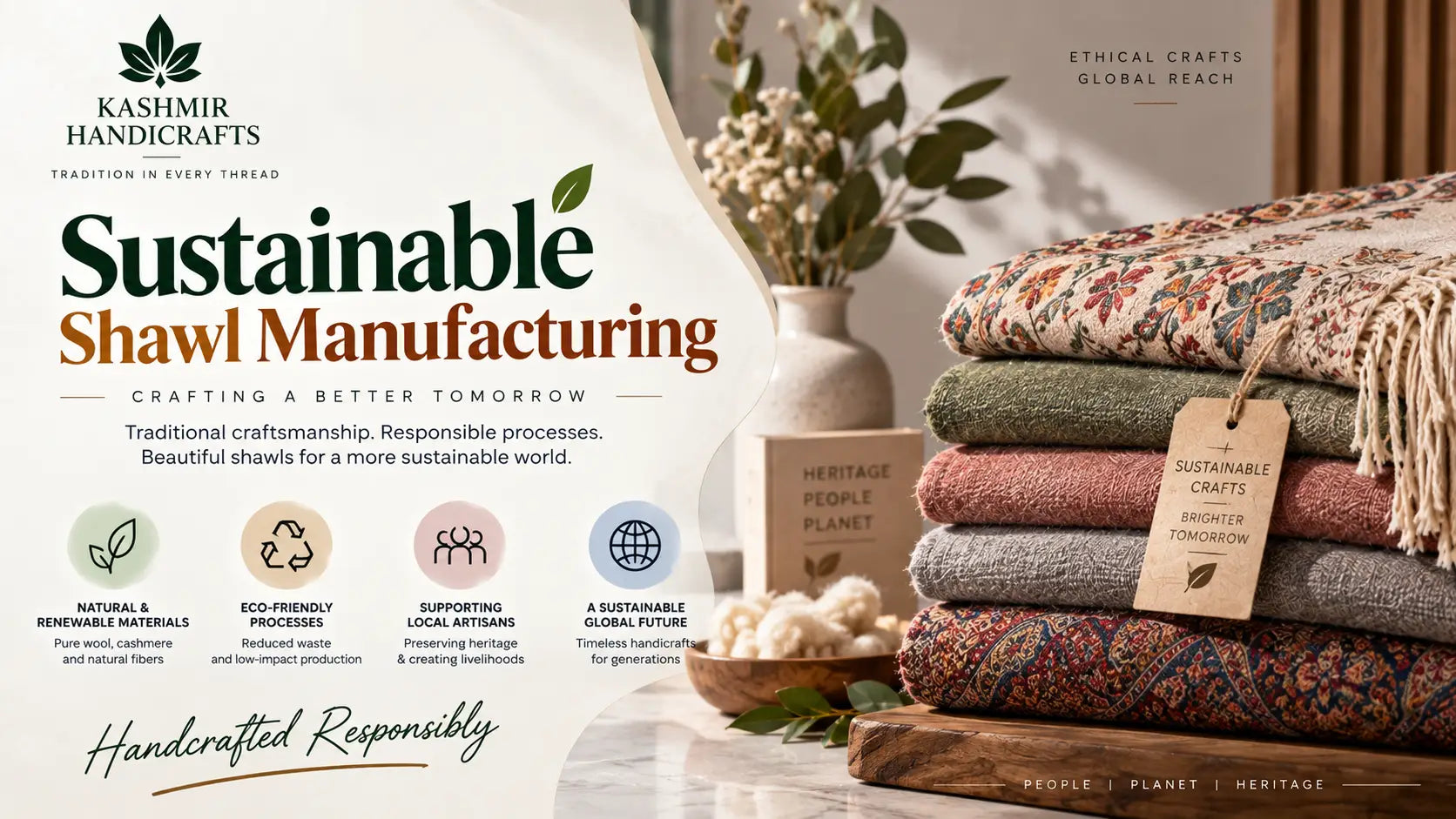
Sustainable shawl manufacturing covers three connected areas — ethical wool sourcing and animal welfare, low-impact dyeing and finishing, and fair wages for the artisans who hand-spin and weave the fabric — and increasingly, B2B buyers are expected to verify all three with documentation, not just a supplier's word. What used to be a marketing angle for D2C brands has become a genuine sourcing checklist item for retailers and importers, particularly those selling into the EU, where sustainability disclosure requirements are tightening.
If you're evaluating suppliers and "sustainable" or "ethical" keeps showing up in their pitch, this guide breaks down what that claim should actually be backed by.
Why Sustainability Has Moved from Marketing to Procurement
For years, sustainability claims in the shawl and textile trade lived almost entirely in retail marketing copy — "eco-friendly," "ethically made," "cruelty-free wool" — with little standardization behind the terms. That's shifting. Retail buyers, particularly in Europe, increasingly ask for supply chain documentation before placing orders, and international certification bodies have built specific standards for exactly this purpose. Understanding these standards is now as relevant to sourcing decisions as fiber content or MOQ.
The Three Pillars of Sustainable Shawl Manufacturing
1. Ethical wool and fiber sourcing
The most relevant certification here is the Responsible Wool Standard (RWS), developed by Textile Exchange. RWS is a voluntary, internationally recognized standard covering the full wool supply chain — from farm to finished product — addressing animal welfare, land management, and traceability. It requires farms to meet the "Five Freedoms" of animal welfare, including access to food and water and protection from pain and stress, explicitly bans mulesing, and mandates measures to protect soil quality and biodiversity on grazing land. Crucially, RWS certifies the raw material stage only — it says nothing about how the fiber is later dyed or finished, which is why it's usually one part of a sustainability claim, not the whole picture.
For pashmina specifically, ethical sourcing questions center on how the Changthangi goats are reared and combed by Changpa nomads in Ladakh — a topic we cover in depth in our guide to pashmina raw material suppliers. Traditional hand-combing rather than shearing is itself a lower-stress harvesting method, which is worth understanding as part of the ethical sourcing conversation.
2. Low-impact dyeing and finishing
This is where OEKO-TEX certifications come in, though it's important to know what they actually cover. OEKO-TEX STANDARD 100 tests the finished fabric for harmful substances — it doesn't certify the farming or production process, only that the end product falls within defined chemical safety limits. It's a useful, widely recognized signal, but on its own it says nothing about dyeing wastewater management or farm-level practices.
Traditional vegetable and organic dyes, long used in Kashmiri shawl-making, are a genuine sustainability advantage over synthetic dye processes, though they add cost and time — a trade-off we discuss in our shawl manufacturing cost breakdown.
3. Fair wages and working conditions for artisans
The Global Organic Textile Standard (GOTS) is the most comprehensive of the major certifications — it covers the entire post-harvest supply chain from ginning through spinning, weaving, dyeing, finishing, and labeling, and it includes social criteria alongside ecological ones, promoting fair labor practices in addition to pesticide-free, organic fiber standards. GOTS is more commonly associated with cotton, but its social-compliance framework is a useful reference point when evaluating any labor-intensive handcraft supply chain, including Kashmiri shawl weaving, where fair artisan compensation is central to the sector's long-term sustainability.
Certifications Compared: What Each One Actually Covers
| Certification | What It Certifies | What It Doesn't Cover |
|---|---|---|
| Responsible Wool Standard (RWS) | Animal welfare, land management, traceability at the farm level | Dyeing, finishing, labor conditions downstream |
| OEKO-TEX Standard 100 | Finished fabric free of harmful substances | Farming practices, wastewater, artisan wages |
| GOTS | Full supply chain — organic fiber content, ecological and social criteria | Wool specifically (more common in cotton); requires ≥70% certified organic fiber |
The practical takeaway for B2B buyers: no single certification tells the whole sustainability story. A supplier holding one certificate isn't necessarily covering the full picture, and it's worth asking specifically which stage of production each certification they mention actually applies to.
What to Ask a Supplier Claiming "Sustainable" Production
- Which certification, specifically? "Sustainable" or "eco-friendly" without a named standard (RWS, OEKO-TEX, GOTS, or an equivalent) is a marketing claim, not a verified one.
- What stage of production does it cover? Raw material, finished fabric, or full supply chain — each answers a different question.
- How are artisans compensated? For handwoven Kashmiri shawls specifically, this is arguably the most important and least standardized sustainability question, since much of the value chain runs through informal, home-based, or cooperative artisan work rather than factory employment.
- Are dyes natural/vegetable-based or synthetic? This affects both the sustainability story and the finished product's price point, as covered in our guide to shawl materials.
- Can they provide documentation, not just a verbal claim? Certificates, audit reports, or third-party verification should be available on request from a manufacturer genuinely operating to these standards.
Why This Matters Commercially, Not Just Ethically
Sustainability credentials increasingly affect market access, not just brand image. EU buyers in particular are operating under growing disclosure expectations around supply chain sustainability, and retailers who can document ethical sourcing have an easier time meeting those requirements than suppliers who can only offer assurances. This is becoming a real differentiator among Indian shawl manufacturers competing for export contracts, and it connects directly to the kind of authenticity verification we cover in our guide to identifying authentic pashmina shawls — genuine, traceable production and sustainable production tend to go hand in hand.
Frequently Asked Questions
What certification should I look for when sourcing "ethical wool" shawls?
The Responsible Wool Standard (RWS) is the most relevant certification for wool sourcing specifically, covering animal welfare and land management at the farm level. It should be paired with a finished-product safety certification like OEKO-TEX for a fuller picture.
Does OEKO-TEX certify that a shawl was made sustainably?
Not entirely. OEKO-TEX Standard 100 certifies that the finished fabric is free of harmful substances — it doesn't cover farming practices, dyeing wastewater management, or labor conditions.
Is GOTS relevant to wool and pashmina shawls?
GOTS is more commonly applied to organic cotton, requiring at least 70% certified organic fiber content, but its social and ecological compliance framework across the full supply chain is a useful reference point even for wool-based handcraft production.
How do I verify fair wages for artisans in a handwoven shawl supply chain?
This is harder to certify formally than fiber or chemical standards, since much of Kashmiri shawl production runs through cooperatives and home-based artisan work. Ask suppliers directly about wage structures and cooperative involvement, and treat vague answers as a red flag.
Final Word
Sustainable shawl manufacturing isn't a single certificate you can check off — it's a combination of ethical fiber sourcing, low-impact dyeing, and fair compensation for the artisans doing the hand-spinning and weaving. As EU and global buyers push for more documented supply chains, suppliers who can back their sustainability claims with named standards — not just the word "eco-friendly" — are the ones worth prioritizing for long-term private label and bulk partnerships.