Cart
0
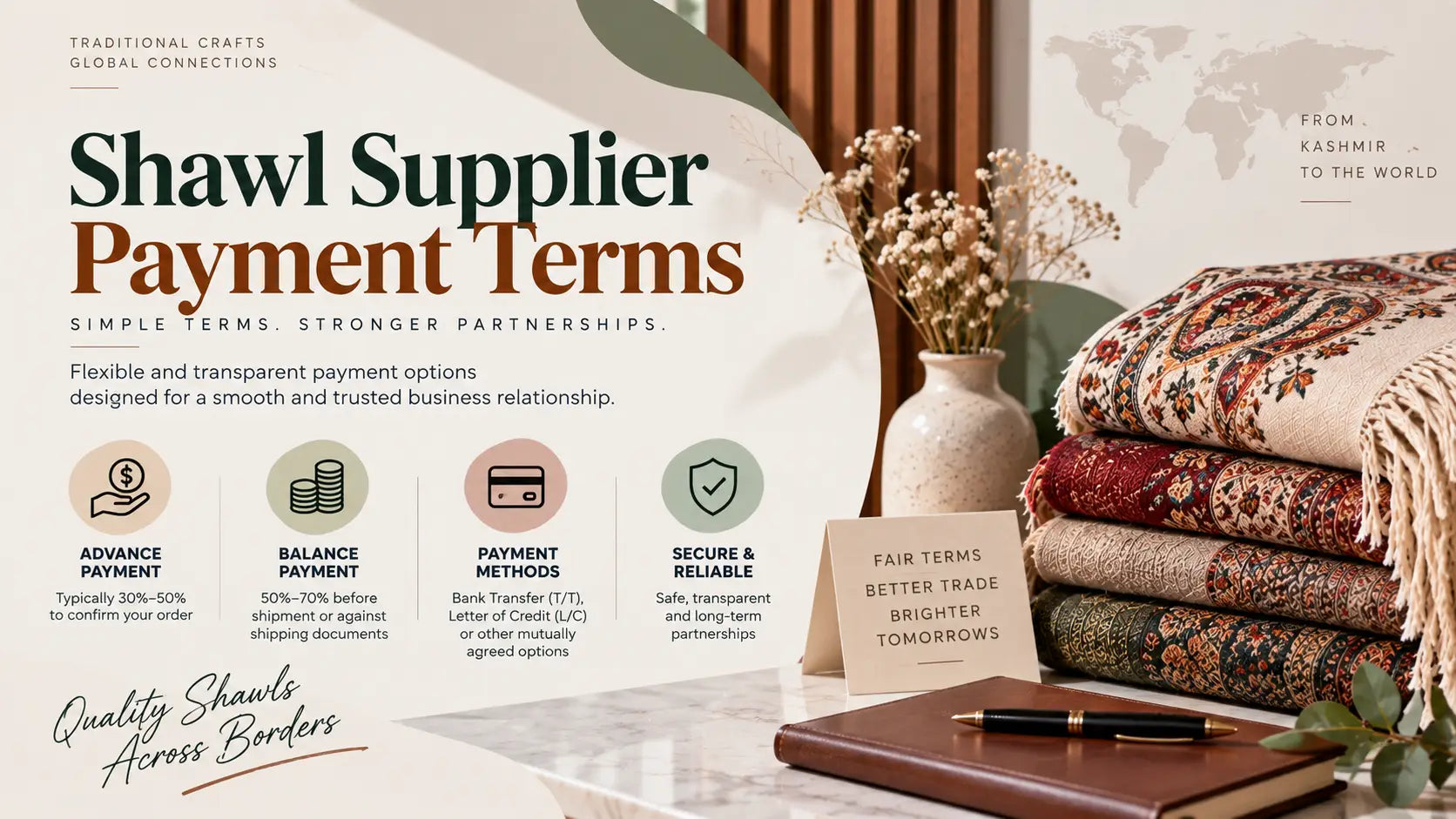
Payment terms with a shawl supplier typically fall along a risk spectrum - cash in advance or T/T (telegraphic transfer) at one end, which is safest for the exporter, through Letters of Credit and documentary collection in the middle, to open account terms at the other end, which is safest for the importer. Choosing the right method isn't just about cash flow; it's about how much risk you're willing to carry before you've verified a new supplier, and it's one of the most overlooked parts of shawl sourcing until something goes wrong.
If you're placing your first bulk order with a Kashmiri or Indian shawl manufacturer, understanding this spectrum — and where a new relationship should realistically sit on it — protects both your working capital and your supply chain.
The Payment Risk Ladder
International trade payment methods exist on a spectrum between two extremes: full advance payment, which places virtually all the risk on the buyer, and open account terms, where goods ship before payment and the exporter carries the risk. Between these sit several intermediate options that split the risk more evenly.
1. Advance payment / T/T before shipment
The importer pays some or all of the invoice value before the shawls are produced or shipped. This is the most common request from suppliers dealing with a new, unverified buyer, and it's low-documentation and fast — but it leaves the importer exposed if the shipment is delayed, doesn't match the sample, or never arrives. This is precisely why factory verification matters so much before wiring funds, a step we cover in our guide to working with a shawl sourcing agent.
2. T/T after shipment
Payment is made once goods have shipped, sometimes against a copy of the bill of lading. This shifts more risk onto the supplier and is generally reserved for trusted, repeat relationships rather than a first order.
3. Letter of Credit (LC)
An LC is a bank-issued guarantee of payment to the exporter, contingent on the exporter presenting a specific set of documents — invoice, packing list, certificate of origin, and often a quality or pre-shipment inspection certificate — that prove the shipment meets the agreed terms. Because a bank sits between both parties, LCs reduce risk for both sides: the buyer only pays once compliant documents are presented, and the seller has a bank-backed payment guarantee rather than relying purely on the buyer's word. LCs come in several forms:
- Irrevocable LC — cannot be changed or cancelled without both parties' consent, the standard baseline for serious trade.
- Confirmed LC — a second bank (often in the exporter's country) adds its own guarantee, useful when the buyer's bank or country carries added risk.
- Sight LC — payment is released as soon as compliant documents are presented.
- Usance (acceptance/time) LC — payment is deferred to an agreed future date, effectively extending credit to the buyer.
LCs add cost and paperwork, but they're the standard choice once order values get large enough that neither party wants to carry the full risk alone.
4. Documentary collection (DP/DA)
Under Documents against Payment (DP), the buyer's bank releases shipping documents — and therefore control of the goods — only once payment is made. Under Documents against Acceptance (DA), documents are released once the buyer formally agrees to pay at a future date. These sit in the middle of the risk spectrum: cheaper and simpler than an LC, but without a full bank payment guarantee behind them.
5. Open account
The supplier ships the goods and invoices the buyer, typically with 30/60/90-day payment terms. This is the cheapest and most convenient method for the buyer, but it puts full risk on the supplier — which means it's realistically only offered once a relationship is well established, not on a first bulk order.
Which Terms Make Sense at Each Stage of a Supplier Relationship
| Relationship Stage | Typical Payment Terms | Why |
|---|---|---|
| First trial order, unverified supplier | Partial advance (30–50%) + balance on shipment, or LC | Limits exposure while production and quality are unproven |
| First bulk order after successful trial | LC (sight) or T/T with documentation checks | Balances risk once samples and a small order have gone well |
| Established, repeat supplier | T/T after shipment or open account | Trust built through order history reduces need for bank-backed guarantees |
| High-value or first-time large order | Confirmed, irrevocable LC | Adds a second bank's guarantee for extra security on large sums |
This progression matters especially when you're scaling from a trial order into serious bulk shawl buying — jumping straight to open account terms with a supplier you've never ordered from before is one of the more common ways importers get burned.
Documents to Request Regardless of Payment Method
Whatever payment structure you agree on, request documentation that lets you verify what you're actually paying for:
- Commercial invoice and packing list — standard, but check they match your purchase order exactly, including fiber content and quantities.
- Certificate of origin — relevant for duty calculations and compliance, tied to the broader question of pashmina shawl import duty.
- Pre-shipment inspection or quality certificate — especially important on a first order, and closely tied to the checks covered in textile quality control.
- Bill of lading — proof the goods have actually shipped, referenced in T/T-after-shipment and documentary collection terms.
Reducing Risk Without an LC on Every Order
LCs aren't always practical for smaller or recurring orders given the paperwork and bank fees involved. A few alternative risk-reduction approaches worth knowing:
- Split payments — a deposit on order confirmation, a second payment after pre-shipment inspection, and a final balance on shipment or delivery.
- Trade credit insurance — coverage such as India's ECGC (Export Credit Guarantee Corporation) protects exporters against buyer non-payment, which can also make suppliers more willing to offer easier terms to importers, since their own risk is covered.
- Third-party inspection before final payment — paying the last installment only after an independent inspection confirms the shipment matches the agreed specification.
Frequently Asked Questions
What payment terms should I expect on a first order with a new shawl supplier?
Most new suppliers will ask for partial or full advance payment, or propose a Letter of Credit for larger orders. Full open account terms on a first order are unusual and worth treating cautiously if offered.
Is a Letter of Credit worth the extra cost for a shawl order?
For higher-value bulk orders or a first-time relationship with an overseas Indian shawl manufacturer, yes — the bank-backed guarantee and document verification process reduce risk meaningfully compared to advance T/T alone.
What's the difference between DP and DA in documentary collection?
Under Documents against Payment (DP), the buyer's bank releases shipping documents only once payment is made. Under Documents against Acceptance (DA), documents are released once the buyer agrees to pay at a later date — meaning the exporter extends credit without a full bank guarantee.
Can I negotiate payment terms with a shawl exporter?
Yes, payment terms are a standard part of purchase order negotiation. Terms typically evolve as trust builds — starting more advance-heavy on a first order and shifting toward post-shipment or open account terms with a proven, repeat supplier.
Final Word
Payment terms are as much a part of vetting a shawl supplier as factory audits and sample checks — the safest method changes depending on how established the relationship is, not just on what a supplier initially requests. Pairing the right payment structure with proper documentation and quality verification is one of the clearest ways to protect a growing shawl export business partnership from costly surprises.