Cart
0
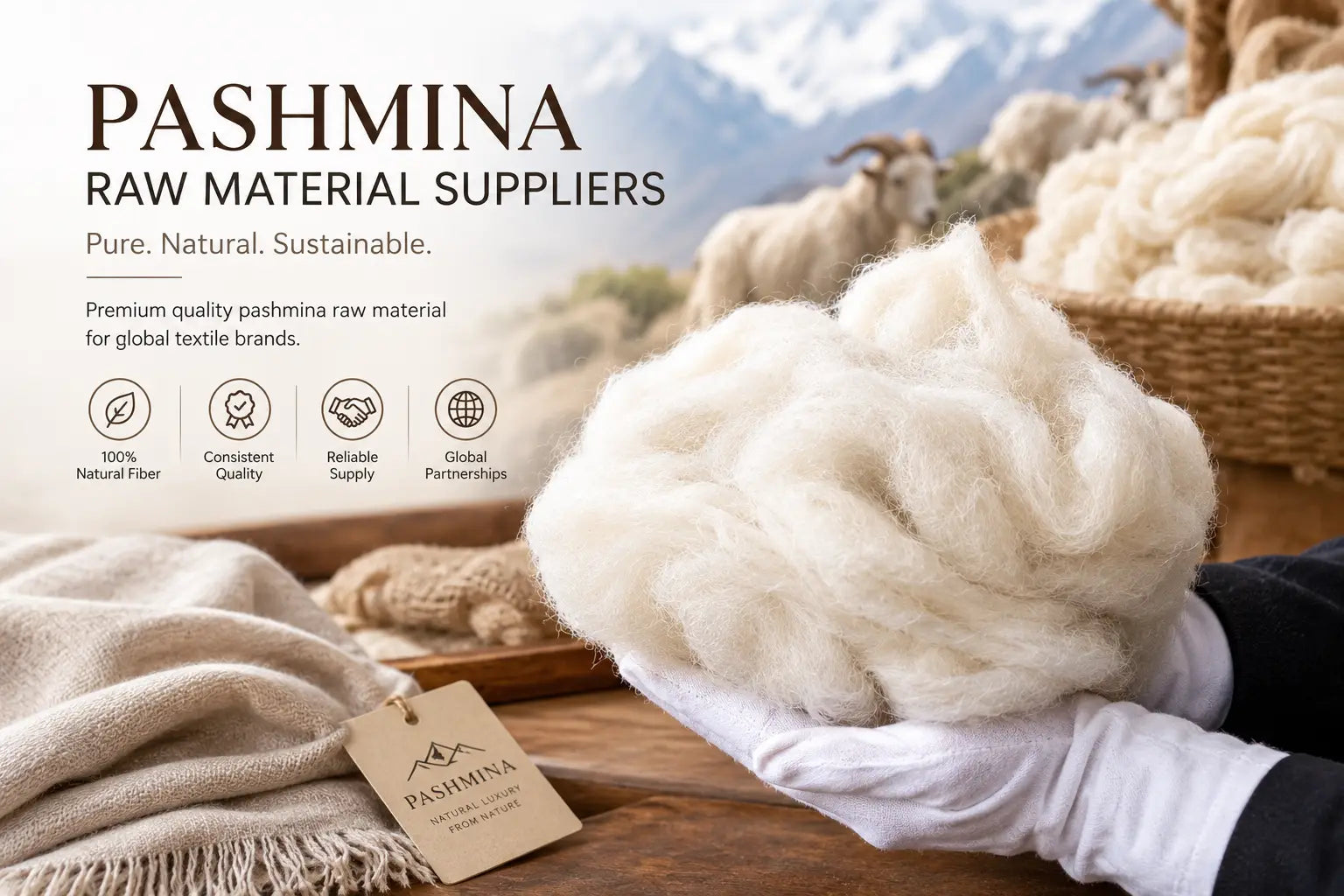
Raw pashmina material comes almost entirely from the Changthangi goat, reared by Changpa nomads on the high-altitude Changthang plateau in Ladakh, before the combed fiber travels to Kashmir for cleaning, spinning, and weaving into finished shawls. For B2B buyers, understanding this supply chain matters because it explains both why genuine pashmina is expensive and scarce, and why so much of what's sold as "pashmina" in the market is quietly cut with sheep wool or merino to stretch supply.
If you're building a premium shawl brand or evaluating manufacturers, knowing where the raw material actually originates — and how to verify it — is one of the most useful things you can learn before placing a bulk order.
The Real Supply Chain: From Ladakh's Highlands to Kashmir's Looms
Pashmina, from the Persian word pashm meaning wool, begins its life nowhere near a factory. It comes from the fine undercoat of the Changthangi goat (also called the Changra or Ladakh Pashmina goat), which survives brutal winters at altitudes of 3,000–6,000 meters on the Changthang plateau. The extreme cold is precisely what causes the goat to grow the ultra-fine, insulating undercoat that becomes pashmina fiber — a coat with a diameter of roughly 12 to 16 microns, among the finest natural fibers in the world.
Harvesting. Each spring, as the goats naturally shed their winter coat, Changpa herders comb the undercoat by hand rather than shearing it, a slower process that avoids harming the animals. A single goat yields only around 200–300 grams of usable raw pashmina per year, which is the core reason genuine pashmina remains a limited-supply material no matter how much demand grows.
Aggregation. Historically, private middlemen bought raw pashm from herders at rates that often shortchanged them. In parts of Ladakh, this has shifted toward cooperative models — the All Changthang Pashmina Growers Cooperative Marketing Society in Leh, for instance, buys raw pashmina directly from pastoralists at a fixed rate specifically to cut out exploitative middlemen. Pricing for raw, uncleaned pashm has historically moved in the range of a few thousand rupees per kilogram, though it fluctuates with demand and yield each season.
Transport to Kashmir. The raw fiber arrives in Kashmir in a genuinely unglamorous state — greasy, mixed with dirt, vegetable matter, and coarse guard hair from the goat's outer coat. It's cleaned and hand-sorted, typically by women in Kashmiri households and cooperatives, who separate the fine undercoat from coarser hair before it's hand-spun into yarn.
Spinning and weaving. Only after this cleaning and hand-spinning stage does the material become the yarn that Kashmiri artisans weave into the handcrafted pashmina shawls sold under that name globally. This is also why the finished product's authenticity is inseparable from its raw material origin — a shawl can only be genuine pashmina if this entire chain, starting with Changthangi fiber, was followed.
Why "Sourcing Raw Material Directly" Isn't Realistic for Most Brands
Buyers occasionally ask whether they can source raw pashmina fiber directly from Ladakh cooperatives and bypass Kashmiri weavers entirely. In practice, this rarely makes commercial sense for a shawl brand:
- Volume is tiny. Ladakh's total annual raw pashmina output is estimated at around 30,000–35,000 kg, harvested from roughly 150,000 goats across the entire region — a volume that barely supports Kashmir's existing weaving industry, let alone a parallel supply chain.
- The cleaning, spinning, and weaving expertise sits in Kashmir, not Ladakh. Raw pashm on its own isn't a usable product; it needs generations of hand-spinning and weaving skill that's concentrated among Kashmiri artisans.
- Cost and logistics rarely justify it. Unless you're operating your own weaving unit, buying raw fiber only adds a layer of processing you'd have to manage yourself.
For nearly all brands and retailers, the realistic path is sourcing finished or semi-finished shawls from established Indian shawl manufacturers who already control this raw-material relationship — not attempting to source Changthangi wool independently.
The Bigger Risk: Adulteration, Not Availability
Because genuine pashm is scarce and expensive, adulteration with sheep wool or ultra-fine merino is a well-documented issue in the market. This is less a raw material sourcing problem than a verification problem — buyers need to confirm what they're actually receiving, since visually and even texturally, blended shawls can be difficult to distinguish from pure pashmina without testing.
In response, India's Bureau of Indian Standards published a formal standard in 2019 for the identification, marking, and labelling of pashmina products specifically to help certify purity. When evaluating a pashmina exporter or wholesale supplier, ask directly whether their products are tested and labeled against this standard, and request documentation rather than taking a verbal assurance of "pure pashmina" at face value.
How to Vet a Supplier's Raw Material Claims
| Question to Ask | What It Tells You |
|---|---|
| Can you show BIS-compliant labeling or third-party fiber testing? | Confirms fiber content isn't just a sales claim |
| Where does your raw pashm come from — Ladakh, or imported Chinese/Mongolian cashmere? | Ladakh-sourced pashm and imported cashmere are related but not identical in trade terms and pricing |
| Is your pricing consistent with pashmina's known scarcity? | Unusually cheap "100% pashmina" at high volume is a red flag for blending |
| Do you work with Kashmiri hand-spinners, or machine-spun yarn? | Affects both authenticity claims and the product's positioning as handcrafted |
| Can I see a sample tested before a bulk order? | Basic quality control step before committing to volume |
This kind of due diligence overlaps closely with the broader question of shawl manufacturer vs supplier — a genuine manufacturer with real supply chain visibility should be able to answer these questions specifically, while a reselling trading company often cannot.
What This Means for Brand Positioning
If you're building a premium or luxury shawl brand, the Ladakh-to-Kashmir supply chain is also a legitimate storytelling asset — sourcing scarcity, hand-combing rather than shearing, and generations of hand-spinning skill are exactly the kind of provenance details that justify premium pricing and differentiate genuine pashmina from mass-market wool shawls. This ties directly into the material specifications worth understanding before you go to market, covered in our broader guide to shawl materials.
Frequently Asked Questions
Where does raw pashmina wool actually come from?
It comes from the undercoat of the Changthangi goat, reared by Changpa nomads on the Changthang plateau in Ladakh, before being transported to Kashmir for cleaning, spinning, and weaving.
How much raw pashmina does one goat produce?
On average, a single Changthangi goat yields around 200–300 grams of usable raw pashmina fiber per year, which is why genuine pashmina remains a limited-supply, premium material.
Can I buy raw pashmina fiber directly instead of finished shawls?
Technically yes through Ladakh cooperatives, but it's rarely practical for shawl brands — the volumes are small, and the cleaning, spinning, and weaving expertise needed to turn raw pashm into usable yarn is concentrated among Kashmiri artisans, not sold as a standalone commodity.
How can I verify a supplier isn't blending pashmina with cheaper wool?
Ask for BIS-compliant labeling or independent fiber testing. India's Bureau of Indian Standards introduced a formal identification and labelling standard for pashmina products in 2019 specifically to address adulteration in the market.
Final Word
Understanding where pashmina actually comes from — a scarce, hand-harvested fiber from one of the harshest inhabited regions on earth — explains both its premium price and the persistent adulteration problem in the wider market. For B2B buyers, the priority isn't chasing raw material sourcing yourself; it's partnering with kashmiri shawls wholesale suppliers who can prove, not just claim, that their raw material traces back to genuine Changthangi pashm.