Cart
0
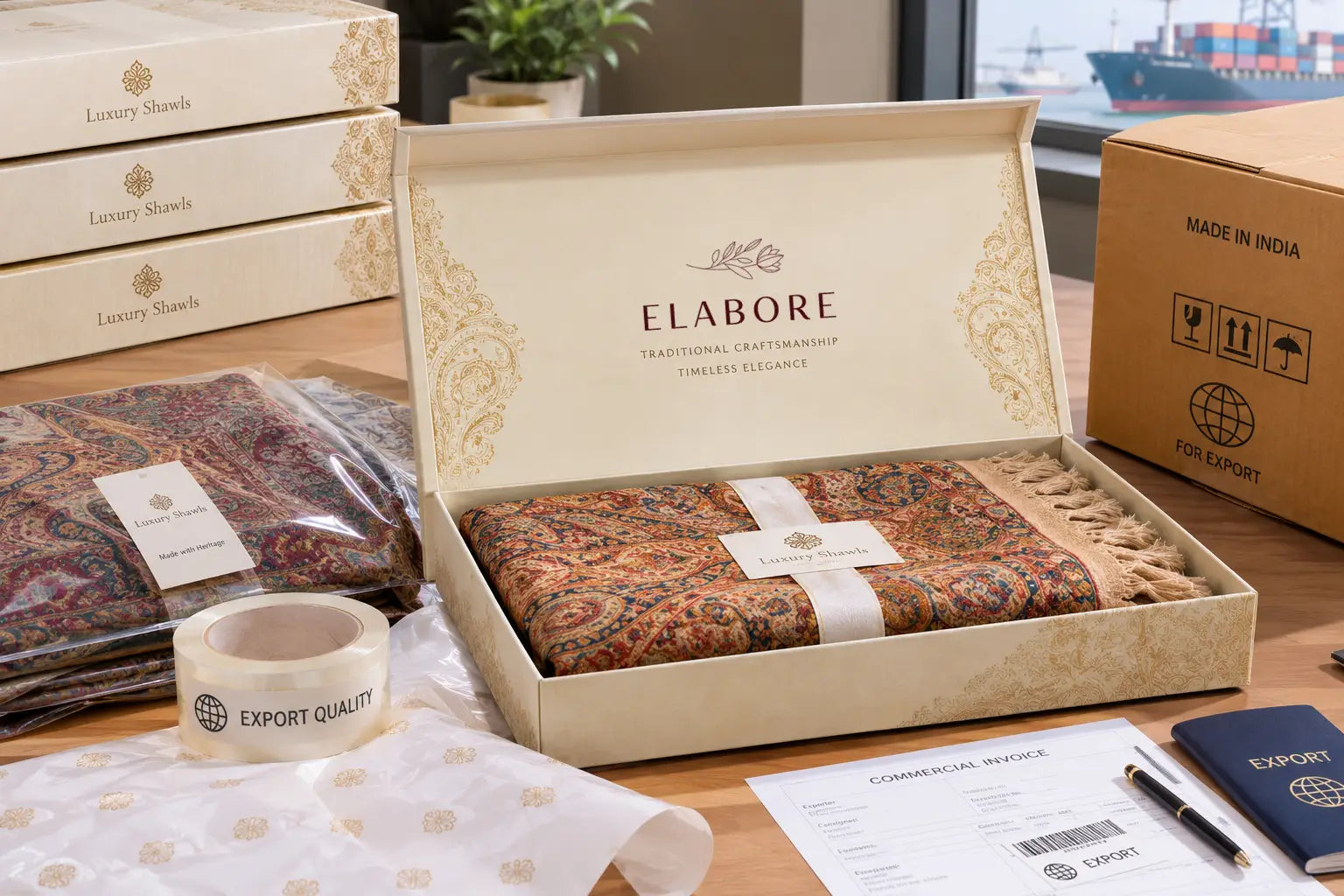
Shawl packaging for export needs to do three jobs at once: meet the destination country's textile labeling laws, protect the fabric during international shipping, and, where relevant, carry the retailer's own branding for private label orders. Getting any one of these wrong is expensive — a missing fiber-content label can get a shipment held at customs, while flimsy packaging can damage delicate pashmina or cashmere before it even reaches the buyer's warehouse.
Most retailers focus their sourcing effort entirely on the shawl itself — the weave, the fiber, the price per piece — and treat packaging as an afterthought to sort out right before the container ships. That's usually where costly mistakes happen. This guide covers what compliant, cost-efficient shawl export packaging actually looks like, from mandatory labeling to branding options for private label buyers.
Why Packaging Compliance Isn't Optional
Textile products don't move across borders on the strength of a good invoice alone — most major markets have specific, legally enforced labeling rules, and non-compliant shipments can be delayed, fined, or rejected at customs.
United States. Under the Textile Fiber Products Identification Act (TFPIA) and the Wool Products Labeling Act (WPLA), every textile item sold in the US — including imported shawls, stoles, and wraps — must carry a label disclosing the fiber content by percentage in descending order of weight, the country of manufacture, and the name or Registered Identification Number (RN) of the manufacturer, importer, or distributor. The Care Labeling Rule additionally requires care instructions on most wearing apparel. Notably, wool content must be specifically identified even when it's under 5% of the total fiber weight — a detail that matters if you're exporting wool-blend or wool-pashmina shawls.
European Union. EU rules require the fiber composition to be disclosed on the label, though country of origin marking isn't mandatory the way it is in the US. Care labels or written care instructions should be in the language of the destination market, and many exporters produce a single multi-market label that satisfies EU, UK, and US requirements at once rather than printing separate labels per country.
Canada. Labels must show fiber content and dealer identity and must be durable enough to survive at least ten washes; bilingual labeling (English and French) is required where products are sold in provinces where both languages are common.
If you're exporting to more than one country, the practical approach most exporters take is a single combined label — fiber content, country of origin, manufacturer identification, and multi-language care instructions all on one tag — rather than managing multiple label runs. This is also something a good shawl sourcing agent or export house should already be handling as a standard part of production, not something you have to specify from scratch on every order.
Packaging vs. Labeling: Two Different Requirements
It's worth separating "packaging" from "labeling," since retailers often conflate the two:
- Labeling is the legally mandated information — fiber content, origin, manufacturer ID, care instructions — that has to appear on or inside the product itself.
- Packaging is the physical protection and presentation — the poly bag, box, tissue paper, or branded pouch the shawl travels and is displayed in.
Both matter for export, but only labeling carries direct legal/customs risk. Packaging affects product condition, unboxing experience, and cost.
Common Packaging Types for Shawl Exports
| Packaging Type | Best For | Notes |
|---|---|---|
| Poly/mesh export bags | Bulk factory-to-warehouse shipments | Low cost, breathable mesh options reduce moisture damage on natural fibers |
| Compostable/biodegradable garment bags | Sustainability-focused D2C and EU-bound brands | Slightly higher cost, increasingly requested by eco-conscious retail buyers |
| Individual branded boxes or pouches | Private label and premium gifting orders | Higher per-unit cost, but essential for custom logo shawls and boutique retail presentation |
| Corrugated export cartons | Outer shipping protection for containers | Standard for freight; doesn't touch the product directly but protects inner packaging from transit damage |
| Acid-free tissue wrapping | Delicate pashmina and hand-embroidered pieces | Prevents dye transfer and creasing on fine, hand-finished shawls |
For most B2B orders, you'll actually be paying for a combination of these — an acid-free tissue-wrapped shawl, inside a branded poly bag or box, packed into corrugated cartons for the container. Skimping on any one layer usually shows up as damage claims later, which is exactly the kind of issue covered under textile quality control inspections before a shipment leaves the factory.
Private Label Packaging: What to Specify Upfront
If you're building your own private label shawls line, packaging is one of the few places where you can differentiate at relatively low cost, even when the shawl itself is made in the same factory as your competitors'. Things worth specifying in your purchase order or production brief:
- Branded hang tags with your logo, fiber content, and care instructions combined into one design.
- Custom pouch or box color and material — cotton drawstring pouches read as more premium than plain poly bags, at a modest cost increase.
- Print position and label material — most suppliers prefer label files in .ai or .eps format; never assume a factory will "figure out" your brand's label placement without a spec sheet.
- Sustainability signals, if relevant to your market — recyclable or compostable packaging is increasingly requested by retail buyers in the EU and by D2C brands positioning around sustainability.
This is also where working with an established Indian shawl manufacturer or an OEM production partner pays off — factories that already handle private label orders regularly will have packaging vendors and label printers on hand, rather than requiring you to source them separately.
Controlling Packaging Costs on Bulk Orders
Packaging costs scale differently than product costs, and it's easy to underestimate them when budgeting a bulk shawl buying order:
- Standardize where you can. Custom boxes for every SKU add cost quickly; a standard branded pouch with a interchangeable hang tag is often more cost-efficient than fully custom boxes per style.
- Negotiate packaging into the unit price. Ask suppliers to quote packaging as a separate line item so you can see exactly what you're paying for and negotiate it independently of the shawl price.
- Match packaging tier to product tier. A premium hand-embroidered pashmina justifies branded boxing and tissue wrapping; a mid-range wool shawl for bulk retail doesn't need the same treatment.
- Factor packaging into your landed cost. Packaging materials and any associated compliance labeling should be included when you calculate total landed cost alongside freight and import duty — not treated as a rounding error after the fact.
Frequently Asked Questions
Is country-of-origin labeling mandatory for shawls exported to the US?
Yes. Under US law, imported textile products including shawls must be labeled with the country of manufacture, fiber content by percentage, and the manufacturer's or importer's identity.
Do I need different labels for different export markets?
Often the safest approach is a single combined label containing the information required across your target markets (fiber content, origin, manufacturer ID, multi-language care instructions), rather than managing separate label runs per country.
Does eco-friendly packaging cost significantly more?
Compostable or biodegradable garment bags typically cost more per unit than standard poly bags, but the gap has narrowed as more Indian export packaging suppliers have entered the category, and it's increasingly expected by EU and sustainability-focused D2C buyers.
Can my supplier handle private label packaging, or do I need a separate vendor?
Most manufacturers experienced in export and private label work can coordinate branded packaging and labeling directly, provided you supply clear design files and specifications upfront.
Final Word
Packaging is easy to underestimate until a shipment gets held at customs over a missing label, or a container of pashmina arrives creased and damaged from insufficient wrapping. Building compliance and protection into your production brief from the start — alongside your existing checks on shawl materials and manufacturing quality — is far cheaper than fixing it after the goods have already shipped.