Cart
0
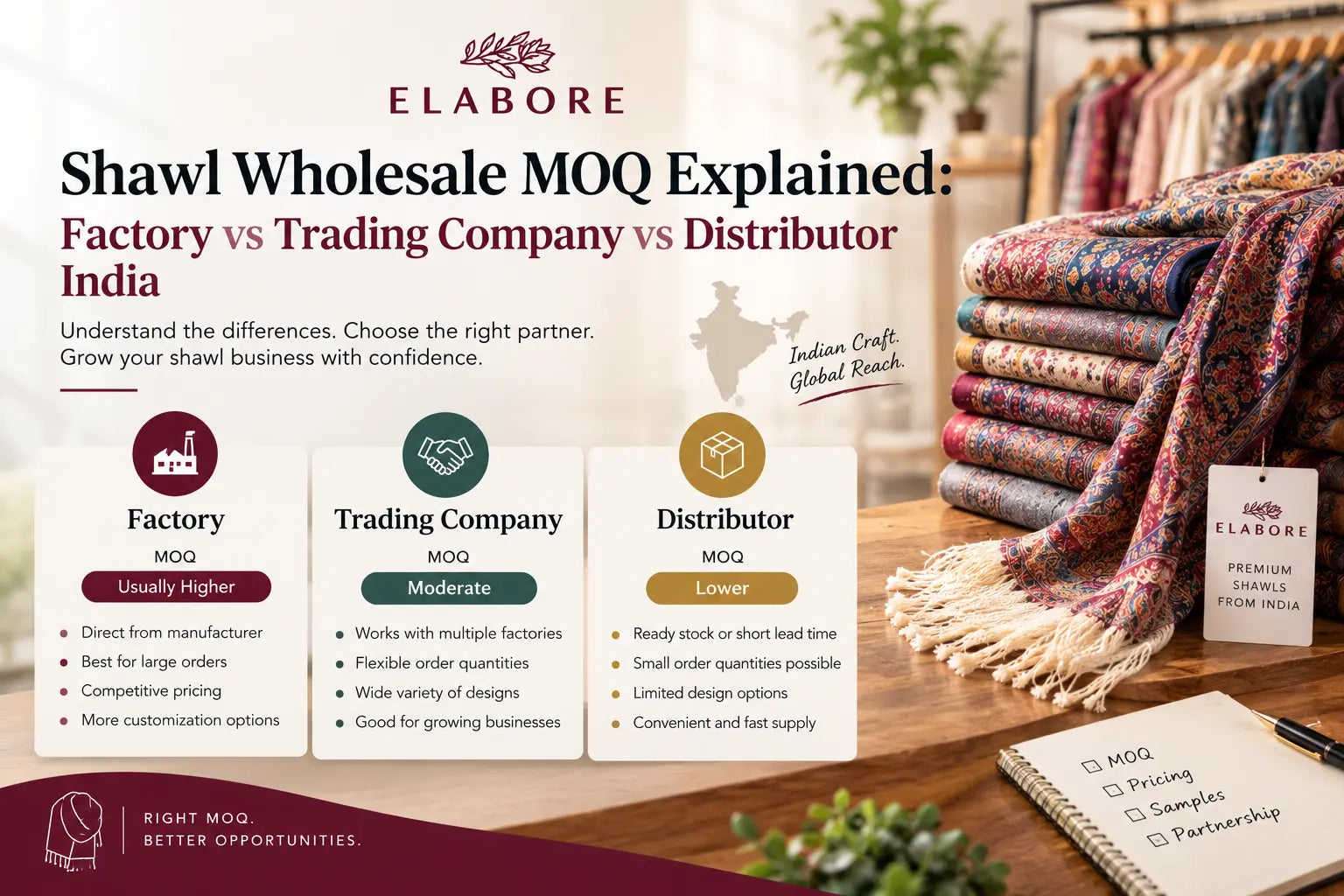
Shawl wholesale MOQ is the smallest quantity a seller accepts in one order. In India, a factory sets the highest shawl wholesale MOQ, usually counted per design and per colour. A trading company offers a lower shawl wholesale MOQ because it buys from many units and sells from stock. A distributor gives the lowest shawl wholesale MOQ, but charges more per piece. Pick the seller type that matches your budget, your design range and your need for a private label.
Why shawl wholesale MOQ confuses so many buyers
Search for shawl wholesale MOQ in India and you land on supplier directories. One listing shows a minimum of a single unit. The next asks for 100 pieces. A viscose shawl exporter asks for 5,000. Same product, very different numbers.
The numbers differ because the sellers are different kinds of businesses. A listing rarely tells you whether you are talking to a mill, a middleman or a stockist. Once you know who is behind the listing, the shawl wholesale MOQ starts to make sense.
What MOQ means when you buy shawls
MOQ stands for minimum order quantity. In shawl buying, sellers count it in four ways:
- Per order: total pieces across all designs, for example 100 pieces mixed.
- Per design: every design must reach its own minimum.
- Per colour: each colourway carries its own minimum.
- Per value: a minimum invoice amount instead of a piece count.
Always ask which one applies. A shawl wholesale MOQ of 200 pieces per order lets you test ten designs at 20 pieces each. The same 200 pieces per design forces you to buy 2,000 pieces for that range.
Factory: the highest shawl wholesale MOQ and the lowest price per piece
A factory owns the looms, dyeing and finishing. It plans yarn, loom time and labour in batches. Changing a loom to a new design or colour costs hours, so the factory wants a run big enough to justify it. That is why the factory shawl wholesale MOQ is high.
What you gain:
- The lowest cost per piece
- Control over fabric blend, weight, size and finish
- Custom designs, logos and private label options
- One party accountable for quality
What you give up:
- More cash tied up in the first order
- Longer lead times
- Less variety, because you commit to fewer designs
A factory suits an established store, a brand with a fixed range or a gifting programme with predictable volume. If you are weighing a mill against a middleman, our guide to shawl manufacturer vs supplier covers the difference in detail, and the piece on Indian shawl manufacturers shows what to look for in a mill.
Trading company: a lower shawl wholesale MOQ with mixed designs
A trading company does not weave. It sources from several factories and weaving units, holds stock and sells assorted lots. Because it spreads risk across many suppliers, the trading company shawl wholesale MOQ is lower, often 25 to 100 pieces, and mixing designs is usually allowed.
Where it works well:
- You can build a varied range from one order
- Ready stock means faster dispatch
- One contact handles several fabrics
Where it falls short:
- A margin sits on top of the factory price
- You have less say over production
- Quality depends on which unit made the batch
Ask a trader which unit produced your shawls and whether anyone inspects them before dispatch. A good trader answers with specifics. Our quality control checklist for shawl importers and retailers lists the checks worth asking about.
Distributor: the lowest shawl wholesale MOQ, the highest unit price
A distributor buys finished shawls from brands or factories and resells to retailers in a region. A distributor shawl wholesale MOQ can be a dozen pieces, sometimes one carton. You pay for convenience, local stock and speed.
This works for first-time retailers, boutiques testing a new category and seasonal pop-ups. It works poorly for private label, custom work or thin margins, since the distributor's cut is built into every piece. Before you commit, run the numbers with our shawl business profit margin guide.
Factory vs trading company vs distributor at a glance
| Factory | Trading company | Distributor | |
|---|---|---|---|
| Typical shawl wholesale MOQ | Highest, per design or colour | Medium, often mixed | Lowest, often per carton |
| Price per piece | Lowest | Medium | Highest |
| Customisation | Full | Limited | Rare |
| Lead time | Longest | Short to medium | Shortest, from stock |
| Quality control | Direct | Indirect | Depends on source |
| Best for | Brands, private label, bulk gifting | Retailers building a range | New buyers, product testing |
How fabric changes shawl wholesale MOQ
Material moves the number more than most buyers expect. Viscose and acrylic blends run on power looms in large batches, so their shawl wholesale MOQ climbs into the thousands. Handwoven and hand embroidered shawls take days per piece, so the minimum is smaller, but the price and lead time rise. Fine wool and silk blends sit in between. Our shawl materials guide for B2B buyers explains how each fabric affects cost and minimums.
How to negotiate a lower shawl wholesale MOQ
You have more room than the listing suggests. These moves work with most sellers:
- Ask for the MOQ per order instead of per design.
- Pick designs and colours already in stock rather than custom ones.
- Offer a repeat schedule, such as two lots across the season.
- Accept a higher price per piece on a small first order.
- Skip custom packaging on the trial lot.
- Order outside peak winter months, when looms have free time.
Sellers say yes more often when you show a plan for the second order.
Which seller fits your order
- Under 50 pieces, testing a market: a distributor or trading company.
- 50 to 300 pieces, building a range: a trading company, or a factory that accepts mixed lots.
- Your own label and tags: a factory. Start with our private label shawls guide.
- Logo shawls for corporate gifting: a factory with embroidery or print capability. See custom logo shawls.
- Shipping abroad: check duty and HS code first with the pashmina shawl import duty guide.
Checklist before you confirm a shawl wholesale order
- Get the MOQ in writing, with its basis (order, design, colour or value).
- Order a sample before the full lot.
- Get fabric composition, weight and size in writing.
- Confirm lead time and payment terms.
- Ask what happens with defective pieces.
- Request a GST invoice, plus export documents if you ship overseas.
For a longer version of this list, read our bulk shawl buying guide on pricing, MOQ and quality.
FAQs on shawl wholesale MOQ
What is a good shawl wholesale MOQ for a new retailer?
Start with 25 to 50 pieces mixed across designs from a trading company or distributor. That tests demand without locking in cash. Move to a factory once you know which designs sell.
Is shawl wholesale MOQ negotiable?
Often yes. Sellers relax the minimum for stock designs, repeat order commitments and off-season orders. Custom designs and new dye lots leave much less room.
Why does a factory ask for a higher MOQ than a trader?
A factory pays for yarn, loom setup and dyeing on every run. A trader sells from existing stock and spreads that cost across many suppliers.
Can I mix designs in one shawl wholesale order?
Mixing works with traders and distributors almost always. Factories may allow it only if the MOQ is counted per order, so confirm the basis first.
How do I tell if a seller is a factory, trader or distributor?
Ask where the shawls are woven, request photos or a visit to the unit, and check whether they can change fabric or design. A factory can. A trader or distributor usually cannot.
Ready to compare options?
If you are sizing up sources, the Elabore Luxury wholesale page explains how bulk orders work. You can send your quantities through the wholesale enquiry form or browse the women shawl and stole wholesale order collection. For a wider view of the market, read our notes on shawl suppliers and pashmina shawls wholesale.