Cart
0
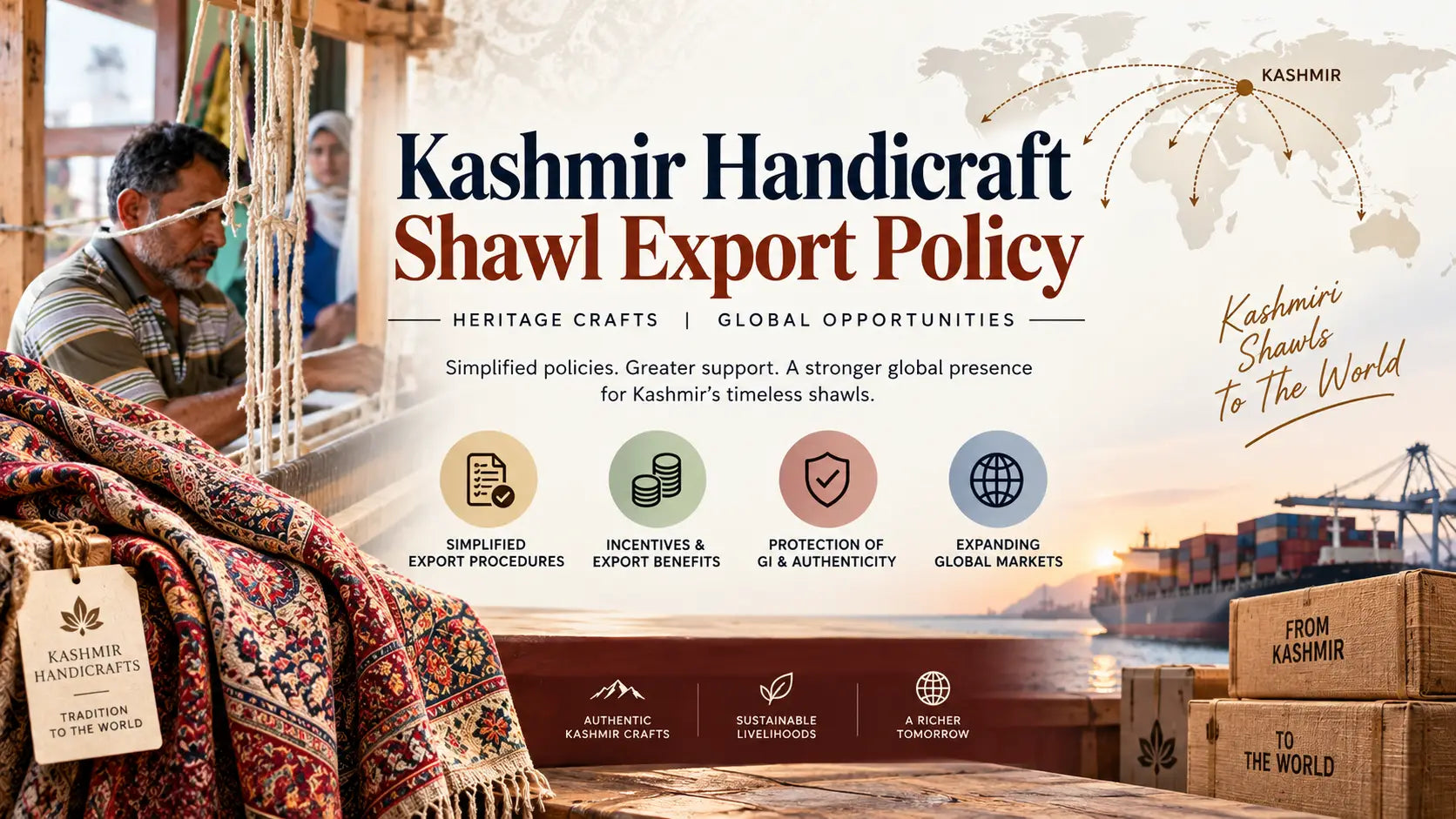
Kashmir's handicraft export ecosystem runs on a layered policy structure: national-level export eligibility through RCMC registration with the Export Promotion Council for Handicrafts (EPCH), tax remission through schemes like RoDTEP and Duty Drawback, and Jammu & Kashmir–specific incentives such as a 10% export subsidy on GI-registered handloom and handicraft products. For B2B buyers, none of this is just bureaucratic background — a supplier's registration status and scheme eligibility are practical signals of legitimacy, and understanding the policy landscape helps explain why genuinely GI-certified, handmade pashmina and Kani shawls are priced and positioned the way they are.
If you're importing from Kashmir or evaluating an exporter's credentials, here's the policy framework worth understanding before you place a bulk order.
The National Layer: RCMC Registration and EPCH
Any legitimate handicraft exporter in India — including shawl manufacturers in Kashmir — needs a Registration-Cum-Membership Certificate (RCMC), issued through the Export Promotion Council for Handicrafts. EPCH is the apex, non-profit export promotion body for the sector, established in 1986–87, and its membership has grown from 35 artisans in its founding year to nearly 8,900 members by 2023–24. As of a 2021–22 DGFT trade notice, RCMC issuance has moved fully to an e-RCMC system through the DGFT platform, making it a mandatory digital registration rather than a paper formality.
For a B2B buyer, this matters practically: asking a supplier for their RCMC/EPCH registration is one of the simplest ways to confirm they're operating as a recognized exporter, not an informal reseller without export standing. It's a useful complement to the kind of factory-level verification we cover in our guide on how to work with a shawl sourcing agent.
National Tax Remission: RoDTEP and Duty Drawback
Once registered, exporters can access national tax remission schemes designed to keep Indian exports price-competitive globally:
- RoDTEP (Remission of Duties and Taxes on Exported Products) replaced the earlier MEIS scheme and refunds embedded central, state, and local duties and taxes that weren't previously rebated. Industry bodies have periodically pushed for rate reviews — EPCH itself has flagged that handicraft sector rates have run relatively low compared to other sectors — so current rates should always be confirmed directly rather than assumed to be fixed.
- Duty Drawback provides a separate route for refunding customs duty paid on imported inputs used in export production.
Kashmir's exporters have specifically lobbied for pashmina shawls to get their own dedicated HS code under RoDTEP, verified by a competent testing laboratory, rather than being capped or grouped with broader handicraft categories — a reminder that HS classification and tax remission are directly tied to how precisely a product is documented, something that also affects buyers navigating pashmina shawl import duty on their end.
The Kashmir-Specific Layer: The Export Subsidy Scheme
Beyond national schemes, Jammu & Kashmir runs its own export subsidy specifically for handloom and handicraft products. Under this scheme, eligible exporters registered with the Handicrafts & Handloom Department receive an incentive of 10% of the total volume of handicraft or handloom products exported to any country, capped at a maximum reimbursement of ₹5 crore. Critically, this subsidy is tied directly to GI (Geographical Indication) certification — it applies only to GI-registered products verified by the department's quality control and testing wing, and it explicitly excludes machine-made goods.
This is a meaningful detail for B2B buyers: a supplier producing genuine, GI-certified, handmade Kani or Sozni shawls is operating inside a policy structure designed specifically to reward authenticity — a real, hand-woven pashmina piece qualifies for state-backed export support in a way a machine-made imitation never can. It's a useful data point when you're comparing suppliers claiming to sell handcrafted pashmina shawls, since eligibility for this subsidy is itself a form of third-party verification.
The Production Side: Karkhandar Scheme and the Handloom & Handicraft Policy 2020
Export policy doesn't exist in isolation from the artisan base producing the goods. Two schemes are worth knowing:
- The Handloom & Handicraft Policy 2020 requires units to register formally in order to access various government subsidies, including export incentives, through the J&K Single Window Portal.
- The Karkhandar Scheme, rolled out via Government Order No. 161-IND of 2021, is a skill-development and training initiative aimed specifically at crafts facing a shrinking skilled workforce — including walnut wood carving, silver filigree, carpet weaving, and Kani shawl weaving, with related crafts like Sozni embroidery included based on local need.
According to the J&K Economic Survey 2025–26, the handicraft and handloom sector supports roughly 4.45 lakh artisans across the union territory, backed by nearly 7,000 registered cooperative societies and over 600 training centres. This scale is directly relevant to sourcing capacity — it's part of why Kashmir remains a viable region for bulk shawl buying despite the labor-intensive nature of hand-woven production.
The Bigger National Schemes Umbrella
J&K's textile and apparel sector, which includes handicrafts, also draws support from several centrally sponsored programs: the National Handloom Development Programme, National Handicrafts Development Programme, Silk Samagra-2, SAMARTH (skill development and placement training), the Integrated Wool Development Programme, and the National Technical Textiles Mission. According to a 2026 government reply in the Rajya Sabha, the textile and apparel sector in J&K employed over 2.3 lakh people, and exports (including handicrafts) grew steadily from ₹734.6 crore in 2023–24 to ₹856.9 crore in 2025–26.
Why This Policy Landscape Matters to B2B Buyers
| Policy Element | Why It Matters When Vetting a Supplier |
|---|---|
| RCMC/e-RCMC via EPCH | Confirms the exporter is formally registered, not operating informally |
| RoDTEP / Duty Drawback | Explains part of an exporter's cost structure and pricing competitiveness |
| J&K Export Subsidy (GI-linked) | Eligibility signals genuine, GI-certified, handmade production |
| Handloom & Handicraft Policy 2020 registration | Indicates the unit is formally recognized by the state department |
| Karkhandar Scheme–linked crafts | Signals investment in preserving skilled techniques like Kani weaving |
None of these are things a buyer typically needs to verify independently through government portals — but asking a supplier directly whether they're RCMC-registered, GI-subsidy eligible, and registered under the state's Handloom & Handicraft Policy is a fast, low-effort way to separate serious Indian shawl manufacturers from informal resellers making unverifiable claims.
Frequently Asked Questions
What is RCMC registration and why does it matter?
RCMC (Registration-Cum-Membership Certificate) is issued through EPCH and is required for a business to formally operate as a recognized handicraft exporter in India. It's now issued digitally as e-RCMC through the DGFT platform.
Does Kashmir have a specific export subsidy for shawls?
Yes. Jammu & Kashmir runs an export subsidy providing a 10% incentive on the export volume of GI-registered handloom and handicraft products, capped at ₹5 crore per exporter, but it applies only to genuine handmade goods verified by the Handicrafts Department's testing lab — not machine-made products.
How does GI certification relate to export incentives?
J&K's export subsidy scheme is explicitly tied to GI registration, meaning only certified, authenticated handmade products qualify — making GI status a useful proxy for authenticity when evaluating suppliers.
Do these schemes affect the price I pay as a buyer?
Indirectly, yes. Export incentives and tax remission schemes affect an exporter's cost base and can influence competitive pricing, though the primary value for B2B buyers is using scheme eligibility as a verification signal rather than expecting it to directly reduce your invoice.
Final Word
Kashmir's handicraft export policy isn't just red tape — it's a structure built specifically to reward genuine, GI-certified, handmade production over machine-made imitation. For B2B buyers, understanding this layered system of national registration, tax remission, and state-level subsidy gives you a practical, low-cost way to vet suppliers before committing to a shawl export business partnership.