Cart
0
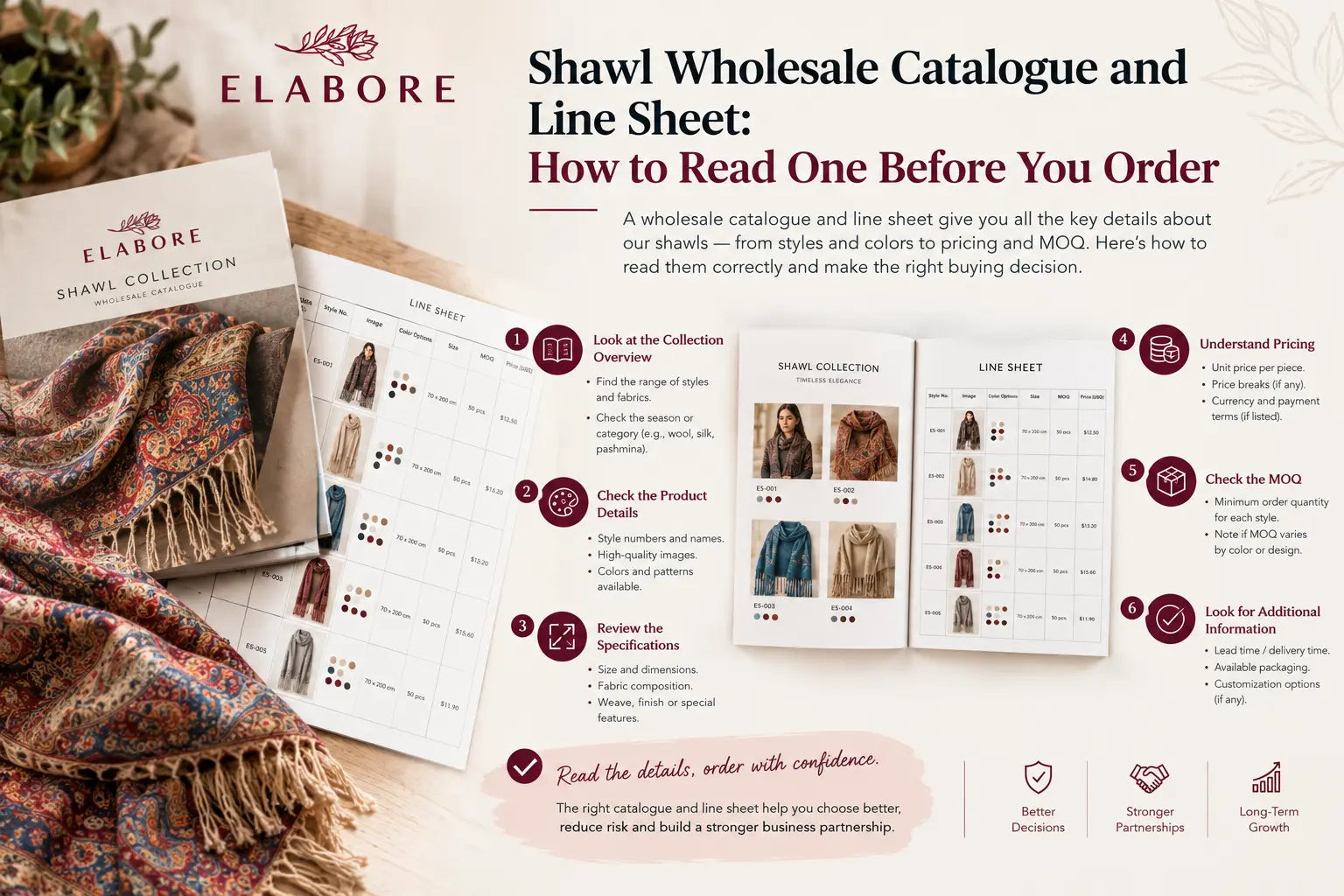
A shawl wholesale catalogue shows what a supplier makes. A line sheet is the shorter, order-ready version, with a code, price, MOQ and colour list for each piece. To read either one properly, check seven things: the fabric composition and weight, the MOQ basis, the price basis, the colour and size options, the lead time, the payment and dispatch terms, and the date of the sheet. If any of these is missing, ask before you order.
Why a shawl wholesale catalogue needs a careful read
Most buyers flip through a shawl wholesale catalogue the way they flip through a magazine. They look at photos, pick designs they like and ask for a price. That is how orders go wrong.
A catalogue is a sales document. It is built to show the best piece in the best light. The details that decide your margin sit in small print: the fabric blend, the weight, the minimum per design, the price basis and the lead time. A shawl wholesale catalogue that leaves these out is not wrong, but it is incomplete, and you should treat it that way.
If you have only used directory listings so far, the difference is large. A directory entry tells you a seller exists and sells shawls. A proper shawl wholesale catalogue tells you what you can actually order, in what quantity and at what price.
Catalogue vs line sheet: what is the difference?
The two terms get mixed up, so here is the split.
- Catalogue: A fuller document with many designs, photos, fabric stories and sometimes a price list. It is made for browsing and brand impression.
- Line sheet: A compact order document, usually one to a few pages. Each item has a design code, a photo, a fabric and size, a wholesale price, a MOQ and a colour list.
- Price list: A table of codes and prices with no photos. Often sent with the catalogue.
Sellers often send a PDF that mixes all three. Whatever the name, the job is the same: it must give you enough information to place an order without guessing. A good shawl wholesale catalogue does this. A weak one sends you back to ask basic questions.
What a complete shawl wholesale catalogue should show
Run a quick check when a new shawl wholesale catalogue arrives. These are the fields you should find on each item.
| Field | What it tells you |
|---|---|
| Design code | A unique reference so you can order without confusion |
| Fabric composition | The blend, for example wool and silk percentages |
| Weight | GSM or grams per piece, which affects warmth and cost |
| Size | Length and width, with fringe included or excluded |
| Colours | Available colourways, ideally with a shade card |
| Wholesale price | Price per piece, with the price basis stated |
| MOQ | Minimum per design, per colour or per order |
| Lead time | Days from order confirmation to dispatch |
| Packaging | How the piece is packed, and the carton quantity |
| Sheet date | When the prices and availability were last updated |
If four or more of these are missing, you are looking at a photo album, not a working shawl wholesale catalogue.
Read the fabric and weight lines first
The fabric line decides everything that follows. "Wool" can mean fine merino or a coarse blend. "Pashmina" in a catalogue may or may not mean the real fibre. If the shawl wholesale catalogue gives only a name and not a composition, ask for the percentage of each fibre.
Weight matters just as much. A heavier shawl costs more to make and feels warmer. Two shawls with the same photo can differ by a wide margin in weight and price. Our shawl materials guide for B2B buyers explains how each fibre behaves, and it helps you judge whether a catalogue price matches the fabric on offer.
One more check: the composition on the sheet should match the care label and the invoice. If it does not, raise it before you pay.
Read the MOQ line carefully
MOQ is where a shawl wholesale catalogue hides the most. A line that reads "MOQ 100" could mean 100 pieces in total, 100 pieces per design or 100 pieces per colour. The cost difference between those three readings is huge.
Always ask which one applies. If your catalogue shows ten designs in four colours each, a per-colour MOQ of 100 pieces means 4,000 pieces for the full range. A per-order MOQ of 100 lets you test the same range with a few pieces each. Our guide to shawl wholesale MOQ by seller type shows how factories, traders and distributors count minimums differently.
Read the price line: what is included?
A price in a shawl wholesale catalogue means little until you know what sits inside it. Check these points:
- Unit: Is the price per piece, per dozen or per set?
- Taxes: Is GST included or added on top?
- Packing and freight: Are they in the price, or extra?
- Currency and date: Which currency, and until when is the price valid?
- Price breaks: Does the price drop at higher quantities?
For shipments abroad, ask whether the price is ex-factory, free on board or delivered. Our guide to the pashmina shawl import duty and HS code helps you work out the landed cost, since duty can change the real price of a piece. In India, shawls, scarves and mufflers sit under HSN heading 6214, which you will also see on invoices.
To see how a quoted price breaks down at the factory end, read our shawl manufacturing cost breakdown.
Check colours, sizes and photos
Photos in a shawl wholesale catalogue are edited. Colours on screen drift from the real fabric. Ask for a physical shade card or a sample before you commit to a colour at volume.
Also check these:
- Colour count: Does the catalogue show every colourway, or only the best sellers?
- Size: Is the stated size the finished size, with or without fringe?
- Close-ups: Is there a macro photo of the weave or embroidery, so you can see the finish?
- Dye lots: Will the bulk colour match the shade card? Colour can vary between batches.
A catalogue with sharp close-ups is usually from a seller who is proud of the finish. One with only wide, styled shots may be hiding it.
Read lead time and availability
A shawl wholesale catalogue often mixes two kinds of items: ready stock and made-to-order pieces. The lead time is very different for each. Ask the seller to mark which designs are in stock and which need production.
If you plan to sell in winter, work backwards from your season. A design that needs several weeks to produce, plus shipping time, can miss the window. Our bulk shawl buying guide shows how to line up orders with your selling calendar.
Read the terms at the bottom
The last page of a shawl wholesale catalogue usually holds the terms, and many buyers skip it. Look for:
- Payment terms and any advance required
- Dispatch time and who pays courier or freight
- Return and defect policy for bulk orders
- Sample policy and whether the fee is adjusted against an order
- Validity of the price list
Read these against our notes on shawl supplier payment terms, so you know what is normal and what is a warning sign. If the catalogue has no terms at all, ask for them in writing before any payment.
Red flags in a shawl wholesale catalogue
Some patterns should slow you down:
- No composition, only a marketing name such as "premium wool".
- No MOQ, or a vague "as per order".
- "Price on request" for every item, with no ranges or breaks.
- Stock photos that look like they belong to another brand.
- No date, so you cannot tell if prices are current.
- No company details, such as address, GST number or a named contact.
None of these proves a seller is dishonest. Together they suggest the catalogue was made to collect enquiries, not to support an order. Run the supplier through the checks in our guide on how to vet and verify a shawl manufacturer before you go further.
How to compare two catalogues fairly
When you hold two shawl wholesale catalogue PDFs side by side, compare like with like. Make a simple sheet with one row per design and columns for composition, GSM, size, price basis, MOQ basis and lead time. Many price gaps vanish once you adjust for weight and blend.
Then order samples of the top two or three pieces from each seller. Our shawl sample order guide explains what to ask for and what to test. If you are still deciding who to buy from, read shawl manufacturer vs supplier first, because the seller type changes what a catalogue can promise.
FAQs on shawl wholesale catalogue
What is a shawl wholesale catalogue?
It is a seller's document showing the shawls available to trade buyers, with designs, fabrics, sizes, colours and prices. A line sheet is a shorter version made for ordering.
What is the difference between a catalogue and a line sheet?
A catalogue is built for browsing and brand impression. A line sheet is a compact order document, with a code, price, MOQ and colour list for each item.
What should I check first in a shawl wholesale catalogue?
Check fabric composition and weight first, then MOQ basis and price basis. These three decide cost and quality more than any photo.
Why do some suppliers say "price on request"?
Prices change with fabric cost, quantity and finish. A fair seller still gives a range or a starting price. If every item says "price on request", ask for a written quote before you invest time.
Can I get a custom shawl wholesale catalogue for my shop?
Many sellers share a filtered list for a specific range, such as stoles or embroidered pieces. Ask for it with your expected quantity, since sellers respond faster to a clear plan. For branded work, see our private label shawls guide.
Ready to see a catalogue?
If you want to check how a wholesale offer is laid out, start at the Elabore Luxury wholesale page. You can send your range and quantities through the wholesale enquiry form, browse the women shawl and stole wholesale order collection or write through the contact page. For wider sourcing, see our notes on pashmina shawls wholesale, shawl suppliers and the shawl business profit margin guide.