
Cart
0
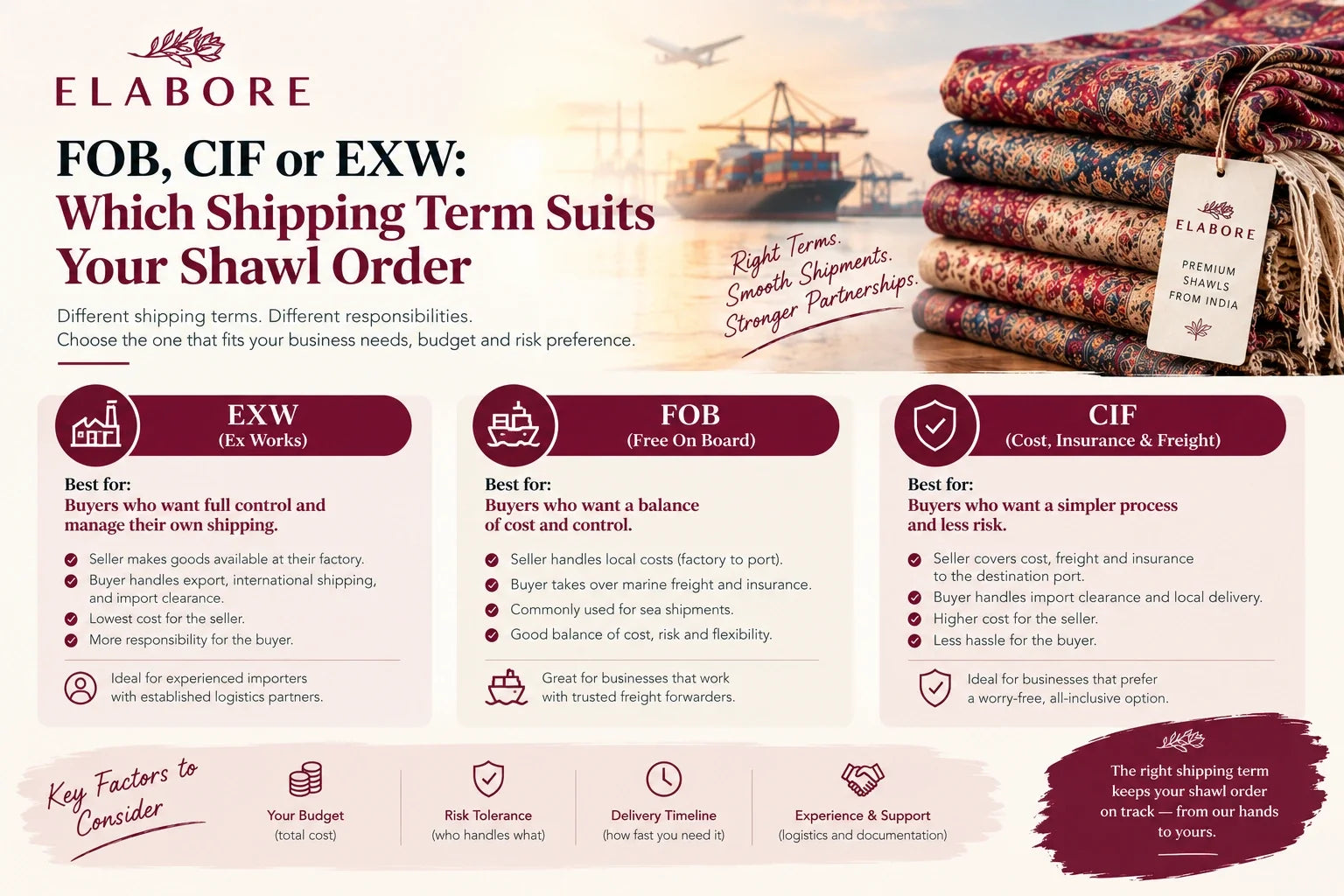
FOB, CIF or EXW decides who pays for freight, insurance and export paperwork on your shawl order, and where the risk passes to you. EXW gives you the lowest price and the most work, because you collect from the seller's door. FOB means the seller loads the goods onto the ship, and you pay the sea freight. CIF means the seller pays freight and basic insurance to your port, but the risk still passes to you at loading. For shawls sent by air or courier, FCA, CPT or CIP are the correct terms, since FOB and CIF apply only to sea freight.
What FOB, CIF or EXW means for a shawl order
These three-letter codes are Incoterms, a set of trade rules from the International Chamber of Commerce. The current version is Incoterms 2020. Each term says three things: who arranges and pays for transport, who handles export and import clearance, and the point where risk moves from seller to buyer.
They do not cover payment, ownership or the product spec. Those belong in your order terms. Our guide to shawl supplier payment terms covers payment, and the shipping term sits beside it.
The choice of FOB, CIF or EXW changes your landed cost and your workload. It can also decide who is responsible when a carton goes missing.
EXW: you collect from the seller's door
Under EXW, or Ex Works, the seller makes the shawls available at their premises. From that point you carry all the cost and risk: loading, transport to the airport or port, export clearance, freight, insurance, import duty and delivery.
When EXW works:
- You have your own forwarder or a buying agent in India
- You want to compare the true cost of each step
- The seller has no export experience
When it hurts: Export clearance in India usually needs an Indian entity with the right registrations. A foreign buyer with no local partner can get stuck. Many importers avoid EXW from India for this reason. If you use an agent, our guide on how a shawl sourcing agent works shows how that setup runs.
FOB: the seller loads, you ship
FOB, or Free on Board, applies to sea freight only. The seller delivers the goods on board the vessel at the named port of shipment, and clears them for export. After that, you pay the main freight, insurance and everything to your door. Risk passes to you once the goods are on board.
Why buyers pick it: You choose the forwarder and the shipping line, so you control freight cost and surcharges. It also keeps the seller's responsibility clear: get the shawls packed, cleared and loaded.
What to watch: You must book the vessel on time, or the seller's goods wait at the port. FOB also gives a lower headline price than CIF, but that price leaves out freight, so compare carefully.
CIF: the seller pays freight and basic insurance
CIF, or Cost, Insurance and Freight, also applies to sea freight only. The seller pays freight and insurance to your named destination port. Two details catch buyers out:
- Risk still passes at loading, not at your port. If the container is damaged at sea, the loss is yours to claim.
- Insurance is minimal. CIF requires only basic cover under Institute Cargo Clauses (C). If you want wider cover, ask for it or buy your own.
CIF is simpler for a first import, because you receive one price covering transport to your port. The trade-off is that you accept the seller's choice of carrier and their rates, and destination charges can still add up. Compare CIF quotes against FOB plus your own freight quote.
FOB vs CIF vs EXW at a glance
| Task or risk | EXW | FCA | FOB | CIF |
|---|---|---|---|---|
| Pack the shawls | Seller | Seller | Seller | Seller |
| Move goods to port or airport in India | Buyer | Seller, to the named place | Seller | Seller |
| Export clearance | Buyer | Seller | Seller | Seller |
| Main freight | Buyer | Buyer | Buyer | Seller |
| Cargo insurance | Buyer's choice | Buyer's choice | Buyer's choice | Seller, basic cover |
| Import clearance and duty | Buyer | Buyer | Buyer | Buyer |
| Risk passes to buyer | When goods are made available at seller's premises | When handed to your carrier | When goods are on board | When goods are on board |
| Transport mode | Any | Any | Sea only | Sea only |
The table also shows why FOB vs CIF vs EXW is not only a price question. It is a question of who does the work and who holds the risk at each stage.
Shipping shawls by air or courier: use FCA, CPT or CIP
Shawls are light and valuable. Small and mid-size orders often travel by air freight or express courier, and larger lots by sea. This matters because FOB and CIF are written for ships. Using them on an air shipment is a common mistake, and it can muddy who is responsible if goods are lost or delayed.
For air, courier or containerised cargo, use the terms that fit any mode:
- FCA (Free Carrier): The seller clears the goods for export and hands them to your carrier at a named place. This is the usual replacement for FOB.
- CPT (Carriage Paid To): The seller pays freight to the named destination. Risk still passes when goods are handed to the first carrier.
- CIP (Carriage and Insurance Paid To): Like CPT, with the seller also buying insurance. Under the 2020 rules, CIP needs wider cover than CIF.
Some sellers also quote a delivered price, such as DAP, where the seller carries the goods to your named place and you handle import clearance. Ask what the price includes, and which paperwork you must provide.
Which shipping term suits your shawl order
Match the term to your situation, not to habit.
- First small order by courier or air: FCA or CPT. If you want one all-in price, ask for CIP or a delivered quote.
- Container or part-container by sea, with a forwarder you trust: FOB. You keep control over freight cost.
- First sea import, no forwarder yet: CIF, with a request for wider insurance. Compare the price against FOB plus a freight quote.
- You have an agent in India handling collection and export: EXW can work, and it gives the lowest base price.
- You want no import work at all: Ask for a delivered term, and check who pays duty and taxes.
Whatever you choose, ask for a landed-cost estimate. Our guide to pashmina shawl import duty and HS codes shows how duty can change the real price. Customs rules differ by country, and some value goods on the CIF figure, so confirm with your customs broker.
Mistakes buyers make with FOB, CIF or EXW
- Leaving out the named place. "FOB" alone is incomplete. Write "FOB Mumbai, Incoterms 2020" or "FCA New Delhi, Incoterms 2020".
- Using FOB or CIF for air freight. Use FCA, CPT or CIP instead.
- Comparing prices on different terms. An EXW price and a CIF price are not comparable until you add the missing costs to the lower one.
- Assuming CIF insurance is full cover. It is minimum cover.
- Forgetting destination charges. Port handling, delivery and local fees can still land on you.
- Skipping the version. Add "Incoterms 2020" so both sides use the same rulebook.
How to write the shipping term into your order
Put the term, the named place and the Incoterms version in the order document, next to the price. For example: "Price per piece, FCA New Delhi, Incoterms 2020." Then list who arranges the export documents, such as the commercial invoice and packing list, and who pays for packing and labelling. Our guide on shawl packaging for export explains what the carton needs to carry. For export compliance on the seller side, see our notes on the Kashmir handicraft export policy and the wider shawl export business guide.
Before any freight is booked, approve a sample and confirm the quantity basis. Our shawl sample order guide and shawl wholesale MOQ explainer cover both. For the full buying process, read our bulk shawl buying guide.
This article is general information. Check shipping terms and duty with a freight forwarder or customs broker before you commit.
FAQs on FOB, CIF or EXW for shawls
What is the difference between FOB, CIF and EXW?
EXW means you collect from the seller's premises and handle everything. FOB means the seller loads the goods on the ship and you pay freight. CIF means the seller pays freight and basic insurance to your port.
Which is cheaper, FOB, CIF or EXW?
EXW has the lowest quoted price because it includes the least. The total cost depends on the freight, insurance and clearance you add. Compare all three on a landed-cost basis.
Can I use FOB or CIF for air freight?
No. FOB and CIF are for sea and inland waterway transport. For air, courier or containers, use FCA, CPT or CIP.
Who is responsible if shawls are damaged in transit?
It depends on where risk passes under the chosen term, and whether insurance was bought. Under FOB and CIF, risk passes once the goods are on board, so insurance matters.
Which term is best for a first shawl import from India?
For small orders, FCA with your own courier or forwarder, or a CIP quote. For sea freight with no forwarder, a CIF quote with wider insurance. Ask for a landed-cost estimate in each case.
Planning your shipment?
To see how a wholesale order is set up, start at the Elabore Luxury wholesale page. Send your quantities through the wholesale enquiry form, browse the women shawl and stole wholesale order collection or write through the contact page. For wider sourcing, read our notes on shawl suppliers and pashmina exporters.